New fiber nanogenerators could lead to electric clothing
February 12, 2010 By Sarah Yang
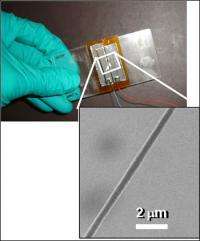
Shown is a fiber nanogenerator on a plastic substrate created by UC Berkeley scientists. The nanofibers can convert energy from mechanical stresses and into electricity, and could one day be used to create clothing that can power small electronics. (Chieh Chang, UC Berkeley)
(PhysOrg.com) -- In research that gives literal meaning to the term "power suit," University of California, Berkeley, engineers have created energy-scavenging nanofibers that could one day be woven into clothing and textiles.
These nano-sized generators have "piezoelectric" properties that allow them to convert into electricity the energy created through mechanical stress, stretches and twists.
"This technology could eventually lead to wearable 'smart clothes' that can power hand-held electronics through ordinary body movements," said Liwei Lin, UC Berkeley professor of mechanical engineering and head of the international research team that developed the fiber nanogenerators.
Because the nanofibers are made from organic polyvinylidene fluoride, or PVDF, they are flexible and relatively easy and cheap to manufacture.
Although they are still working out the exact calculations, the researchers noted that more vigorous movements, such as the kind one would create while dancing the electric boogaloo, should theoretically generate more power. "And because the nanofibers are so small, we could weave them right into clothes with no perceptible change in comfort for the user," said Lin, who is also co-director of the Berkeley Sensor and Actuator Center at UC Berkeley.
The fiber nanogenerators are described in this month's issue of Nano Letters, a peer-reviewed journal published by the American Chemical Society.
The goal of harvesting energy from mechanical movements through wearable nanogenerators is not new. Other research teams have previously made nanogenerators out of inorganic semiconducting materials, such as zinc oxide or barium titanate. "Inorganic nanogenerators — in contrast to the organic nanogenerators we created — are more brittle and harder to grow in significant quantities," Lin said.
The tiny nanogenerators have diameters as small as 500 nanometers, or about 100 times thinner than a human hair and one-tenth the width of common cloth fibers. The researchers repeatedly tugged and tweaked the nanofibers, generating electrical outputs ranging from 5 to 30 millivolts and 0.5 to 3 nanoamps.
Furthermore, the researchers report no noticeable degradation after stretching and releasing the nanofibers for 100 minutes at a frequency of 0.5 hertz (cycles per second).
Lin's team at UC Berkeley pioneered the near-field electrospinning technique used to create and position the polymeric nanogenerators 50 micrometers apart in a grid pattern. The technology enables greater control of the placement of the nanofibers onto a surface, allowing researchers to properly align the fiber nanogenerators so that positive and negative poles are on opposite ends, similar to the poles on a battery.
Without this control, the researchers explained, the negative and positive poles might cancel each other out and reducing energy efficiency.
The researchers demonstrated energy conversion efficiencies as high as 21.8 percent, with an average of 12.5 percent.
“Surprisingly, the energy efficiency ratings of the nanofibers are much greater than the 0.5 to 4 percent achieved in typical power generators made from experimental piezoelectric PVDF thin films, and the 6.8 percent in nanogenerators made from zinc oxide fine wires,” said the study's lead author, Chieh Chang, who conducted the experiments while he was a graduate student in mechanical engineering at UC Berkeley.
"We think the efficiency likely could be raised further," Lin said. "For our preliminary results, we see a trend that the smaller the fiber we have, the better the energy efficiency. We don't know what the limit is."
Provided by University of California - Berkeley (news : web)
-
New nanogenerator may charge iPods and cell phones with a wave of the hand
Mar 26, 2009 |
not rated yet |
0
-
Running Hamsters Can Power Nano Devices (Video)
Feb 12, 2009 |
not rated yet |
0
-
Energy-harvesting rubber sheets could power pacemakers, mobile phones
Jan 27, 2010 |
not rated yet |
0
-
Spinning at the nanoscale: Electrospun fibers could be used for protective clothing, wearable power, more
May 05, 2009 |
not rated yet |
0
-
New grants to create fabrics that render toxic chemicals harmless
May 23, 2008 |
not rated yet |
0
-
Engineers build first sub-10-nm carbon nanotube transistor
Feb 01, 2012 |
4.9 / 5 (30) |
30
-
Something old, something new: Evolution and the structural divergence of duplicate genes
Jan 31, 2012 |
4.6 / 5 (7) |
1
-
The hidden nanoworld of ice crystals: Revealing the dynamic behavior of quasi-liquid layers
Jan 30, 2012 |
5 / 5 (3) |
1
-
Stock market network reveals investor clustering
Jan 27, 2012 |
3.9 / 5 (23) |
8
-
Of microchemistry and molecules: Electronic microfluidic device synthesizes biocompatible probes
Jan 26, 2012 |
5 / 5 (1) |
0
-
polymer nanocomposites
1 hour ago
-
Corrosion Tests on Magnesium
14 hours ago
-
polyethylene copper nanocomposite
20 hours ago
-
Output of xrd analysis
Feb 08, 2012
-
Transport phenomena problem based on problems 18.B11 and 19B.6 from Bird, stewart, lw
Feb 06, 2012
-
Help with material selection - Car Piston
Feb 05, 2012
- More from Physics Forums - Materials & Chemical Engineering
More news stories
'Dark plasmons' transmit energy
Microscopic channels of gold nanoparticles have the ability to transmit electromagnetic energy that starts as light and propagates via "dark plasmons," according to researchers at Rice University.
10 hours ago |
5 / 5 (4) |
0
|
Nanotube therapy takes aim at breast cancer stem cells
Wake Forest Baptist Medical Center researchers have again proven that injecting multiwalled carbon nanotubes (MWCNTs) into tumors and heating them with a quick, 30-second laser treatment can kill them.
Nanotechnology / Bio & Medicine
15 hours ago |
5 / 5 (1) |
0
|
Inspired by steel, nanomanufacturing gets wear-resistant carbide tip
(PhysOrg.com) -- Scientists at the University of Pennsylvania, the University of Wisconsin-Madison and IBM Research - Zurich have fabricated an ultrasharp silicon carbide tip possessing such high strength ...
20 hours ago |
5 / 5 (3) |
1
|
New technology platform for molecule-based electronics
Researchers at the Nano-Science Center at the University of Copenhagen have developed a new nano-technology platform for the development of molecule-based electronic components using the wonder material graphene. At the same ...
Nanotechnology / Nanomaterials
17 hours ago |
5 / 5 (2) |
0
New kind of solar cell could capture significantly more energy than current cells
New solar cells could increase the maximum efficiency of solar panels by over 25%, according to scientists from the University of Cambridge.
Feb 08, 2012 |
4.5 / 5 (11) |
14
|
FDA-approved drug rapidly clears amyloid from the brain, reverses Alzheimer's symptoms in mice
Neuroscientists at Case Western Reserve University School of Medicine have made a dramatic breakthrough in their efforts to find a cure for Alzheimer's disease. The researchers' findings, published in the journal Science, show t ...
Hydrogen from acidic water: Researchers develop potential low cost alternative to platinum for splitting water
A technique for creating a new molecule that structurally and chemically replicates the active part of the widely used industrial catalyst molybdenite has been developed by researchers with the Lawrence Berkeley ...
Ultraviolet protection molecule in plants yields its secrets
Lying around in the sun all day is hazardous not just for humans but also for plants, which have no means of escape. Ultraviolet (UV) radiation from the sun can damage proteins and DNA inside cells, leading ...
Soraa LED light may dim 50-watt halogen rivals
(PhysOrg.com) -- Soraa, a Fremont, California company founded in 2008, this week launched its first product, a light that uses LEDS (light emitting diodes). The "Soraa LED MR16 lamp" is the "perfect" replacement ...
Anyone can learn to be more inventive, cognitive researcher says
There will always be a wild and unpredictable quality to creativity and invention, says Anthony McCaffrey, a cognitive psychology researcher at the University of Massachusetts Amherst, because an "Aha moment" is rare and ...
Engineers find inspiration for new materials in Piranha-proof armor
(PhysOrg.com) -- Its a matchup worthy of a late-night cable movie: put a school of starving piranha and a 300-pound fish together, and who comes out the winner?
Feb 12, 2010
Rank: 5 / 5 (2)
Feb 12, 2010
Rank: 5 / 5 (1)
Feb 14, 2010
Rank: 3 / 5 (1)