Norway plans the world's most powerful wind turbine
February 12, 2010
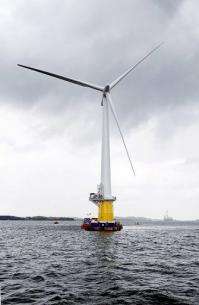
Photo obtained from StatoilHydro shows a floating full-scale offshore wind turbine

Enlarge

This undated handout photo obtained in 2009 from StatoilHydro shows the world's first floating full-scale offshore wind turbine in the North Sea off the coast of Norway. Norway plans to build the world's most powerful wind turbine, hoping the new technology will increase the profitability of costly offshore wind farms, partners behind the project said Friday.

Norway plans to build the world's most powerful wind turbine, hoping the new technology will increase the profitability of costly offshore wind farms, partners behind the project said Friday.

With a rotor diametre of 145 metres (475 feet), the 10-megawatt protype will be roughly three times more powerful than ordinary currently in place, Enova, a public agency owned by Norway's petroleum and oil industry ministry, said.

The world's largest wind turbine, 162.5 metres (533 feet) tall, will be built by Norwegian company Sway with the objective of developing a technology that will result in higher for offshore .

It will first be tested on land in Oeygarden, southwestern , for two years.

The gain in power over current turbines will be obtained partly by reducing the weight and the number of moving parts in the turbine.

According to the NTB news agency, the prototype will cost 400 million kroner to build and could supply power to 2,000 homes.

"We are aiming to install it in 2011," Enova's head of new technology Kjell Olav Skoelsvik told AFP.

Enova pledged 137 million Norwegian kroner (17 million euros, 23 million dollars) to build the prototype.

"It is milestone in the efforts to develop the future's wind power," Norway's energy minister Terje Riis-Johansen said in a statement.

Environmental groups have been highly critical of Norway's government for not having invested enough in wind power.

The Scandinavian country is one of the world's top oil and gas producers but obtains most of its own energy through .

(c) 2010 AFP

4.4 /5 (22 votes)  

Filter


Move the slider to adjust rank threshold, so that you can hide some of the comments.


Display comments: newest first

Quantum_Conundrum
Feb 12, 2010

Rank: 5 / 5 (4)
a rotor with a span of 1/7th of a kilometer.

Now if we can just cover the earth's surface with these, our energy problems should disappear...
tpb
Feb 12, 2010

Rank: 4.3 / 5 (6)
So only 37,000 dollars per house.
These windmills better last at least 50 years, or they will never be paid for.
Quantum_Conundrum
Feb 12, 2010

Rank: 4 / 5 (4)
One would think that increasing the height of the rotor would be more cost-effective than increasing the size of the rotor, since wind speed goes up by about 1mph for every 10 yards or so of elevation.

So for example, if they doubled the height, but left the rotor the same size, then you would expect about another 14-16 mph wind speed, thus giving significantly better energy...probably double or triple on average, in fact, since the bottom half of the rotor's swing is currently barely above ground/sea level with the model seen in that picture...if you doubled the height, the bottom would experience average wind speeds equal or greater than what the top currently experiences...since momentum of wind goes up quadratically with speed, this means that doubling the average wind speed hitting the rotor represents a ~4 fold increase in energy potential...
Quantum_Conundrum
Feb 12, 2010

Rank: 5 / 5 (3)
But in order to get a 4-fold increase in energy from a change in rotor design, you would need to have double the radius/diameter of the rotor, which represents a significant increase in mass of the rotor and therefore increase in wear and tear on the generator.

On the other hand, doubling the height is relatively "low tech" compared to building a bigger rotor or bigger generator which can work while carrying the extra weight.

So again, to me, after a certain limit, it makes more sense to invest more in a much taller POLE than to invest in a bigger rotor...
alq131
Feb 12, 2010

Rank: 5 / 5 (1)
tpb, I had the same calculation. Assume then that at about $35,000 per house, and a $200/mo electric bill, it would take 13+ years to pay it off. That's not including maintenance on the rotor or the infrastructure that would take to access it in the open ocean, and supporting the power lines that would have to be draped on the seafloor to land....this is all still a very expensive proposition.
ricarguy
Feb 12, 2010

Rank: 5 / 5 (1)
So it comes out to about $2 per watt, when the wind is blowing strong enough, but not too strong. Maybe "production" will cut that cost figure in half. It doesn't say if that is the installed cost, or just the cost to make one. Interesting intro line, they "hope it will increase profitability". I take that to mean they are not today, even with Norway's electric rates.
One of the big issues with these is reliability, the bill for a service call can buy a few of those houses.
Like I tell all the unquestioning followers of the "alternative energy panacea", if it were that easy and made that much sense, we'd be doing it already. Still I hope that progress is made.
Quantum_Conundrum
Feb 12, 2010

Rank: 2.6 / 5 (5)
Well, as far as "alternative energy" goes, we KNOW that geothermal is doable and makes sense given recent published articles even on this very site, the only reason they won't do it is because then they woudln't be able to charge as much for power.

We also have Methan Hydrate. According to a program I saw on discovery yesterday, Methane Hydrate is estimated to represent as much as ten times as much energy as all other fossil fuels in earth's history combined...

Sadly, I think the AGW con-game has served only to hinder the development of new energy supplies, rather than encouraging or enhancing those developments.
StarDust21
Feb 12, 2010

Rank: 2.5 / 5 (2)
The problem with these huge wind turbines is the extremity of the rotor quickly reaches the speed of sound which creates vibrations that lead to catastrophes, I wonder what they did to fix that
Sonhouse
Feb 12, 2010

Rank: 2 / 5 (2)
a rotor with a span of 1/7th of a kilometer.

Now if we can just cover the earth's surface with these, our energy problems should disappear...

Just don't fly around in your electric powered ultralight:)
Sonhouse
Feb 12, 2010

Rank: 5 / 5 (1)
The problem with these huge wind turbines is the extremity of the rotor quickly reaches the speed of sound which creates vibrations that lead to catastrophes, I wonder what they did to fix that

I never thought of the speed of the rotor, it turns out that one 475 feet, almost 150 meters in diameter means the tips would be supersonic even at 50 RPM so you have to go 40 RPM or under unless you can eliminate the extra drag associated with supersonic turbulence. So if the generator had to be going 4000 RPM to be efficient you will end up with a 1 to 100 ratio gearbox, that would represent a lot of wear right there.
Quantum_Conundrum
Feb 12, 2010

Rank: 5 / 5 (1)

I never thought of the speed of the rotor, it turns out that one 475 feet, almost 150 meters in diameter means the tips would be supersonic even at 50 RPM so you have to go 40 RPM or under unless you can eliminate the extra drag associated with supersonic turbulence. So if the generator had to be going 4000 RPM to be efficient you will end up with a 1 to 100 ratio gearbox, that would represent a lot of wear right there.


In other words, half the rotor diameter at double the height would definitely be cheaper to make, longer lasting, and more efficient with higher max energy potential...

thanks...
zevkirsh
Feb 12, 2010

Rank: 3 / 5 (1)
the bigger they are the harder they fall. we need smarter wind power not bigger.
Parsec
Feb 12, 2010

Rank: 4.7 / 5 (3)
So only 37,000 dollars per house.
These windmills better last at least 50 years, or they will never be paid for.


Calculating the payback time based on the cost of the prototype is ridiculous. Generally speaking, the costs decline rather sharply when any device is manufactured in any sort of quantity.

Or did you think this was about building only one turbine and powering 2000 homes?
mertzj
Feb 13, 2010

Rank: 4 / 5 (1)
Wind turbines are designed to spin at 16 rpms max for the most part and the generators ay 1800.
EarthlingX
Feb 13, 2010

Rank: 5 / 5 (1)
There are not only turbines with the horizontal axis:
http://en.wikiped..._turbine

Put small, in the mall bought turbines, on the city rooftops, that's high and windy, or between buildings, or using up-drafts ..
Sonhouse
Feb 13, 2010

Rank: 5 / 5 (1)
Well, as far as "alternative energy" goes, we KNOW that geothermal is doable and makes sense given recent published articles even on this very site, the only reason they won't do it is because then they woudln't be able to charge as much for power.

We also have Methan Hydrate. According to a program I saw on discovery yesterday, Methane Hydrate is estimated to represent as much as ten times as much energy as all other fossil fuels in earth's history combined...

Sadly, I think the AGW con-game has served only to hinder the development of new energy supplies, rather than encouraging or enhancing those developments.

Methane hydrates are viable sources but they have to be mined from the bottom of the ocean and still produce CO2. We can't just ignore alternate means of producing energy, like the laser fusion work going on, that may beat the magnetic confinement dudes, if that happens, it's a whole different story.
Buyck
Feb 15, 2010

Rank: 5 / 5 (1)
One windturbine with 10-megawatt supply power to 2,000 homes.

What if you build 1000 of this windturbines?! Lets say that we count 50% of losses during transportation and lower winds and so on...

Then you even have 5000 Mw of power! And power for 1 000 000 homes. Even the costs of each turbine will drop in the coming years.
Rank 4.4 /5 (22 votes)
Related Stories
Relevant PhysicsForums posts
  • Calling function with no input argument
    created3 hours ago
  • Force free body diagram problem on gym equipment
    created4 hours ago
  • Empirical data regarding shower heads and water
    created12 hours ago
  • feed hold button on CNC lathe
    createdFeb 09, 2012
  • RFAC in Fortran
    createdFeb 09, 2012
  • dynamics 2/32
    createdFeb 08, 2012
  • More from Physics Forums - General Engineering

More news stories

Expat French get Internet vote for first time

French citizens will for the first time this year be able to vote in a parliamentary election over the Internet, an experiment that could be extended to other elections if successful.

Technology / Internet

created 37 minutes ago | popularity not rated yet | comments 0

"Twisted Metal" gamers get shot at real gunplay

Fans of "Twisted Metal" will get to welcome a long-awaited sequel of the car-battle videogame with a real-world bang by blasting an ice cream truck to bits with a machine gun.

Technology / Software

created 26 minutes ago | popularity not rated yet | comments 0

New error-correcting codes guarantee the fastest possible rate of data transmission

Error-correcting codes are one of the triumphs of the digital age. They’re a way of encoding information so that it can be transmitted across a communication channel — such as an optical fiber o ...

Technology / Computer Sciences

created 6 hours ago | popularity 5 / 5 (3) | comments 3 | with audio podcast

India probes Google over 'forex transactions'

Indian authorities are probing whether online giant Google broke domestic foreign-exchange transactions rules while shifting funds abroad, the Press Trust of India reported on Friday.

Technology / Internet

created 1 hour ago | popularity not rated yet | comments 0

Small modular reactor design could be a 'SUPERSTAR'

(PhysOrg.com) -- Though most of today's nuclear reactors are cooled by water, we've long known that there are alternatives; in fact, the world's first nuclear-powered electricity in 1951 came from a reactor ...

Technology / Energy & Green Tech

created 6 hours ago | popularity 4.2 / 5 (10) | comments 14 | with audio podcast


Putting the squeeze on planets outside our solar system

(PhysOrg.com) -- Using high-powered lasers, scientists at Lawrence Livermore National Laboratory and collaborators discovered that molten magnesium silicate undergoes a phase change in the liquid state, abruptly ...

Employers feel no love for unscrupulous practice of 'service sweethearting'

A new study led by two Florida State University marketing professors finds that some frontline service employees who are rewarded for hikes in customer loyalty and satisfaction also may engage in "service ...

US issues guidelines to avoid heparin contamination

Four years after US drug-maker Baxter International's blood thinner heparin was contaminated in China, causing dozens of deaths, US regulators on Friday issued draft guidelines for safe production.

The power of estrogen -- male snakes attract other males

A new study has shown that boosting the estrogen levels of male garter snakes causes them to secrete the same pheromones that females use to attract suitors, and turned the males into just about the sexiest ...

Curry spice component may help slow prostate tumor growth

Curcumin, an active component of the Indian curry spice turmeric, may help slow down tumor growth in castration-resistant prostate cancer patients on androgen deprivation therapy (ADT), a study from researchers ...

Grass to gas: Researchers' genome map speeds biofuel development

Researchers at the University of Georgia have taken a major step in the ongoing effort to find sources of cleaner, renewable energy by mapping the genomes of two originator cells of Miscanthus x giganteus, a large perenn ...