Scientists turn light into electrical current using a golden nanoscale system
February 12, 2010
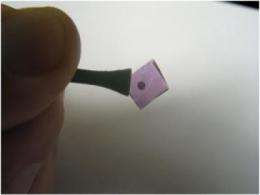
Material scientists at the Nano/Bio Interface Center of the University of Pennsylvania have demonstrated the transduction of optical radiation to electrical current in a molecular circuit. Credit: Dawn Bonnell, the University of Pennsylvania
Material scientists at the Nano/Bio Interface Center of the University of Pennsylvania have demonstrated the transduction of optical radiation to electrical current in a molecular circuit. The system, an array of nano-sized molecules of gold, respond to electromagnetic waves by creating surface plasmons that induce and project electrical current across molecules, similar to that of photovoltaic solar cells.
The results may provide a technological approach for higher efficiency energy harvesting with a nano-sized circuit that can power itself, potentially through sunlight. Recently, surface plasmons have been engineered into a variety of light-activated devices such as biosensors.
It is also possible that the system could be used for computer data storage. While the traditional computer processor represents data in binary form, either on or off, a computer that used such photovoltaic circuits could store data corresponding to wavelengths of light.
Because molecular compounds exhibit a wide range of optical and electrical properties, the strategies for fabrication, testing and analysis elucidated in this study can form the basis of a new set of devices in which plasmon-controlled electrical properties of single molecules could be designed with wide implications to plasmonic circuits and optoelectronic and energy-harvesting devices.
Dawn Bonnell, a professor of materials science and the director of the Nano/Bio Interface Center at Penn, and colleagues fabricated an array of light sensitive, gold nanoparticles, linking them on a glass substrate. Minimizing the space between the nanoparticles to an optimal distance, researchers used optical radiation to excite conductive electrons, called plasmons, to ride the surface of the gold nanoparticles and focus light to the junction where the molecules are connected. The plasmon effect increases the efficiency of current production in the molecule by a factor of 400 to 2000 percent, which can then be transported through the network to the outside world.
In the case where the optical radiation excites a surface plasmon and the nanoparticles are optimally coupled, a large electromagnetic field is established between the particles and captured by gold nanoparticles. The particles then couple to one another, forming a percolative path across opposing electrodes. The size, shape and separation can be tailored to engineer the region of focused light. When the size, shape and separation of the particles are optimized to produce a "resonant" optical antennae, enhancement factors of thousands
might result.
Furthermore, the team demonstrated that the magnitude of the photoconductivity of the plasmon-coupled nanoparticles can be tuned independently of the optical characteristics of the molecule, a result that has significant implications for future nanoscale optoelectronic devices.
"If the efficiency of the system could be scaled up without any additional, unforeseen limitations, we could conceivably manufacture a one-amp, one-volt sample the diameter of a human hair and an inch long," Bonnell said.
The study is published in the current issue of the journal ACS Nano.
-
IMEC reports method to integrate plasmonic technology with state-of-the-art ICs
Apr 30, 2009 |
not rated yet |
0
-
Molecular machines drive plasmonic nanoswitches
Feb 11, 2009 |
not rated yet |
0
-
Panasonic Develops VCSEL Laser with Surface Plasmon Mirrors
May 25, 2006 |
not rated yet |
0
-
'Light on a chip' potential seen by scientists spoofing natural phenomenon
Jul 08, 2004 |
not rated yet |
0
-
DNA-Based Assembly Line for Nano-Construction of New Biosensors, Solar Cells (w/Video)
Mar 30, 2009 |
not rated yet |
0
-
Engineers build first sub-10-nm carbon nanotube transistor
Feb 01, 2012 |
4.9 / 5 (31) |
30
-
Something old, something new: Evolution and the structural divergence of duplicate genes
Jan 31, 2012 |
4.6 / 5 (7) |
1
-
The hidden nanoworld of ice crystals: Revealing the dynamic behavior of quasi-liquid layers
Jan 30, 2012 |
5 / 5 (3) |
1
-
Stock market network reveals investor clustering
Jan 27, 2012 |
3.9 / 5 (23) |
8
-
Of microchemistry and molecules: Electronic microfluidic device synthesizes biocompatible probes
Jan 26, 2012 |
5 / 5 (1) |
0
-
Question about Gravity?
1 hour ago
-
Wearing black in a desert
2 hours ago
-
Did space exist before mass?
2 hours ago
-
How can E&M Waves be polarized?
2 hours ago
-
Does light travel for ever?
3 hours ago
-
Infinity by Particles
4 hours ago
- More from Physics Forums - General Physics
More news stories
What lies beneath: Mapping hidden nanostructures
The ability to diagnose and predict the properties of materials is vital, particularly in the expanding field of nanotechnology. Electron and atom-probe microscopy can categorize atoms in thin sheets of material, ...
12 hours ago |
5 / 5 (1) |
1
New kind of solar cell could capture significantly more energy than current cells
New solar cells could increase the maximum efficiency of solar panels by over 25%, according to scientists from the University of Cambridge.
Feb 08, 2012 |
4.5 / 5 (12) |
14
|
Nanoshell whispering galleries improve thin solar panels
Visitors to Statuary Hall in the U.S. Capitol Building may have experienced a curious acoustic feature that allows a person to whisper softly at one side of the cavernous, half-domed room and for another on ...
Nanotechnology / Nanomaterials
Feb 07, 2012 |
4.3 / 5 (6) |
6
|
'Dark plasmons' transmit energy
Microscopic channels of gold nanoparticles have the ability to transmit electromagnetic energy that starts as light and propagates via "dark plasmons," according to researchers at Rice University.
Feb 09, 2012 |
5 / 5 (6) |
1
|
Revealing how a battery material works
Since its discovery 15 years ago, lithium iron phosphate (LiFePO4) has become one of the most promising materials for rechargeable batteries because of its stability, durability, safety and ability to deliver ...
Nanotechnology / Nanomaterials
Feb 08, 2012 |
5 / 5 (5) |
0
|
Google users warned of threat to smartphone wallets
Users of Google smartphone wallets were being warned on Friday that there is a way to crack pass codes intended to thwart thieves from going on illicit shopping sprees.
Anonymous knocks CIA website offline (Update)
The website of the Central Intelligence Agency was inaccessible on Friday after the hacker group Anonymous claimed to have knocked it offline.
Complex wiring of the nervous system may rely on a just a handful of genes and proteins
Researchers at the Salk Institute have discovered a startling feature of early brain development that helps to explain how complex neuron wiring patterns are programmed using just a handful of critical genes. ...
New error-correcting codes guarantee the fastest possible rate of data transmission
Error-correcting codes are one of the triumphs of the digital age. Theyre a way of encoding information so that it can be transmitted across a communication channel such as an optical fiber o ...
The power of estrogen -- male snakes attract other males
A new study has shown that boosting the estrogen levels of male garter snakes causes them to secrete the same pheromones that females use to attract suitors, and turned the males into just about the sexiest ...
Humans may have helped the decline of African rainforests 3000 years ago
(PhysOrg.com) -- Large areas of rainforests in Central Africa mysteriously disappeared over three thousand years ago, to be replaced by savannas. The prevailing theory has been that the cause was a change ...
Feb 12, 2010
Rank: 3 / 5 (3)
Feb 14, 2010
Rank: 4 / 5 (2)
Feb 16, 2010
Rank: 2.5 / 5 (2)
This field obviously will have more applications
Cosmology Promotes Inventions
Vidyardhi Nanduri