Laser knocks down test missile off Calif. coast
February 14, 2010
Laser knocks down test missile off Calif. coast

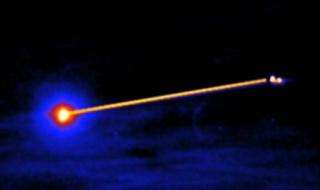
Airborne Laser Test. Image credit: U.S. Department of Defense

The Air Force says a high-powered laser has destroyed a missile in flight during a test of a national defense system off the California coast.

The successful test is a boost to a program that has had billions in cost overruns and saw its budget sharply cut by the last year.

The Air Force and Boeing Co. announced Friday that an airborne laser system tracked a target missile as it accelerated over the ocean off the Point Mugu Naval Warfare Center on Thursday night. The Air Force says an energy beam heated the missile until it broke up.

It's the first time the laser has knocked down a liquid-fueled missile. The says it destroyed a solid-fuel during a test on Feb. 3. Laser knocks down test missile off Calif. coast
Enlarge

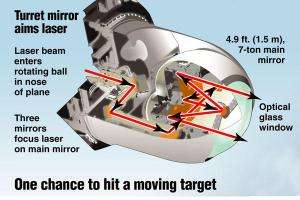
This airborne laser mounts to the front of a special military 747 jumbo jet.


Copyright © 2010 The Associated Press. All rights reserved.

4.6 /5 (15 votes)  

Filter


Move the slider to adjust rank threshold, so that you can hide some of the comments.


Display comments: newest first

Sonhouse
Feb 14, 2010

Rank: not rated yet
They did not say how much energy the laser beam had nor how long it needed to track the target. My guess is 100Kw and a couple of seconds. I think the megawatt level laser has only recently been developed, not ready for real tests yet.
Does anyone know if solid fuel rockets are more susceptible to laser damage than liquid fuel? On the face of it, it would seem liquid fuel would be more vulnerable to attack but maybe the insulation makes it less so. I would think even if it does not ignite the fuel, if the beam destroys the outer skin it would fly apart regardless of the fuel.
yyz
Feb 14, 2010

Rank: not rated yet
"Does anyone know if solid fuel rockets are more susceptible to laser damage than liquid fuel?"

From ABL wiki:

"The ABL does not burn through or disintegrate its target. It heats the missile skin, weakening it, causing failure from high speed flight stress."

"On February 11, 2010 in a test at Point Mugu Naval Air Warfare Center-Weapons Division Sea Range off the central California coast, the system successfully destroyed a liquid-fuel boosting ballistic missile. Less than one hour later, the system successfully engaged a solid-fuel short-range missile launched from San Nicolas Island, California. Test criteria were met and the second test was ended prior to target destruction since the system had destroyed an identical solid-fuel missile in flight eight days earlier."

So it works equally well on solid or liquid fueled missiles.
rgw
Feb 14, 2010

Rank: not rated yet
Wouldn't it be easier to throw a rock?

No, but maybe a rockhead would work.
marjon
Feb 14, 2010

Rank: not rated yet
Wouldn't it be easier to throw a rock?

Such 'rocks' are called kinetic warheads.
It would be easier if such rocks could be located near the launch site. Do you think if we ask nicely Iran would allow a THAAD battery next to their ballistic missiles?
daywalk3r
Feb 15, 2010

Rank: 1 / 5 (1)
"Big applause and fanfare!"

Now try the same, but with the missile painted WHITE instead of BLACK! ^^

And the next step could be a missile with a mirror-like polished stainless steel outer layer ;-)
antialias
Feb 15, 2010

Rank: 1 / 5 (1)
How about one with a cat-eye design scaled to the frequency of the laser? Would throw the beam right back at 'em
marjon
Feb 15, 2010

Rank: not rated yet
"Big applause and fanfare!"

Now try the same, but with the missile painted WHITE instead of BLACK! ^^

And the next step could be a missile with a mirror-like polished stainless steel outer layer ;-)

That is one more design feature (expense)the missile factory has to add.
Simonsez
Feb 15, 2010

Rank: not rated yet
What would be the effects of a megawatt energy laser applied to, say, the human body? A crowd of human bodies? Wood? Occupied military or civilian vehicles?
Objectivist
Feb 15, 2010

Rank: not rated yet
Next up: dummy missiles with adjustable mirrors for beam reflection. Perhaps even equipped with an extra outer layer of hull with channels between which may transport liquid nitrogen. Or what the hell, how about just a regular missile with the same liquid nitrogen contraption? It could be triggered above a certain temperature to release instantly, allowing it to cool off for the required amount of time before it hits the target. That plus the mirror-like polished stainless steel which daywalk3r suggested. It would be fun to compete against these guys in parallel. As they build a more sophisticated laser, your team builds a more sophisticated anti-laser missile.
dirk_bruere
Feb 15, 2010

Rank: not rated yet
I bet it wasn't polished metal, nor spinning
fixer
Feb 15, 2010

Rank: 1 / 5 (1)
This would complement the earlier article on killing mosquito's, micro lasers for close in defense, megawatts to take out the forest.
Ever get the feeling your tax dollars are being wasted?
Simonsez
Feb 16, 2010

Rank: 5 / 5 (3)
Ever get the feeling your tax dollars are being wasted?


All the time. However, if my tax dollars are being spent to develop multi-purpose lasers, where do I sign up to give more?
sams
Feb 16, 2010

Rank: 3 / 5 (2)
Heh, I got censored by PhysOrg for saying "Wouldn't it be easier to throw a rock?" Reason: "POINTLESS VERBIAGE" (their capitals not mine). Luckily other readers were intelligent enough to discern the point: that the technology for laser-based knock downs is excessively expensive and energy intensive when other simpler technology would be just as effective.
abhishekbt
Feb 17, 2010

Rank: not rated yet
Wouldn't it be easier to throw a rock?

Such 'rocks' are called kinetic warheads.
It would be easier if such rocks could be located near the launch site. Do you think if we ask nicely Iran would allow a THAAD battery next to their ballistic missiles?


Can't seem to get this. Wouldn't we need such 'kinetic warheads' at the target site? As soon as you something incoming, throw a rock!
jonnyboy
Feb 20, 2010

Rank: not rated yet
Wouldn't it be easier to throw a rock?

Such 'rocks' are called kinetic warheads.
It would be easier if such rocks could be located near the launch site. Do you think if we ask nicely Iran would allow a THAAD battery next to their ballistic missiles?


Can't seem to get this. Wouldn't we need such 'kinetic warheads' at the target site? As soon as you something incoming, throw a rock!

Yep, just make absolutely, positively sure that that rock doesn't miss at a combined closing rate in excess of 18,000 mph (5 miles per second). I sincerely hope that you are not in the city being defended by that rock.
Shootist
Feb 21, 2010

Rank: not rated yet
I bet it wasn't polished metal, nor spinning


Have you ever seen a missile that didn't spin?
marjon
Feb 21, 2010

Rank: not rated yet
Wouldn't it be easier to throw a rock?

Such 'rocks' are called kinetic warheads.
It would be easier if such rocks could be located near the launch site. Do you think if we ask nicely Iran would allow a THAAD battery next to their ballistic missiles?


Can't seem to get this. Wouldn't we need such 'kinetic warheads' at the target site? As soon as you something incoming, throw a rock!

It is better to knock down the missile closer to the launch site. Return to sender, so to speak.
eachus
Feb 22, 2010

Rank: not rated yet
Mirror-polished stainless steel wouldn't help, since the ABL works at the infrared end of the visible spectrum* where stainless steel is not a particularly good reflector. Same for aluminum, although I have worked with specially coated aluminum which is highly reflective down into the infrared. However, I'm not sure that such coatings could survive launch.

As for spinning, LN2 and other proposals here, remember what happened with the Patriot against SCUD variants. It turned out that disrupting the shock wave around a reentering SCUD was enough to knock it into self-destruction without physically hitting the missle or warhead. Some shock wave disruption occurs with the ABL. May not knock down a missle designed to handle it, but it certainly makes the designer's job much tougher.

* I can see deeper at the red end of the spectrum than most. But the COIL in ABL produces 1315 nm light which should be lower than what I can see.
Rank 4.6 /5 (15 votes)
Related Stories
Relevant PhysicsForums posts
  • Calling function with no input argument
    created15 hours ago
  • Force free body diagram problem on gym equipment
    created16 hours ago
  • Empirical data regarding shower heads and water
    createdFeb 10, 2012
  • feed hold button on CNC lathe
    createdFeb 09, 2012
  • RFAC in Fortran
    createdFeb 09, 2012
  • dynamics 2/32
    createdFeb 08, 2012
  • More from Physics Forums - General Engineering

More news stories

Anonymous knocks CIA website offline (Update)

The website of the Central Intelligence Agency was inaccessible on Friday after the hacker group Anonymous claimed to have knocked it offline.

Technology / Internet

created 9 hours ago | popularity 5 / 5 (9) | comments 16

Google users warned of threat to smartphone wallets

Users of Google smartphone wallets were being warned on Friday that there is a way to crack pass codes intended to thwart thieves from going on illicit shopping sprees.

Technology / Internet

created 8 hours ago | popularity 5 / 5 (2) | comments 0

New error-correcting codes guarantee the fastest possible rate of data transmission

Error-correcting codes are one of the triumphs of the digital age. They’re a way of encoding information so that it can be transmitted across a communication channel — such as an optical fiber o ...

Technology / Computer Sciences

created 18 hours ago | popularity 4.9 / 5 (8) | comments 6 | with audio podcast

New power source discovered

(PhysOrg.com) -- Researchers at the Massachusetts Institute of Technology (MIT) and RMIT University have made a breakthrough in energy storage and power generation.

Technology / Energy & Green Tech

created 17 hours ago | popularity 4.8 / 5 (29) | comments 8 | with audio podcast

Small modular reactor design could be a 'SUPERSTAR'

(PhysOrg.com) -- Though most of today's nuclear reactors are cooled by water, we've long known that there are alternatives; in fact, the world's first nuclear-powered electricity in 1951 came from a reactor ...

Technology / Energy & Green Tech

created 17 hours ago | popularity 4.4 / 5 (13) | comments 23 | with audio podcast


Humans may have helped the decline of African rainforests 3000 years ago

(PhysOrg.com) -- Large areas of rainforests in Central Africa mysteriously disappeared over three thousand years ago, to be replaced by savannas. The prevailing theory has been that the cause was a change ...

The power of estrogen -- male snakes attract other males

A new study has shown that boosting the estrogen levels of male garter snakes causes them to secrete the same pheromones that females use to attract suitors, and turned the males into just about the sexiest ...

Complex wiring of the nervous system may rely on a just a handful of genes and proteins

Researchers at the Salk Institute have discovered a startling feature of early brain development that helps to explain how complex neuron wiring patterns are programmed using just a handful of critical genes. ...

Could Venus be shifting gear?

(PhysOrg.com) -- ESA’s Venus Express spacecraft has discovered that our cloud-covered neighbour spins a little slower than previously measured. Peering through the dense atmosphere in the infrared, the ...

Advanced power-grid model finds low-cost, low-carbon future in West

(PhysOrg.com) -- The least expensive way for the Western U.S. to reduce greenhouse gas emissions enough to help prevent the worst consequences of global warming is to replace coal with renewable and other ...

Fool's gold may prove an unlikely alternative to overexploited catalytic materials

Catalytic materials, which lower the energy barriers for chemical reactions, are used in everything from the commercial production of chemicals to catalytic converters in car engines. However, with current catalytic materials ...