Electric cars: put a battery in your roof
February 15, 2010 by Boris Cambreleng
Lithium-ion batteries used in the current generation of plug-in vehicles depend on dwindling supplies of lithium

Enlarge

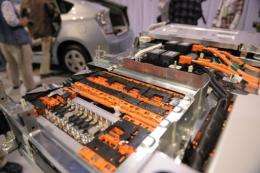
A sample showing the insides of a lithium-ion battery is pictured in Tokyo, at Toyota showroom. Lithium-ion batteries used in the current generation of plug-in vehicles are not only heavy, which adds to energy consumption, but also depend on dwindling supplies of the metal lithium, whose prices have risen steadily.

A nanoscale material developed in Britain could one day yield wafer-thin cellphones and light-weight, long-range electric cars powered by the roof, boot and doors, researchers have reported.

For now, the new technology -- a patented mix of carbon fibre and polymer resin that can charge and release electricity just like a regular battery -- has not gone beyond a successful laboratory experiment.

But if scaled-up, it could hold several advantages over existing energy sources for hybrid and , according to the scientists at Imperial College London who developed it.

Lithium-ion batteries used in the current generation of plug-in vehicles are not only heavy, which adds to , but also depend on dwindling supplies of the metal lithium, whose prices have risen steadily.

The new material -- while expensive to make -- is entirely synthetic, which means production would not be limited by availability of natural resources.

Another plus: conventional batteries need to generate juice, a process which causes them to degrade over time and gradually lose the capacity to hold a charge.

The carbon-polymer composite does not depend on chemistry, which not only means a longer life but a quicker charge as well.

Because the material is composed of elements measured in billionths of a metre, "you don't compromise the of the fibers," explained Emile Greenhalgh, an engineer at Imperial College and one of the inventors.

As hard a steel, it could in theory double as the body of the vehicle, cutting the weight by up to a third.

The Tesla Roadster, a luxury electric car made in the United States, for example, weighs about 1,200 kilos (2,650 pounds), more than a third of which is accounted for by batteries, which turn the scales at a hefty 450 kilos (990 pounds). The vehicle has a range of about 300 kilometers (185 miles) before a recharge is needed.

"With our material, we would ultimately lose that 450 kilos (990 pounds)," Greenhalgh said in an interview. "That car would be faster and travel further."

Vehicles with bodies crafted from the new material would likewise shed weight because it is four time lighter than steel, while remaining as strong and stiff.

"It is the sort of thing you find in tennis rackets or fishing rods -- a carbon fibre composite," Greenhalgh said.

"We aim to increase the surface area of the fibres as much as possible without degrading the mechanical properties. The larger the surface, the more electrical charge they can store."

The European Union (EU) announced last week that it would sink 3.4 million euros (4.6 million dollars) over three years into developing the new technology, with Imperial College coordinating a project spread over nine companies and institutes in Britain, Sweden, Germany and Greece.

Swedish car manufacturer Volvo has said it might build a demonstration panel into an existing electric car prototype.

Within three years, the researchers expect shave 15 percent off the weight of a car, and in five to six years, be able to integrate the material into the body.

But it will take a decade before the new material could fully replace existing batteries, Greenhalgh cautioned.

One of the question marks is cost.

Carbon fibre is a lot more expensive than steel, but mass production should bring down costs dramatically, he said.

(c) 2010 AFP

3.7 /5 (11 votes)  

Filter


Move the slider to adjust rank threshold, so that you can hide some of the comments.


Display comments: newest first

SiBorg
Feb 15, 2010

Rank: 4.5 / 5 (2)
It is great to see that energy storage research is getting the attention it desperately needs and that such interesting progress is being made.

The article seems a little misleading in suggesting that it is a battery technology. The patent says it's a super capacitor. An energy density figure would be good to know too.
dk2009
Feb 15, 2010

Rank: not rated yet
"With our material, we would ultimately lose that 450 kilos (990 pounds)." So does that mean this is "ultimately" pie-in-the-sky stuff like fusion energy and there was really no reason to print this fantasy article, or is this technology really working in a demonstrable way? And sure, carbon fiber is lighter than Li-ion but how MUCH of this material is needed to equal the capacity of a comparable sized Li-ion battery? That is, how many cubic centimeters of this compares to the same cubic centimeters of Li-ion?
John_balls
Feb 15, 2010

Rank: not rated yet
Lithium is not in decline.
david_42
Feb 15, 2010

Rank: not rated yet
The only way this "would not be limited by availability of natural resources" is if it was made of something unnatural, like unicorn horn.
Bonkers
Feb 15, 2010

Rank: not rated yet
The total amount of lithium recoverable from global reserves has been estimated at 35 million tonnes.
- should be OK for a while

Oh, and what's this? ...
"conventional batteries need chemical reactions to generate juice"

Oh, ok, just another mindless folksy-ism.
ricarguy
Feb 15, 2010

Rank: not rated yet
As a rough rule of thumb, present day super-capacitors have about 10% of the energy density of modern Li-ion batteries, which in turn is a small fraction of the energy density of a liter of gasoline or diesel. Without real indication of an improvement over existing technology, I think "DK" above is right about this being pie-in-the-sky. If their material is patented already, why wouldn't they provide some real numbers unless it's nothing yet to be proud of? The battery taking the form of the body panel was promised with mm thin, Li-polymer battery technology too, some years back.

This article is more of an announcement that someone got a nice little EU gov't grant. One can't really have much more of an opinion of it since we are told so little of what it is. We'll see what they come up with after they spend a few more years and a few more million dollars trying to improve and make their development practical.

fixer
Feb 15, 2010

Rank: not rated yet
Printable batteries? Why not print them on the back of a printable solar cell, Too obvious?
baudrunner
Feb 16, 2010

Rank: not rated yet
So the car is destined to become a capacitor, and we will be sitting right in the middle of a powerful electro-magnetic field when we drive them. I think I'll stay with my ten-speed. They're just so much better for your health, and on so many levels.
bmcghie
Feb 20, 2010

Rank: not rated yet
^ Maybe, but I doubt you could charge your railgun capacitors nearly as quickly. Think of the speed of your commute, if all the other cars were blown off the the road ahead of you!

Heh heh. Kidding, Kidding.
PinkElephant
Feb 22, 2010

Rank: not rated yet
Imagine such a car in a collision with a conventional gas-powered one: gasoline vapors, plus massive electric discharge. Yay, fireworks!
Rank 3.7 /5 (11 votes)
Relevant PhysicsForums posts
  • Calling function with no input argument
    created9 hours ago
  • Force free body diagram problem on gym equipment
    created10 hours ago
  • Empirical data regarding shower heads and water
    created18 hours ago
  • feed hold button on CNC lathe
    createdFeb 09, 2012
  • RFAC in Fortran
    createdFeb 09, 2012
  • dynamics 2/32
    createdFeb 08, 2012
  • More from Physics Forums - General Engineering

More news stories

Google users warned of threat to smartphone wallets

Users of Google smartphone wallets were being warned on Friday that there is a way to crack pass codes intended to thwart thieves from going on illicit shopping sprees.

Technology / Internet

created 2 hours ago | popularity 5 / 5 (1) | comments 0

Anonymous knocks CIA website offline (Update)

The website of the Central Intelligence Agency was inaccessible on Friday after the hacker group Anonymous claimed to have knocked it offline.

Technology / Internet

created 4 hours ago | popularity 5 / 5 (6) | comments 10

New error-correcting codes guarantee the fastest possible rate of data transmission

Error-correcting codes are one of the triumphs of the digital age. They’re a way of encoding information so that it can be transmitted across a communication channel — such as an optical fiber o ...

Technology / Computer Sciences

created 12 hours ago | popularity 5 / 5 (4) | comments 5 | with audio podcast

New power source discovered

(PhysOrg.com) -- Researchers at the Massachusetts Institute of Technology (MIT) and RMIT University have made a breakthrough in energy storage and power generation.

Technology / Energy & Green Tech

created 11 hours ago | popularity 4.8 / 5 (19) | comments 7 | with audio podcast

Small modular reactor design could be a 'SUPERSTAR'

(PhysOrg.com) -- Though most of today's nuclear reactors are cooled by water, we've long known that there are alternatives; in fact, the world's first nuclear-powered electricity in 1951 came from a reactor ...

Technology / Energy & Green Tech

created 12 hours ago | popularity 4.2 / 5 (10) | comments 20 | with audio podcast


Complex wiring of the nervous system may rely on a just a handful of genes and proteins

Researchers at the Salk Institute have discovered a startling feature of early brain development that helps to explain how complex neuron wiring patterns are programmed using just a handful of critical genes. ...

Putting the squeeze on planets outside our solar system

(PhysOrg.com) -- Using high-powered lasers, scientists at Lawrence Livermore National Laboratory and collaborators discovered that molten magnesium silicate undergoes a phase change in the liquid state, abruptly ...

NASA sees wide-eyed cyclone Jasmine

Cyclone Jasmine's eye has opened wider on NASA satellite imagery, as it moves through the Southern Pacific Ocean.

The power of estrogen -- male snakes attract other males

A new study has shown that boosting the estrogen levels of male garter snakes causes them to secrete the same pheromones that females use to attract suitors, and turned the males into just about the sexiest ...

NASA sees Giovanna reach cyclone strength, threaten Madagascar

Tropical Storm 12S built up steam and became a cyclone on February 10, 2012 as NASA's Terra satellite passed overhead. Residents of east-central Madagascar should prepare for this cyclone to make landfall ...

Humans may have helped the decline of African rainforests 3000 years ago

(PhysOrg.com) -- Large areas of rainforests in Central Africa mysteriously disappeared over three thousand years ago, to be replaced by savannas. The prevailing theory has been that the cause was a change ...