Some birds may use their feathers to touch
February 15, 2010 by Lin Edwards
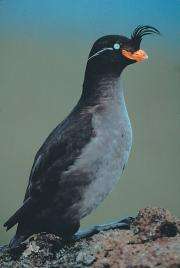
Auklet (Aethia cristatella). Image: Wikimedia Commons
(PhysOrg.com) -- A new study of auklets suggests the birds use their ornamental feathers in much the same way as cats use their whiskers: to feel their surroundings.
Male and female auklets (Aethia sp.) have elaborate and prominent whiskers or crests of feathers on their heads, and two ornithologists, Professor Ian Jones of Memorial University in St John’s, and Dr Sampath Seneviratne of the University of British Columbia in Vancouver, Canada, wondered why. There are several species of auklets, with different types of head feathers, but both genders sport the ornamental feathers.
Auklets breed in dark crevices in rocks, and the researchers made an experimental maze devoid of light and resembling a crevice, and observed the behavior of auklets placed into the maze. They found that birds with more prominent crests bump into things less than those with shorter plumes. When they flattened the feathers in whiskered and crested auklets, they found the birds were 2.5 times more likely to bump their heads than those with unflattened feathers, and the birds with longer crests were more affected than those with naturally shorter crests.
Many birds besides auklets have ornamental crests, tail feathers, beards or whiskers, and while ornamental plumage is thought to have functions in advertising sexual availability and prowess, and sometimes for camouflage or as a warning, the researchers thought they could also have a tactile function, being used by the birds to feel their way in the environment.
To find out, Jones and Seneviratne compared the ornamentation, lifestyles and habitats of numerous species of non-passerine (non-perching) birds, including penguins, parrots, hummingbirds and pheasants. Dr Seneviratne said they discovered birds living in dark, complex, or crowded environments, or which are active at night are more likely to have facial feathers, and there was a “highly significant correlation” for that trend across all non-perching birds.
The scientists think similar feathers on other birds may also have a tactile function, especially in environments where vision is limited, or where there is a greater deal of clutter or objects to avoid. Facial feathers would help the bird avoid damage to its eyes, beak, and eardrums.
The results of the study appear in the Animal Behaviour journal.
© 2010 PhysOrg.com
-
Researcher finds amorous avian anointment protects mates
Aug 21, 2007 |
not rated yet |
0
-
The color of dinosaur feathers identified
Jan 27, 2010 |
not rated yet |
0
-
Ancient Birds Flew On All-Fours
Sep 26, 2006 |
not rated yet |
0
-
Tropical winter habitat drives natal dispersal of young migratory birds
Feb 18, 2008 |
not rated yet |
0
-
Scientists 'rebuild' giant moa using ancient DNA
Jul 01, 2009 |
not rated yet |
0
-
Engineers build first sub-10-nm carbon nanotube transistor
Feb 01, 2012 |
4.9 / 5 (31) |
30
-
Something old, something new: Evolution and the structural divergence of duplicate genes
Jan 31, 2012 |
4.6 / 5 (7) |
1
-
The hidden nanoworld of ice crystals: Revealing the dynamic behavior of quasi-liquid layers
Jan 30, 2012 |
5 / 5 (3) |
1
-
Stock market network reveals investor clustering
Jan 27, 2012 |
3.9 / 5 (23) |
8
-
Of microchemistry and molecules: Electronic microfluidic device synthesizes biocompatible probes
Jan 26, 2012 |
5 / 5 (1) |
0
-
Protease cleavage
5 hours ago
-
Pertubance in a model
12 hours ago
-
Cancer drugs and Alzheimer's, Oh my!
20 hours ago
-
Squishing cells
21 hours ago
-
Any books/articles for evolutionary stable strategy models in humans?
Feb 09, 2012
-
Science behind the bore feeling?
Feb 09, 2012
- More from Physics Forums - Biology
More news stories
The power of estrogen -- male snakes attract other males
A new study has shown that boosting the estrogen levels of male garter snakes causes them to secrete the same pheromones that females use to attract suitors, and turned the males into just about the sexiest ...
10 hours ago |
4.8 / 5 (5) |
0
|
Grass to gas: Researchers' genome map speeds biofuel development
Researchers at the University of Georgia have taken a major step in the ongoing effort to find sources of cleaner, renewable energy by mapping the genomes of two originator cells of Miscanthus x giganteus, a large perenn ...
7 hours ago |
3.7 / 5 (3) |
0
|
Experts reveal how plants don't get sunburn
(PhysOrg.com) -- Experts at the University of Glasgow have discovered how plants survive the harmful rays of the sun.
10 hours ago |
5 / 5 (2) |
0
|
Protein libraries in a snap
(PhysOrg.com) -- A Rice University undergraduate will depart with not only a degree but also a possible patent for his invention of an efficient way to create protein libraries, an important component of biomolecular ...
13 hours ago |
5 / 5 (2) |
0
|
Miami battling invasion of giant African snails
No one knows how they got there. But an invasion of African giant snails has southern Florida in a panic over potential crop damage, disease and general yuckiness surrounding the slimy gastropods.
14 hours ago |
4 / 5 (1) |
4
Google users warned of threat to smartphone wallets
Users of Google smartphone wallets were being warned on Friday that there is a way to crack pass codes intended to thwart thieves from going on illicit shopping sprees.
Anonymous knocks CIA website offline (Update)
The website of the Central Intelligence Agency was inaccessible on Friday after the hacker group Anonymous claimed to have knocked it offline.
Complex wiring of the nervous system may rely on a just a handful of genes and proteins
Researchers at the Salk Institute have discovered a startling feature of early brain development that helps to explain how complex neuron wiring patterns are programmed using just a handful of critical genes. ...
NASA sees wide-eyed cyclone Jasmine
Cyclone Jasmine's eye has opened wider on NASA satellite imagery, as it moves through the Southern Pacific Ocean.
Putting the squeeze on planets outside our solar system
(PhysOrg.com) -- Using high-powered lasers, scientists at Lawrence Livermore National Laboratory and collaborators discovered that molten magnesium silicate undergoes a phase change in the liquid state, abruptly ...
NASA sees Giovanna reach cyclone strength, threaten Madagascar
Tropical Storm 12S built up steam and became a cyclone on February 10, 2012 as NASA's Terra satellite passed overhead. Residents of east-central Madagascar should prepare for this cyclone to make landfall ...