Diversity of Corals, Algae in Warm Indian Ocean Suggests Resilience to Future Global Warming
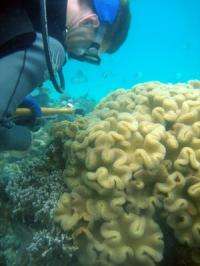
(PhysOrg.com) -- Penn State researchers and their international collaborators have discovered a diversity of corals harboring unusual species of symbiotic algae in the warm waters of the Andaman Sea in the northeastern Indian Ocean. "The existence of so many novel coral symbioses thriving in a place that is too warm for most corals gives us hope that coral reefs and the ecosystems they support may persist — at least in some places — in the face of global warming," said the team's leader, Penn State Assistant Professor of Biology Todd LaJeunesse.
According to LaJeunesse, the comprehensiveness of the team's survey, which also included analysis of the corals and symbiotic algae living in the cooler western Indian Ocean and Great Barrier Reef area of Australia, is unparalleled by any other study. The team's findings will be published during the week ending 20 February 2010 in an early online issue of the Journal of Biogeography.
Corals are colonies of tiny animals that derive nutrients and energy from golden-brown, photosynthetic algae that live inside the corals' cells. "This symbiotic relationship is sensitive to changes in the environment," said LaJeunesse. "For example, because the algae are photosynthetic, they are very sensitive to changes in light. They are also sensitive to temperature," he said. "An increase in sea-surface temperature of just a few degrees Fahrenheit for a period of several months can cause many of the coral-algal symbioses to break down and the algae to be expelled. This process is known as bleaching because it leaves behind the clear animal tissue and the white skeleton underneath. When bleaching is severe, due to either high temperatures or low light availability, corals soon die without their symbiotic partners."
LaJeunesse said that continued global warming eventually may cause the demise of coral-reef ecosystems, which would have major impacts on the tourism and food-fisheries industries. According to team member Ove Hoegh-Guldberg, a professor at the University of Queensland in Australia, coral-dominated reefs may become scarce within the next 30 to 50 years, given the increase in the number of bleaching events that recently have taken place.
"The fact that the Andaman Sea and other regions around Southeast Asia are home to such a high diversity of corals is surprising because the water there is so warm and sometimes murky," said LaJeunesse. "The inshore locations we surveyed are not the sort of places where you would expect to see thriving coral communities. Not only is the water warm and murky, but the tidal flux is so great that many of the corals can spend hours out of water, exposed to the harsh sun and dry air."
The team identified the species of algae that associate with corals, as well as giant clams, sea anemones, zoanthids, and other reef-dwelling animals that form close symbiotic relationships with the single-celled algae that are referred to as zooxanthellae. In the Andaman Sea, the scientists found a variety of seemingly thermally tolerant algae species, with one species being particularly abundant. Called Symbiodinium trenchi, the species is a generalist organism — one that is able to associate with a variety of hosts. Corals harboring this symbiont appear to be tolerant of high heat. LaJeunesse found the same species in the Caribbean Ocean during a bleaching event that took place in 2005. "Symbiodinium trenchi, which normally occurs in very low numbers in the Caribbean, was able to take advantage of the warming event and become more prolific because of its apparent tolerance of high temperatures," he said. "The species appears to have saved certain colonies of coral from the damaging effects of unusually warm water."
In contrast, the scientists found very few thermally tolerant algae species in the cooler western Indian Ocean and Great Barrier Reef area. According to LaJeunesse, the Andaman Sea is on average three or four degrees Fahrenheit warmer than the western Indian Ocean and the Great Barrier Reef area. "Symbiodinium trenchi and other related symbiont species can tolerate this warm water, but if global warming causes the water to warm further, even these species might not be able to deal with it," he said. "However, if the water warms by three or four degrees Fahrenheit in the cooler western Indian Ocean or Great Barrier Reef area, Symbiodinium trenchi easily could persist. The problem is that Symbiodinium trenchi occurs in very low numbers in these cooler areas and, so far, has not proliferated during bleaching events as it has in the Caribbean."
LaJeunesse said that some scientists have suggested that reefs suffering from high water temperatures might be "seeded" with the thermally tolerant Symbiodinium trenchi; however, he is not sure the approach will work. "Symbiodinium trenchi forms symbiotic associations only with corals and other animals that acquire their symbionts from the environment," he said. "Other species of coral are born with algae already in their cells. If Symbiodinium trenchi were introduced into a new environment, it may be able to 'rescue' some species that acquire their symbionts from the environment, but it would not be able to 'rescue' species that are born with algae already in their cells because these species have evolved special relationships with their algae."
Not only is LaJeunesse concerned that "seeding" reefs with algae, like Symbiodinium trenchi, will fail to "rescue" animals that are born with algae already in their cells, but he also is concerned about possible negative repercussions. "You never know what the effects might be of introducing an organism into an ecosystem in which it is not well established," he said.
LaJeunesse explained that the diversity of species the team found in the Andaman Sea likely is the result of the dramatic changes in the ocean environment that the region has experienced since the beginning of the Pleistocene Epoch. Typically, during times of environmental change, generalist species of algae that are able to associate with a variety of animal hosts are more successful than specialist species of algae that can associate only with particular hosts because the generalists can spread to many hosts, thus forming new combinations that might be better suited to the new environment. Once the environmental change has stabilized, some of the generalist species form special associations with new hosts and, as a result, become new specialist species.
LaJeunesse said that one of the team's most important findings is that coral-algal symbioses are much more ecologically and evolutionarily responsive to environmental changes than previously was believed. "The responsiveness of these symbioses to historical climate change gives us hope that some species may survive in some places in the face of future warming," he said. "Yet, even though these symbiotic relationships have persisted through historical climate changes, they never have experienced the rapid rate of warming that we are seeing today. So, while we shouldn't underestimate life and its ability to respond to change, we also should do everything in our power not to test its resilience."
More information: www3.interscience.wiley.com/jo … me?CRETRY=1&SRETRY=0
Provided by Pennsylvania State University


