Study examines family lineage of King Tut, his possible cause of death
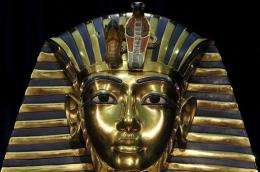
Using several scientific methods, including analyzing DNA from royal mummies, research findings suggest that malaria and bone abnormalities appear to have contributed to the death of Egyptian pharaoh King Tutankhamun, with other results appearing to identify members of the royal family, including King Tut's father and mother, according to a study in the February 17 issue of JAMA.
The 18th dynasty (circa 1550-1295 B.C.) of the New Kingdom was one of the most powerful royal houses of ancient Egypt, and included the reign of Tutankhamun, probably the most famous of all pharaohs, although his tenure was brief. He died in the ninth year of his reign, circa 1324 B.C., at age 19 years. "Little was known of Tutankhamun and his ancestry prior to Howard Carter's discovery of his intact tomb (KV62) in the Valley of the Kings in 1922, but his mummy and the priceless treasures buried with him, along with other important archeological discoveries of the 20th century, have provided significant information about the boy pharaoh's life and family," the authors write.
Because Tutankhamun died so young, and left no heirs, there have been numerous speculations regarding diseases that may have occurred in his family, as well as debate regarding the cause of Tutankhamun's death. Also, artifacts have shown the royalty of that era as having a somewhat feminized or androgynous appearance. Diseases that have been suggested to explain this appearance include a form of gynecomastia (excessive development of the breasts in males; usually the result of a hormonal imbalance), Marfan syndrome and others. "However, most of the disease diagnoses are hypotheses derived by observing and interpreting artifacts and not by evaluating the mummified remains of royal individuals apart from these artifacts," they write. There have also been questions regarding the identification of a number of royal mummies from this era and the exact relationships between some members of the royal family.
Zahi Hawass, Ph.D., of the Supreme Council of Antiquities, Cairo, Egypt, and colleagues conducted a study to determine familial relationships among 11 royal mummies of the New Kingdom, and to search for pathological features attributable to inherited disorders, infectious diseases and blood relationship. They also examined for evidence regarding Tutankhamun's death, with some scholars having hypothesized that it was attributable to an injury; septicemia (bloodstream infection) or fat embolism (release of fat into an artery) secondary to a femur fracture; murder by a blow to the back of the head; or poisoning.
From September 2007 to October 2009, royal mummies underwent detailed anthropological, radiological, and genetic studies (DNA was extracted from 2 to 4 different biopsies per mummy). In addition to Tutankhamun, 10 mummies (circa 1410-1324 B.C.) possibly or definitely closely related in some way to Tutankhamun were chosen; of these, the identities were certain for only 3. In addition to these 11 mummies, 5 other royal individuals dating to the early New Kingdom (circa 1550-1479 B.C.) were selected that were distinct from the supposed members of the Tutankhamun lineage. Most of these 5 mummies were used as a morphological (form and structure) and genetic control group. Genetic fingerprinting allowed the construction of a 5-generation pedigree of Tutankhamun's immediate lineage.
The researchers found that several of the anonymous mummies or those with suspected identities were now able to be addressed by name, which included KV35EL, who is Tiye, mother of the pharaoh Akhenaten and grandmother of Tutankhamun, and the KV55 mummy, who is most probably Akhenaten, father of Tutankhamun. This kinship is supported in that several unique anthropological features are shared by the 2 mummies and that the blood group of both individuals is identical. The researchers identified the KV35YL mummy as likely Tutankhamun's mother.
No signs of gynecomastia or Marfan syndrome were found. "Therefore, the particular artistic presentation of persons in the Amarna period is confirmed as a royally decreed style most probably related to the religious reforms of Akhenaten. It is unlikely that either Tutankhamun or Akhenaten actually displayed a significantly bizarre or feminine physique. It is important to note that ancient Egyptian kings typically had themselves and their families represented in an idealized fashion," they write.
The researchers did find an accumulation of malformations in Tutankhamun's family. "Several pathologies including Kohler disease II [bone disorder] were diagnosed in Tutankhamun; none alone would have caused death. Genetic testing for STEVOR, AMA1, or MSP1 genes specific for Plasmodium falciparum [the malaria parasite] revealed indications of malaria tropica in 4 mummies, including Tutankhamun's. These results suggest avascular bone necrosis [condition in which the poor blood supply to the bone leads to weakening or destruction of an area of bone] in conjunction with the malarial infection as the most likely cause of death in Tutankhamun. Walking impairment and malarial disease sustained by Tutankhamun is supported by the discovery of canes and an afterlife pharmacy in his tomb," the authors write. They add that a sudden leg fracture, possibly from a fall, might have resulted in a life-threatening condition when a malaria infection occurred.
"In conclusion, this study suggests a new approach to research into the molecular genealogy and pathogen paleogenomics of the Pharaonic era. With additional data, a scientific discipline called molecular Egyptology might be established and consolidated, thereby merging natural sciences, life sciences, cultural sciences, humanities, medicine, and other fields."
More information: JAMA. 2010;303[7]:638-647.
Provided by JAMA and Archives Journals


