Researchers find key interaction that controls telomeres
February 17, 2010
Researchers find key interaction that controls telomeres

Enlarge

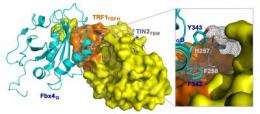
The point at which Fbx4 and TIN2 bind to TRF1 overlaps. Where both are present, TIN2 binds to TRF1 first and blocks Fbx4 from binding. Credit: University of Michigan Comprehensive Cancer Center

In the dominoes that make up human cells, researchers at the University of Michigan Comprehensive Cancer Center have traced another step of the process that stops cells from becoming cancerous.

It starts with the enzyme telomerase, which affects the caps, or telomeres, at the end of a chromosome. Telomeres shorten over time. But telomerase prevents this from happening, making the cell immortal. If is triggered in the cell, the presence of telomerase leads to the growth of the cancer.

Telomerase is kept in control by the protein TRF1, which keeps the telomeres operating correctly. But another protein, Fbx4, can bind to TRF1 and degrade it, causing the to lengthen.

Now, researchers have discovered, a third protein, TIN2, can step in and override Fbx4 by binding to TRF1 first and preventing Fbx4 from attaching to it.

This finding paves the way for developing a drug that acts like TIN2, keeping everything in check and stopping the first domino from falling.

Results of the study appear in the Feb. 16 issue of Developmental Cell.

"In 90 percent of cancers, no matter what caused the cancer to form, it needs telomerase activity to maintain the cell. Without telomerase, the cell will die. Our work is key to understanding a detailed mechanism for how these interact and how to design a drug to block Fbx4," says senior author Ming Lei, Ph.D., assistant professor of at the University of Michigan Medical School.

The researchers found that the location in the molecule where Fbx4 binds to TRF1 overlaps with where TIN2 binds to TRF1. Where both Fbx4 and TIN2 are present, the TIN2 wins out and binds to the TRF1 first. This blocks Fbx4 from binding to the TRF1, thereby stabilizing TRF1 and keeping the telomere length in control.

The researchers are now looking at that mimic TIN2's binding to TRF1, in order to block Fbx4. The work is still in preliminary stages and no new therapies are being tested in patients.

If a drug is discovered, it could impact all cancer types. Currently, molecularly targeted therapies address a pathway or gene that's involved in only specific types of cancer. But telomerase is involved in all types of cancer.

"If we find a drug that can inhibit telomerase activity in any fashion, that could be a universal cancer drug," says Lei, a Howard Hughes Medical Institute Early Career Scientist.

More information: Developmental Cell, Vol. 18, No. 2, pp. 214-225

Provided by University of Michigan (news : web)

Filter


Move the slider to adjust rank threshold, so that you can hide some of the comments.


Display comments: newest first

stealthc
Feb 17, 2010

Rank: not rated yet
your cancer therapies manipulating telomeres sounds dangerous, I wouldn't want to be one of your test subjects. Honestly this sounds like it could produce a whole host of genetic side-effects from the manipulation of this process, unless if deployed using a targeting mechanism to only the effected areas of the body.
Rank 5 /5 (12 votes)
Related Stories
Relevant PhysicsForums posts
  • Mitosis
    created4 hours ago
  • Stem cell question.
    created5 hours ago
  • Protease cleavage
    created11 hours ago
  • Pertubance in a model
    created18 hours ago
  • Cancer drugs and Alzheimer's, Oh my!
    createdFeb 09, 2012
  • Squishing cells
    createdFeb 09, 2012
  • More from Physics Forums - Biology

More news stories

The power of estrogen -- male snakes attract other males

A new study has shown that boosting the estrogen levels of male garter snakes causes them to secrete the same pheromones that females use to attract suitors, and turned the males into just about the sexiest ...

Biology / Plants & Animals

created 16 hours ago | popularity 4.8 / 5 (6) | comments 1 | with audio podcast

Grass to gas: Researchers' genome map speeds biofuel development

Researchers at the University of Georgia have taken a major step in the ongoing effort to find sources of cleaner, renewable energy by mapping the genomes of two originator cells of Miscanthus x giganteus, a large perenn ...

Biology / Biotechnology

created 13 hours ago | popularity 3.8 / 5 (5) | comments 0 | with audio podcast

Miami battling invasion of giant African snails

No one knows how they got there. But an invasion of African giant snails has southern Florida in a panic over potential crop damage, disease and general yuckiness surrounding the slimy gastropods.

Biology / Ecology

created 20 hours ago | popularity 4 / 5 (1) | comments 4

Experts reveal how plants don't get sunburn

(PhysOrg.com) -- Experts at the University of Glasgow have discovered how plants survive the harmful rays of the sun.

Biology / Cell & Microbiology

created 16 hours ago | popularity 4.8 / 5 (5) | comments 0 | with audio podcast

Protein libraries in a snap

(PhysOrg.com) -- A Rice University undergraduate will depart with not only a degree but also a possible patent for his invention of an efficient way to create protein libraries, an important component of biomolecular ...

Biology / Cell & Microbiology

created 19 hours ago | popularity 4.8 / 5 (4) | comments 1 | with audio podcast


Anonymous knocks CIA website offline (Update)

The website of the Central Intelligence Agency was inaccessible on Friday after the hacker group Anonymous claimed to have knocked it offline.

Google users warned of threat to smartphone wallets

Users of Google smartphone wallets were being warned on Friday that there is a way to crack pass codes intended to thwart thieves from going on illicit shopping sprees.

New error-correcting codes guarantee the fastest possible rate of data transmission

Error-correcting codes are one of the triumphs of the digital age. They’re a way of encoding information so that it can be transmitted across a communication channel — such as an optical fiber o ...

Humans may have helped the decline of African rainforests 3000 years ago

(PhysOrg.com) -- Large areas of rainforests in Central Africa mysteriously disappeared over three thousand years ago, to be replaced by savannas. The prevailing theory has been that the cause was a change ...

New power source discovered

(PhysOrg.com) -- Researchers at the Massachusetts Institute of Technology (MIT) and RMIT University have made a breakthrough in energy storage and power generation.

Small modular reactor design could be a 'SUPERSTAR'

(PhysOrg.com) -- Though most of today's nuclear reactors are cooled by water, we've long known that there are alternatives; in fact, the world's first nuclear-powered electricity in 1951 came from a reactor ...