How does the proton get its spin?
February 17, 2010 by Anne Trafton
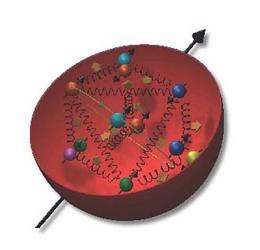
Artist's rendering of the inner structure of a proton showing quarks and quark-antiquark pairs, with springs showing the gluons that bind the quarks. Image courtesy of Klaus Rith
(PhysOrg.com) -- At a meeting this week of the American Physical Society in Washington, MIT Associate Professor of Physics Bernd Surrow reported on new results from the STAR experiment at the Relativistic Heavy Ion Collider (RHIC) that provide a better understanding of the internal structure of the proton, the basic building block of all nuclei.
The world’s only polarized proton collider, at Brookhaven National Laboratory in Upton, N.Y., RHIC is used by MIT physicists to understand how the proton gets its spin, a fundamental quantum mechanical property (spin manifests itself as an intrinsic magnetic field, a property that is the basis of magnetic resonance imaging, or MRI). In 2009, spin-polarized protons were collided in RHIC at a record high center-of-mass energy of 500 giga electron volts (GeV). At this high energy — an energy 250 times the mass of the two individual protons making the collision — the protons are moving essentially at the speed of light and the quarks inside the proton are able to “see” each other at a resolution that is very small compared to the size of the proton. This allows scientists to study the proton's internal structure.
Nobody has yet succeeded in performing a decomposition for the proton spin in terms of its constituent quarks and gluons. The accompanying cartoon shows a model of how complicated the “simple” proton actually is; its structure arises through the strong force and is described by the quantum theory of quarks and gluons known as quantum chromodynamics (QCD). This theory has thus far been unable to explain the origin of proton spin, so new insight is obtained from experiments. It has been established that the quarks themselves account for only about 25 percent of the proton’s spin and previous Brookhaven data provided by Surrow’s team indicate that the gluon’s contribution is also small.
Protons have a spin of ½, a number whose simplicity is compelling, considering that the proton is made up of several constituent particles.
The results presented in Washington this week have established a new way to explore the spin structure of the proton by using the weak interaction, which is responsible for radioactive β-decay (a process that converts a neutron into a proton while emitting an electron and an electron antineutrino). The weak interaction is mediated by very massive (about 80 GeV) particles known as W bosons. At RHIC, the longitudinal polarization of the colliding polarized proton beams at high energies allows the experiments to directly observe the weak interactions by detecting the decay electrons of the W bosons produced. This process gives rise to a large parity violating signal. (Parity violation means that physics results are different in processes occurring in left- and right-handed systems.) Such a signal has now been established for the first time by careful measurement of the spin-dependent cross section under the leadership of Surrow's group at the MIT Laboratory for Nuclear Science. The STAR experiment is well suited to carry out such measurements because of its large acceptance for the detection of the decay electron produced by the W boson. In addition, it can discriminate against background processes from the strong interaction.
The production of W bosons provides an ideal tool to study the quark spin structure of the proton. W bosons are produced in quark-antiquark collisions and can be detected through their respective decay electrons. The analysis distinguishes the electric charge sign of the decay product, which provides a direct view of the quark polarization at high energies where fundamental calculations are well under control. The results from Surrow’s group clearly establish the different polarization patterns of up and down quarks. They are consistent with fundamental calculations within the Standard Model (SM) of particle physics. This new technique allows direct sensitivity to the polarization of anti-quarks.
Surrow’s group is also developing new tracking detectors that will greatly increase the ability to detect the parity-violating W events in further data-taking planned for 2011/2012. These measurements will focus on measuring the polarization of the anti-quarks, which only live fleetingly in the proton.
Provided by Massachusetts Institute of Technology (news : web)
-
Seeking Answers to the Puzzle of Proton Spin
Apr 24, 2006 |
not rated yet |
0
-
Protons - Everything Revolves Around Spin
Dec 17, 2007 |
not rated yet |
0
-
Moving Quarks Help Solve Proton Spin Puzzle
Sep 11, 2008 |
not rated yet |
0
-
eRHIC gets to the heart of the matter
Apr 26, 2006 |
not rated yet |
0
-
End of an era at HERA accelerator
Jul 02, 2007 |
not rated yet |
0
-
Engineers build first sub-10-nm carbon nanotube transistor
Feb 01, 2012 |
4.9 / 5 (31) |
30
-
Something old, something new: Evolution and the structural divergence of duplicate genes
Jan 31, 2012 |
4.6 / 5 (7) |
1
-
The hidden nanoworld of ice crystals: Revealing the dynamic behavior of quasi-liquid layers
Jan 30, 2012 |
5 / 5 (3) |
1
-
Stock market network reveals investor clustering
Jan 27, 2012 |
3.9 / 5 (23) |
8
-
Of microchemistry and molecules: Electronic microfluidic device synthesizes biocompatible probes
Jan 26, 2012 |
5 / 5 (1) |
0
-
Non-Integrable Quadratic Hamiltonian
1 hour ago
-
Mysteries in Classical Physics
3 hours ago
-
(Conceptual) questions about capacitors, circuits
4 hours ago
-
a steel rod and an iron rod is placed inside an ac current soleoid
5 hours ago
-
Nature of principal strains
5 hours ago
-
Magnet in a AC current solenoid
6 hours ago
- More from Physics Forums - Classical Physics
More news stories
Putting the squeeze on planets outside our solar system
(PhysOrg.com) -- Using high-powered lasers, scientists at Lawrence Livermore National Laboratory and collaborators discovered that molten magnesium silicate undergoes a phase change in the liquid state, abruptly ...
15 hours ago |
4.3 / 5 (7) |
0
|
Hovering not hard if you're top-heavy, researchers find
Top-heavy structures are more likely to maintain their balance while hovering in the air than are those that bear a lower center of gravity, researchers at New York University's Courant Institute of Mathematical Sciences ...
16 hours ago |
5 / 5 (2) |
1
|
SLAC, Stanford team focuses on high-energy electrons to treat cancer
Accelerator physicists at SLAC and cancer specialists from Stanford are working on a new technology that could dramatically reduce the time needed for cancer radiation treatments. The team ran an initial experiment ...
19 hours ago |
5 / 5 (2) |
0
Measurements from high-energy collisions lead to better understanding of why meson particles disappear
For several years, physicists at the Relativistic Heavy Ion Collider (RHIC) at Brookhaven National Laboratory (BNL), USA, have studied an unusual state of matter called the quarkgluon plasma, which they ...
20 hours ago |
4.5 / 5 (4) |
0
Explained: Sigma
It's a question that arises with virtually every major new finding in science or medicine: What makes a result reliable enough to be taken seriously? The answer has to do with statistical significance -- but ...
Feb 09, 2012 |
5 / 5 (16) |
53
Anonymous knocks CIA website offline (Update)
The website of the Central Intelligence Agency was inaccessible on Friday after the hacker group Anonymous claimed to have knocked it offline.
New error-correcting codes guarantee the fastest possible rate of data transmission
Error-correcting codes are one of the triumphs of the digital age. Theyre a way of encoding information so that it can be transmitted across a communication channel such as an optical fiber o ...
Humans may have helped the decline of African rainforests 3000 years ago
(PhysOrg.com) -- Large areas of rainforests in Central Africa mysteriously disappeared over three thousand years ago, to be replaced by savannas. The prevailing theory has been that the cause was a change ...
Small modular reactor design could be a 'SUPERSTAR'
(PhysOrg.com) -- Though most of today's nuclear reactors are cooled by water, we've long known that there are alternatives; in fact, the world's first nuclear-powered electricity in 1951 came from a reactor ...
New power source discovered
(PhysOrg.com) -- Researchers at the Massachusetts Institute of Technology (MIT) and RMIT University have made a breakthrough in energy storage and power generation.
The power of estrogen -- male snakes attract other males
A new study has shown that boosting the estrogen levels of male garter snakes causes them to secrete the same pheromones that females use to attract suitors, and turned the males into just about the sexiest ...
Feb 17, 2010
Rank: 4 / 5 (4)
Feb 17, 2010
Rank: 4.2 / 5 (5)
If the question isn't going to be answered in the text, why ask the question at all? Especially in the title.
It would be more aptly titled "We still don't know how the proton gets its spin. Despite the latest research..."
Feb 17, 2010
Rank: 4 / 5 (4)
It will be interesting to see what the final results are in any case.
Feb 17, 2010
Rank: 3 / 5 (2)
Feb 18, 2010
Rank: 4.8 / 5 (4)
Feb 18, 2010
Rank: not rated yet
Not so much the fault of the writing as it is a fault of the way we interpret it.
I appreciate these kinds of articles, I'd just rather not have my hopes go up with the title, and down with the article.
Feb 18, 2010
Rank: 2.3 / 5 (3)
Feb 18, 2010
Rank: not rated yet
http://focus.aps..../v12/st5
Feb 18, 2010
Rank: 5 / 5 (1)
How do they get those tiny, very tiny springs into the proton?
And, what are they made of?
Feb 18, 2010
Rank: not rated yet
But the convention requires quarks and gluons, of course...
Feb 18, 2010
Rank: not rated yet
http://www.chem.l...ics.html
At the case of electron, the Mobius strip model was proposed a long time ago already (Wasserman, Spec.Sc.Tech.(1992)). This model was detailed later:
http://members.ch...tron.pdf
IMO strip model of hadrons correspond the path of quarks triplets which are revolving each other like system of gravitating bodies. More massive down-quarks (3.5–6.0 MeV/c2) are concentrated bellow up-quark (1.5–3.3 MeV/c2) near the center of neutron, like inside of gravitationaly coupled Eefimov state of three massive bodies of different mass.
http://cerncourie...rn/41014
Feb 18, 2010
Rank: not rated yet
http://en.wikiped...a_matrix
Feb 18, 2010
Rank: not rated yet
Why dont they just call it a magnetic field???
Which is what it is.
Feb 19, 2010
Rank: not rated yet
Feb 19, 2010
Rank: not rated yet
Look at quantum rotation operators - spin means that 'quantum phase' (whatever it means...) makes something like this
http://demonstrat...arities/
on each plane orthogonal to spin axis, what through Aharonov-Bohm effect connects with its internal magnetic structure ... for me it also automatically leads to proton's internal structure without any problems with spin (4th section of http://arxiv.org/...0.2724v1 ) which also while deep inelastic scattering would look to be made of three parts which carry small part of its mass and fulfilling asymptotic freedom ...
Feb 20, 2010
Rank: not rated yet
http://misclab.um...ve_b.jpg
The existence of spin follows from special relativity, too. By special relativity light spreads by constant speed, so if we can see energy spreading by subluminal speed, for example near black hole or inside of atom orbitals, then the energy always circulates at place. Without spin our universe would remain fully transparent and empty, because all energy would propagate through it in the same speed in all directions.
Feb 20, 2010
Rank: not rated yet