GE and Hitachi want to use nuclear waste as a fuel
February 18, 2010 by Lin Edwards
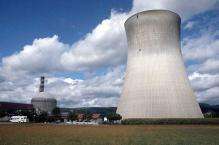
(PhysOrg.com) -- One of the world's biggest providers of nuclear reactors, GE Hitachi Nuclear Energy (a joint venture of General Electric and Hitachi), wants to reprocess nuclear waste for use as a fuel in advanced nuclear power plants, instead of burying it in waste repositories such as that proposed at Nevada's Yucca Mountain.
Conventional nuclear power plants in the US only harness around five percent of the energy of nuclear fuels. The reprocessing technique would separate nuclear waste into different types of fuels, some of which can be used in conventional nuclear power plants, and some of which can only be used in advanced fast neutron reactors. Reprocessing of nuclear waste to extract more useable fuel has been criticized in the US because it produces pure plutonium, which could be stolen and used to make nuclear weapons. To get around this difficulty, GE Hitachi’s proposed method produces a fuel that is much harder to steal.
The GE Hitachi process separates wastes from conventional nuclear power plants into three streams, by applying voltage to a molten salt. The first waste material consists of the products of fission, which cannot be further used as fuel and will need to be stored, but the storage time required is reduced from tens of thousands of years to a few hundred years (although a small fraction of the material will still need to be stored for over 10,000 years). The second material is uranium that does not have enough fissile material to be used in the light water uranium reactors in the US, which need enriched uranium, but it can be used by deuterium (heavy water) uranium reactors, which are used in Canada.
The final group of waste products is a mixture of transuranic elements including plutonium and neptunium. The plutonium is not separated from the other elements, and the mixture releases 1,000 times more heat and 10,000 times more neutrons than pure plutonium. This makes it much harder to steal, and therefore less of a security risk, and it is also much easier to detect. The mixture of transuranic elements can be used in nuclear reactors that use molten sodium as the coolant rather than water, and this type is used in Japan and a few other countries. GE Hitachi has designed a reactor known as the PRISM reactor that would be able to use the mixed fuel, but sodium cooled reactors have not been approved for use in the US.
A GE Hitachi spokesman said previous US administrations had little interest in re-using spent nuclear fuel, but the Obama administration is increasing support for nuclear power and looking at possibilities such as reprocessing. If adopted, the proposal would significantly decrease the amount of dangerous nuclear waste that needs to be stored.
© 2010 PhysOrg.com
-
Sustainable nuclear energy moves a step closer
Dec 11, 2006 |
not rated yet |
0
-
Engineers develop technique to help combat nuclear proliferation
Mar 04, 2009 |
not rated yet |
0
-
U.S. says it will discard some plutonium
Sep 18, 2007 |
not rated yet |
0
-
Researcher urges nuclear waste options
Aug 18, 2006 |
not rated yet |
0
-
Understanding the chemistry of ionic liquids for nuclear fuel reprocessing
Sep 12, 2006 |
not rated yet |
0
-
Engineers build first sub-10-nm carbon nanotube transistor
Feb 01, 2012 |
4.9 / 5 (31) |
30
-
Something old, something new: Evolution and the structural divergence of duplicate genes
Jan 31, 2012 |
4.6 / 5 (7) |
1
-
The hidden nanoworld of ice crystals: Revealing the dynamic behavior of quasi-liquid layers
Jan 30, 2012 |
5 / 5 (3) |
1
-
Stock market network reveals investor clustering
Jan 27, 2012 |
3.9 / 5 (23) |
8
-
Of microchemistry and molecules: Electronic microfluidic device synthesizes biocompatible probes
Jan 26, 2012 |
5 / 5 (1) |
0
-
Calling function with no input argument
12 hours ago
-
Force free body diagram problem on gym equipment
13 hours ago
-
Empirical data regarding shower heads and water
21 hours ago
-
feed hold button on CNC lathe
Feb 09, 2012
-
RFAC in Fortran
Feb 09, 2012
-
dynamics 2/32
Feb 08, 2012
- More from Physics Forums - General Engineering
More news stories
Anonymous knocks CIA website offline (Update)
The website of the Central Intelligence Agency was inaccessible on Friday after the hacker group Anonymous claimed to have knocked it offline.
7 hours ago |
5 / 5 (7) |
12
Google users warned of threat to smartphone wallets
Users of Google smartphone wallets were being warned on Friday that there is a way to crack pass codes intended to thwart thieves from going on illicit shopping sprees.
5 hours ago |
5 / 5 (2) |
0
New error-correcting codes guarantee the fastest possible rate of data transmission
Error-correcting codes are one of the triumphs of the digital age. Theyre a way of encoding information so that it can be transmitted across a communication channel such as an optical fiber o ...
Technology / Computer Sciences
15 hours ago |
4.8 / 5 (6) |
6
|
New power source discovered
(PhysOrg.com) -- Researchers at the Massachusetts Institute of Technology (MIT) and RMIT University have made a breakthrough in energy storage and power generation.
Technology / Energy & Green Tech
14 hours ago |
4.8 / 5 (24) |
8
|
Small modular reactor design could be a 'SUPERSTAR'
(PhysOrg.com) -- Though most of today's nuclear reactors are cooled by water, we've long known that there are alternatives; in fact, the world's first nuclear-powered electricity in 1951 came from a reactor ...
Technology / Energy & Green Tech
15 hours ago |
4.3 / 5 (11) |
22
|
Complex wiring of the nervous system may rely on a just a handful of genes and proteins
Researchers at the Salk Institute have discovered a startling feature of early brain development that helps to explain how complex neuron wiring patterns are programmed using just a handful of critical genes. ...
Humans may have helped the decline of African rainforests 3000 years ago
(PhysOrg.com) -- Large areas of rainforests in Central Africa mysteriously disappeared over three thousand years ago, to be replaced by savannas. The prevailing theory has been that the cause was a change ...
The power of estrogen -- male snakes attract other males
A new study has shown that boosting the estrogen levels of male garter snakes causes them to secrete the same pheromones that females use to attract suitors, and turned the males into just about the sexiest ...
Putting the squeeze on planets outside our solar system
(PhysOrg.com) -- Using high-powered lasers, scientists at Lawrence Livermore National Laboratory and collaborators discovered that molten magnesium silicate undergoes a phase change in the liquid state, abruptly ...
Could Venus be shifting gear?
(PhysOrg.com) -- ESAs Venus Express spacecraft has discovered that our cloud-covered neighbour spins a little slower than previously measured. Peering through the dense atmosphere in the infrared, the ...
Advanced power-grid model finds low-cost, low-carbon future in West
(PhysOrg.com) -- The least expensive way for the Western U.S. to reduce greenhouse gas emissions enough to help prevent the worst consequences of global warming is to replace coal with renewable and other ...
Feb 18, 2010
Rank: 2.8 / 5 (4)
See: "New Invention Using Spent Nuclear Fuel Rods Could Unlock U.S. Oil Reserves Three Times Larger Than Saudi Arabia's” posted at http://www.busine...-2010-2.
Producing oil shale with this residual heat that posed a problem for Yucca Mountain does not preclude further recycling. BWR fuel can be recovered and burned again as is, without the cost and associated proliferation and safety problems of reprocessing, in a CANDU.
Feb 18, 2010
Rank: 3.3 / 5 (3)
This heat can produce America's oil shale reserves which are three times larger Than Saudi Arabia's.
Producing oil shale with this residual heat, that poses a problem for repositories like Yucca Mountain, does not preclude its further recycling. BWR fuel can be recovered and burned again as is, without the cost and associated proliferation and safety problems of reprocessing, in a CANDU.
Feb 18, 2010
Rank: 3.3 / 5 (3)
Feb 18, 2010
Rank: 4 / 5 (1)
Feb 18, 2010
Rank: not rated yet
Although the U-235 content of spent BWR fuel is higher than that in the natural uranium used in CANDUs it still can't exactly be used as is.
There are still fuel sheath/bundling issues, fission products to deal with, etc. I love CANDUs as a place to use the reprocessed fuel and I agree that the cost of reprocessing BWR fuel to be used in a CANDU reduces cost and proliferation issues, but there is still a significant amount of processing that needs to be done to fuel coming out of a BWR before heading into a CANDU.
Feb 18, 2010
Rank: not rated yet
Currently, nuclear waste is to be stored in a way that it can be retrieved should it need to be transported/studied/whatever (regardless of what may have been done in the past, this is how it is done now).
Because of this it is far more likely that fuel will be stored in the same manner it is now rather than be shipped across oceans and borders. When the technology and techniques described in the article are being used in the US, the spent fuel will be retrieved and reprocessed.
Feb 18, 2010
Rank: 5 / 5 (1)
The transfer from LWR to CANDU can be literally "direct", involving only the cutting of spent LWR fuel rods to CANDU length (~50 cm), resealing (or double-sheathing), and reengineering into cylindrical bundles suitable for CANDU geometry.
http://www.nuclea...fuel.htm
Feb 19, 2010
Rank: not rated yet
Feb 19, 2010
Rank: not rated yet
I think we're agreeing with each other. When I said the fuel still needs to be processed before it went into a CANDU this is what I was referring to. No chemical reprocessing, but the handling of fresh(ish) fuel and cutting/sheathing/bundling of these fuel rods would still be considered processing of the fuel and are still fairly hazardous and time consuming activities.
I'm not saying I don't support it (because I definitely do think it's one of the easiest ways to reuse BWR fuel), but to say it goes "directly" from BWR to CANDU seems a little misleading.
Feb 19, 2010
Rank: not rated yet
Point taken.
Feb 23, 2010
Rank: not rated yet