Dolphin cognitive abilities raise ethical questions, says Emory neuroscientist
February 18, 2010
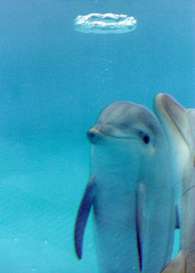
Two bottlenose dolphins playing with a bubble ring they just created. Photo by Brenda McCowan.
Many modern dolphin brains are significantly larger than those of humans and second in mass to the human brain when corrected for body size, says an Emory scientist. Some dolphin brains exhibit features correlated with complex intelligence, including a large expanse of neocortical volume that is more convoluted than that of humans, extensive insular and cingulated regions, and highly differentiated cellular regions. This has ethical and policy considerations.
Emory University neuroscientist Lori Marino will speak on the anatomical basis of dolphin intelligence at the American Association for the Advancement of Science conference (AAAS) in San Diego, on Sunday, Feb. 21.
"Many modern dolphin brains are significantly larger than our own and second in mass to the human brain when corrected for body size," Marino says.
A leading expert in the neuroanatomy of dolphins and whales, Marino will appear as part of a panel discussing these findings and their ethical and policy implications.
Some dolphin brains exhibit features correlated with complex intelligence, she says, including a large expanse of neocortical volume that is more convoluted than our own, extensive insular and cingulated regions, and highly differentiated cellular regions.
"Dolphins are sophisticated, self-aware, highly intelligent beings with individual personalities, autonomy and an inner life. They are vulnerable to tremendous suffering and psychological trauma," Marino says.
The growing industry of capturing and confining dolphins to perform in marine parks or to swim with tourists at resorts needs to be reconsidered, she says.
"Our current knowledge of dolphin brain complexity and intelligence suggests that these practices are potentially psychologically harmful to dolphins and present a misinformed picture of their natural intellectual capacities," Marino says.
Marino worked on a 2001 study that showed that dolphins can recognize themselves in a mirror - a finding that indicates self-awareness similar to that seen in higher primates and elephants.
-
Scientists say dolphins should be treated as non-human persons
Jan 06, 2010 |
not rated yet |
0
-
Dolphin 'therapy' a dangerous fad, Emory researchers warn
Dec 18, 2007 |
not rated yet |
0
-
Group calls for ban on dolphin therapy
Oct 28, 2007 |
not rated yet |
0
-
'Flipper' trainer against dolphin tourism
Oct 28, 2005 |
not rated yet |
0
-
Humpback whales have brain cells also found in humans
Nov 27, 2006 |
not rated yet |
0
-
Engineers build first sub-10-nm carbon nanotube transistor
Feb 01, 2012 |
4.9 / 5 (31) |
30
-
Something old, something new: Evolution and the structural divergence of duplicate genes
Jan 31, 2012 |
4.6 / 5 (7) |
1
-
The hidden nanoworld of ice crystals: Revealing the dynamic behavior of quasi-liquid layers
Jan 30, 2012 |
5 / 5 (3) |
1
-
Stock market network reveals investor clustering
Jan 27, 2012 |
3.9 / 5 (23) |
8
-
Of microchemistry and molecules: Electronic microfluidic device synthesizes biocompatible probes
Jan 26, 2012 |
5 / 5 (1) |
0
-
Protease cleavage
7 hours ago
-
Pertubance in a model
13 hours ago
-
Cancer drugs and Alzheimer's, Oh my!
21 hours ago
-
Squishing cells
22 hours ago
-
Any books/articles for evolutionary stable strategy models in humans?
Feb 09, 2012
-
Science behind the bore feeling?
Feb 09, 2012
- More from Physics Forums - Biology
More news stories
The power of estrogen -- male snakes attract other males
A new study has shown that boosting the estrogen levels of male garter snakes causes them to secrete the same pheromones that females use to attract suitors, and turned the males into just about the sexiest ...
11 hours ago |
4.8 / 5 (5) |
0
|
Grass to gas: Researchers' genome map speeds biofuel development
Researchers at the University of Georgia have taken a major step in the ongoing effort to find sources of cleaner, renewable energy by mapping the genomes of two originator cells of Miscanthus x giganteus, a large perenn ...
8 hours ago |
3.8 / 5 (5) |
0
|
Experts reveal how plants don't get sunburn
(PhysOrg.com) -- Experts at the University of Glasgow have discovered how plants survive the harmful rays of the sun.
11 hours ago |
5 / 5 (2) |
0
|
Miami battling invasion of giant African snails
No one knows how they got there. But an invasion of African giant snails has southern Florida in a panic over potential crop damage, disease and general yuckiness surrounding the slimy gastropods.
15 hours ago |
4 / 5 (1) |
4
Protein libraries in a snap
(PhysOrg.com) -- A Rice University undergraduate will depart with not only a degree but also a possible patent for his invention of an efficient way to create protein libraries, an important component of biomolecular ...
15 hours ago |
5 / 5 (3) |
0
|
Google users warned of threat to smartphone wallets
Users of Google smartphone wallets were being warned on Friday that there is a way to crack pass codes intended to thwart thieves from going on illicit shopping sprees.
Anonymous knocks CIA website offline (Update)
The website of the Central Intelligence Agency was inaccessible on Friday after the hacker group Anonymous claimed to have knocked it offline.
Complex wiring of the nervous system may rely on a just a handful of genes and proteins
Researchers at the Salk Institute have discovered a startling feature of early brain development that helps to explain how complex neuron wiring patterns are programmed using just a handful of critical genes. ...
New error-correcting codes guarantee the fastest possible rate of data transmission
Error-correcting codes are one of the triumphs of the digital age. Theyre a way of encoding information so that it can be transmitted across a communication channel such as an optical fiber o ...
Putting the squeeze on planets outside our solar system
(PhysOrg.com) -- Using high-powered lasers, scientists at Lawrence Livermore National Laboratory and collaborators discovered that molten magnesium silicate undergoes a phase change in the liquid state, abruptly ...
Humans may have helped the decline of African rainforests 3000 years ago
(PhysOrg.com) -- Large areas of rainforests in Central Africa mysteriously disappeared over three thousand years ago, to be replaced by savannas. The prevailing theory has been that the cause was a change ...
Feb 18, 2010
Rank: 1.7 / 5 (6)
The simple fact is they are able to be trained. They are also done so through incentive and reward, not punishment. Firstly, it seems unlikely they are suffering, seeing as they are kept safe and plenty fat.
Secondly, while their intelligence is certainly surprising, it is no better than that of a primate. It is certainly not up to the level of a human. Moreover, brain size tells us nothing. When measured, pound for pound, the common shrew has the largest brain to body ratio. Surely, it's not the smartest animal alive...
Marino has a long history of producing research that makes strenuous and questionable inferences.
Feb 19, 2010
Rank: not rated yet
Feb 19, 2010
Rank: 5 / 5 (1)
and now this marino woman again!
chill.
Feb 19, 2010
Rank: 5 / 5 (1)
It is typical human arrogance to think we are superior enough not to have to ponder the way we treat other sentient beings...
Feb 19, 2010
Rank: not rated yet
Feb 19, 2010
Rank: 5 / 5 (1)
Feb 19, 2010
Rank: 4 / 5 (2)
That's a very Douglas Adams kind of sentiment. Made me smile.
The big grains of cetaceans are employed in echolocation, navigation, and coordination of activities within a "school" of animals. Through sonar, they have high-fidelity volumetric "vision", in addition to their optical vision; this requires a great deal of additional brain matter to process and represent.
Lacking articulated appendages, and consigned to a relatively monotonous environment (compared to land), cetacean cognitive abilities are not so much geared toward tool use or invention, as is the case with the human brain.
So, while they are indeed quite intelligent, and social, the quality of their intellect is rather different and in some ways limited. I wouldn't go so far as to compare them to humans; I'm much more comfortable with an analogy to chimps.
Feb 19, 2010
Rank: 5 / 5 (2)
And Lokheed: There's more to life, including a dolphin's life, than being safe and fat.
Feb 20, 2010
Rank: not rated yet
But I do agree that animal suffering should be avoided.
However, dolphins performing at a sea world don't necessarily suffer. If their trainer loves them (instead of being a whip wielding dictator), and if they are given a sense of purpose and joy, the dolphins may well be as happy as those roaming some boring patch of coastal waters.
Feb 21, 2010
Rank: not rated yet
Feb 21, 2010
Rank: not rated yet