Hollywood movies follow a mathematical formula
February 19, 2010 by Lin Edwards
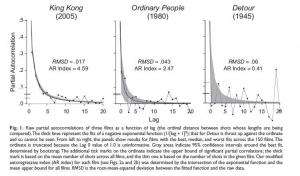
Image: James E. Cutting, Psychological Science, DOI: 10.1177/0956797610361679.
(PhysOrg.com) -- Hollywood movies have found a mathematical formula that lets them match the effects of their shots to the attention spans of their audiences.
Psychologist Professor James Cutting and his team from Cornell University in Ithaca, New York, analyzed 150 high-grossing Hollywood films released from 1935 to 2005 and discovered the shot lengths in the more recent movies followed the same mathematical pattern that describes the human attention span. The pattern was derived by scientists at the University of Texas in Austin in the 1990s who studied the attention spans of subjects performing hundreds of trials. The team then converted the measurements of their attention spans into wave forms using a mathematical technique known as the Fourier transform.
They found that the magnitude of the waves increased as their frequency decreased, a pattern known as pink noise, or 1/f fluctuation, which means that attention spans of the same lengths recurred at regular intervals. The same pattern has been found by Benoit Mandelbrot (the chaos theorist) in the annual flood levels of the Nile, and has been seen by others in air turbulence, and also in music.
Cutting made his discovery by measuring the length of every shot in 150 comedy, drama and action films, and then converted the measurements into waves for every movie. He found that the more recent the films were, the more likely they were to obey the 1/f fluctuation, and this did not just apply to fast action movies. Cutting said the significant thing is that shots of similar lengths recur in a regular pattern through the film.
Cutting believes obeying the 1/f law makes films “resonate with the rhythm of human attention spans,” and this makes them more gripping. Films edited in this way would then tend to be more successful and the style of shooting and editing more likely to be copied. Films of Cutting’s own favorite genre, the Film Noir, do not generally follow the 1/f law, with shot lengths tending to be more random. By contrast The Empire Strikes Back (1980) and the 2005 blockbuster movie Star Wars Episode III (which Cutting considers to be “just dreadful”) both follow 1/f rigidly.
The researchers concluded that over the next few decades film makers may take more care to follow the 1/f law to try to boost audience engagement.
More information: Attention and the Evolution of Hollywood Film; James E. Cutting, Jordan E. DeLong and Christine E. Nothelfer, Psychological Science published online 5 February 2010. DOI:10.1177/0956797610361679 . Full text of the paper is available here.
© 2010 PhysOrg.com
-
Blockbuster 'Avatar' to accelerate 3D revolution
Jan 06, 2010 |
not rated yet |
0
-
Study: Comedy films good for your heart
Jan 17, 2006 |
not rated yet |
0
-
Probing Question: Will digital actors replace humans in Hollywood?
Sep 25, 2008 |
not rated yet |
0
-
Site offers movie ratings with a twist
Sep 10, 2009 |
not rated yet |
0
-
AMD64 Is The Force Behind Star Wars
Aug 09, 2004 |
not rated yet |
0
-
Engineers build first sub-10-nm carbon nanotube transistor
Feb 01, 2012 |
4.9 / 5 (29) |
30
-
Something old, something new: Evolution and the structural divergence of duplicate genes
Jan 31, 2012 |
4.6 / 5 (7) |
1
-
The hidden nanoworld of ice crystals: Revealing the dynamic behavior of quasi-liquid layers
Jan 30, 2012 |
5 / 5 (3) |
1
-
Stock market network reveals investor clustering
Jan 27, 2012 |
4 / 5 (22) |
8
-
Of microchemistry and molecules: Electronic microfluidic device synthesizes biocompatible probes
Jan 26, 2012 |
5 / 5 (1) |
0
-
Curve fitting
3 hours ago
-
Parts Per Thousand & Gradients Question
11 hours ago
-
simple maximization question! very confused :s
11 hours ago
-
Derivative of a vector
14 hours ago
-
What does the frequency representation of a function show?
14 hours ago
-
Co-prime of vectors
15 hours ago
- More from Physics Forums - General Math
More news stories
New insights into how to correct false knowledge
The abundance of false information available on the Internet, in movies and on TV has created a big challenge for educators.
Other Sciences / Social Sciences
16 hours ago |
5 / 5 (6) |
9
|
Neanderthal demise due to many influences, including cultural changes: study
As an ice age crept upon them thousands of years ago, Neanderthals and modern human ancestors expanded their territory ranges across Asia and Europe to adapt to the changing environment.
Other Sciences / Archaeology & Fossils
17 hours ago |
4.3 / 5 (3) |
7
|
Splat! Geek-in-chief Obama tests marshmallow gun
US President Barack Obama tested a new prototype Tuesday for his commander-in-chief's arsenal -- a high-powered marshmallow gun that sent a tasty missile screaming through the White House.
12 hours ago |
4.5 / 5 (2) |
3
Parents blame child sex abuse victims more if perpetrator is another youth, research shows
Parents are much more likely to blame and doubt their children when their child has been sexually abused by another adolescent instead of an adult, according to new research from the Crimes against Children Research Center ...
Other Sciences / Social Sciences
17 hours ago |
3.5 / 5 (2) |
2
Fall of Communism changed mathematics in US: New study
The collapse of the Soviet Union in 1992 brought an influx of Soviet mathematicians to U.S. institutions, and those scholars' differing areas of specialization have changed the way math is studied and taught in this country, ...
11 hours ago |
1 / 5 (1) |
0
Scared of a younger rival? Not for some male songbirds
When mature male white-crowned sparrows duel to win a mate or a nesting territory, a young bird just doesn't get much respect.
Tiny primate 'talks' in ultrasound
One of the world's smallest primates, the Philippine tarsier, communicates in a range of ultrasound inaudible to predator and prey alike, according to a study published on Wednesday.
Playing school sports affects youths' smoking
Young people's choices about using drugs and alcohol are influenced by peersnot only close friends, but also sports teammates. A new study of middle schoolers and their social networks has found that teammates' smoking ...
New study: Adolescents suffering from depression more likely to be bullied
A new study provides evidence that adolescents who suffer from depression are more likely to develop difficulty in peer relationships including being bullied at school.
Preventing bacteria from falling in with the wrong crowd could help stop gum disease
Stripping some mouth bacteria of their access key to gangs of other pathogenic oral bacteria could help prevent gum disease and tooth loss. The study, published in the journal Microbiology suggests that t ...
New study sheds light on genetics of rice metabolism
A large-scale study analyzing metabolic compounds in rice grains conducted by researchers at the RIKEN Plant Science Center (PSC) and their collaborators has identified 131 rice metabolites and clarified the ...
Feb 19, 2010
Rank: 4.9 / 5 (7)
If $movie.revenuestream gt $movie.expenditure append $_.success=1
else append $_.success=0
If $movie.success=1 wait years=5
then repeat
If $movie.success=0 rename $movie.title
then repeat
End
CLS
Feb 19, 2010
Rank: 3 / 5 (2)
Feb 19, 2010
Rank: 5 / 5 (1)
Think Mission Impossible I, II, III or the James Bond series.....and then think Freaky Friday, The Hot Chick, and Being John Malkovich.
Feb 19, 2010
Rank: 5 / 5 (2)
It's a pseudo powershell script for "If we made money, put out a remake in 5 years. If we didn't make money, recycle the story with new actors and characters."
I thought it was humorous.
Feb 19, 2010
Rank: 5 / 5 (1)
I find the explanation offered in the article far more likely. The community of film editors is pretty small, and those associated with successful movies get more work. This moves editors with the 'style' of cutting towards the 1/f law into more and more movies, gradually replacing those that do not.
They will probably soon be teaching this law to film editors in school. Nothing wrong with it, the 1/f law can be followed even for quite original and unique scripts.
Feb 20, 2010
Rank: not rated yet
Moreover, there is a serious conditioning factor at work. Growing up with post-90s films, I find it harder to watch films the older they are, because of the slower pace. It's not that I can't focus, it's that I get easily bored by the strenuous plot progression.
My generation has been conditioned to process a lot of information really fast and as such, we're quite impatient when it comes to entertainment. I just wonder how will the post-2000 kids look at things. I feel we're approaching some sort of asymptote.
Feb 20, 2010
Rank: not rated yet
That scheme of old forgotten, ancient and mysterious seems to be popular in Hollywood, and you will make even more $ out of less movie.
Feb 20, 2010
Rank: not rated yet
Feb 20, 2010
Rank: not rated yet
Feb 20, 2010
Rank: not rated yet
the amount of explosives for each movie.
Feb 21, 2010
Rank: not rated yet
It is probably that you are more "conditioned" to the loud noises and flashing lights, with little regard for the story. I have no problem "processing" any film, whether it be new or old, as long as the storyline is halfway decent. I would bet that after you have seen enough movies, you will find that the flash and bang aspect loses some of it's appeal.
Mar 21, 2010
Rank: not rated yet
It was.
Patterns in your script helped me decipher it, but maybe Klingon would have been more familiar language to use.