Synchronized flying robots could paint pictures in the sky (w/ Video)
February 21, 2010 by Lisa Zyga
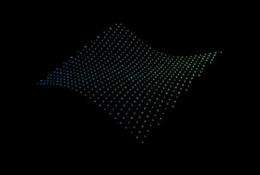
In the Flyfire project, large numbers of micro helicopters with LEDs act as moving smart pixels, performing elaborate synchronized motions that create an elastic display. Credit: MIT SENSEable City Lab.
(PhysOrg.com) -- In a new MIT project called Flyfire, tiny robotic helicopters with LEDs can act as flying pixels, moving together to create transient images in three-dimensional space. If it sounds like something out of a Disney animation, it sort of is.
"It's like when Winnie the Pooh hits a beehive: a swarm of bees comes out and chases him while changing its configuration to resemble a beast," said E Roon Kang, a research fellow at MIT’s SENSEable City Lab who is leading the project. "In Flyfire, each bee is essentially a pixel that emits colored light and reconfigures itself into different forms."
This video is not supported by your browser at this time.
This short video shows the possibilities MIT envisions for Flyfire.
The Flyfire project, a collaboration between the SENSEable City Lab and the Aerospace Robotics and Embedded Systems Laboratory (ARES Lab), is made possible due to recent advances in battery technology and wireless control. The researchers’ goal is to transform any ordinary space into a highly immersive and interactive display environment through the use of flying “smart pixels,” or robots with LEDs. In the Flyfire concept, swarms of robotic helicopters are remotely controlled and self-organize themselves to perform elaborate synchronized choreographies.The robotic pixels can be manipulated in real time using precise, self-stabilizing technology developed by the ARES Lab. While current technology enables the researchers to simultaneously control just a handful of robotic helicopters, they hope to scale up to “very large numbers” of synchronized helicopters.
The researchers envision the technology being used for 3D public displays, since the images can be experienced from far away and from all directions. As shown in the video, the flying pixels can generate a variety of unique free-form displays in the sky, such as spelling words, drawing pictures, and visually displaying any kind of information.
In a press release, the labs note that Flyfire could also be a step toward “smart dust,” which is a futuristic wireless network made of tiny, synchronized devices the size of dust.
More information: http://senseable.mit.edu/flyfire/
© 2010 PhysOrg.com
-
'Wiki City Rome' to draw a map like no other
Aug 31, 2007 |
not rated yet |
0
-
World's Highest Resolution 3D Images
Aug 31, 2004 |
not rated yet |
0
-
AIDA Robot Aims To Change The Way We Interact With Our Car (w/ Video)
Nov 01, 2009 |
not rated yet |
0
-
Tracking trash
Jul 15, 2009 |
not rated yet |
0
-
Latest 3D TV Technology Offers Interactive Control
Mar 19, 2009 |
not rated yet |
0
-
Engineers build first sub-10-nm carbon nanotube transistor
Feb 01, 2012 |
4.9 / 5 (31) |
30
-
Something old, something new: Evolution and the structural divergence of duplicate genes
Jan 31, 2012 |
4.6 / 5 (7) |
1
-
The hidden nanoworld of ice crystals: Revealing the dynamic behavior of quasi-liquid layers
Jan 30, 2012 |
5 / 5 (3) |
1
-
Stock market network reveals investor clustering
Jan 27, 2012 |
3.9 / 5 (23) |
8
-
Of microchemistry and molecules: Electronic microfluidic device synthesizes biocompatible probes
Jan 26, 2012 |
5 / 5 (1) |
0
-
Calling function with no input argument
7 hours ago
-
Force free body diagram problem on gym equipment
8 hours ago
-
Empirical data regarding shower heads and water
16 hours ago
-
feed hold button on CNC lathe
Feb 09, 2012
-
RFAC in Fortran
Feb 09, 2012
-
dynamics 2/32
Feb 08, 2012
- More from Physics Forums - General Engineering
More news stories
Google users warned of threat to smartphone wallets
Users of Google smartphone wallets were being warned on Friday that there is a way to crack pass codes intended to thwart thieves from going on illicit shopping sprees.
41 minutes ago |
not rated yet |
0
CIA website offline, Anonymous takes credit
The website of the Central Intelligence Agency was unresponsive on Friday after the hacker group Anonymous claimed to have knocked it offline.
2 hours ago |
5 / 5 (3) |
8
New error-correcting codes guarantee the fastest possible rate of data transmission
Error-correcting codes are one of the triumphs of the digital age. Theyre a way of encoding information so that it can be transmitted across a communication channel such as an optical fiber o ...
Technology / Computer Sciences
10 hours ago |
5 / 5 (4) |
5
|
New power source discovered
(PhysOrg.com) -- Researchers at the Massachusetts Institute of Technology (MIT) and RMIT University have made a breakthrough in energy storage and power generation.
Technology / Energy & Green Tech
9 hours ago |
4.8 / 5 (16) |
3
|
Small modular reactor design could be a 'SUPERSTAR'
(PhysOrg.com) -- Though most of today's nuclear reactors are cooled by water, we've long known that there are alternatives; in fact, the world's first nuclear-powered electricity in 1951 came from a reactor ...
Technology / Energy & Green Tech
10 hours ago |
4.2 / 5 (10) |
19
|
NASA sees wide-eyed cyclone Jasmine
Cyclone Jasmine's eye has opened wider on NASA satellite imagery, as it moves through the Southern Pacific Ocean.
NASA sees Giovanna reach cyclone strength, threaten Madagascar
Tropical Storm 12S built up steam and became a cyclone on February 10, 2012 as NASA's Terra satellite passed overhead. Residents of east-central Madagascar should prepare for this cyclone to make landfall ...
Complex wiring of the nervous system may rely on a just a handful of genes and proteins
Researchers at the Salk Institute have discovered a startling feature of early brain development that helps to explain how complex neuron wiring patterns are programmed using just a handful of critical genes. ...
Putting the squeeze on planets outside our solar system
(PhysOrg.com) -- Using high-powered lasers, scientists at Lawrence Livermore National Laboratory and collaborators discovered that molten magnesium silicate undergoes a phase change in the liquid state, abruptly ...
The power of estrogen -- male snakes attract other males
A new study has shown that boosting the estrogen levels of male garter snakes causes them to secrete the same pheromones that females use to attract suitors, and turned the males into just about the sexiest ...
Grass to gas: Researchers' genome map speeds biofuel development
Researchers at the University of Georgia have taken a major step in the ongoing effort to find sources of cleaner, renewable energy by mapping the genomes of two originator cells of Miscanthus x giganteus, a large perenn ...
Feb 19, 2010
Rank: not rated yet
Feb 19, 2010
Rank: 1 / 5 (1)
As for that "smart dust," isn't that part of the chemtrail experiments for increasing cellphone telemetry? What happens when we breathe in "smart dust?"
Feb 19, 2010
Rank: not rated yet
Perhaps even the microwave could induce the light itself by coupling to a EM reflector/convertor area imbedded in the surface of the swarmbot, consisting of metamaterial nanostructures such as quantumdots.
Feb 19, 2010
Rank: not rated yet
Feb 20, 2010
Rank: not rated yet
Feb 21, 2010
Rank: not rated yet
Feb 28, 2010
Rank: not rated yet
The wind you see is a problem for lightweight helicopters, even moderate wind will likely make flying in close formation impossible. This makes displays using them not practical outdoors contrary to what the article claims.