Urgent need to prepare developing countries for surge in e-wastes: UN
Sales of electronic products in countries like China and India and across continents such as Africa and Latin America are set to rise sharply in the next 10 years.
And, unless action is stepped up to properly collect and recycle materials, many developing countries face the spectre of hazardous e-waste mountains with serious consequences for the environment and public health, according to UN experts in a landmark report released today by UNEP.
Issued at a meeting of Basel Convention and other world chemical authorities prior to UNEP's Governing Council meeting in Bali, Indonesia, the report, "Recycling - from E-Waste to Resources," used data from 11 representative developing countries to estimate current and future e-waste generation - which includes old and dilapidated desk and laptop computers, printers, mobile phones, pagers, digital photo and music devices, refrigerators, toys and televisions.
In South Africa and China for example, the report predicts that by 2020 e-waste from old computers will have jumped by 200 to 400 percent from 2007 levels, and by 500% in India
By that same year in China, e-waste from discarded mobile phones will be about 7 times higher than 2007 levels and, in India, 18 times higher.
By 2020, e-waste from televisions will be 1.5 to 2 times higher in China and India while in India e-waste from discarded refrigerators will double or triple.
China already produces about 2.3 million tonnes (2010 estimate) domestically, second only to the United States with about 3 million tonnes. And, despite having banned e-waste imports, China remains a major e-waste dumping ground for developed countries.
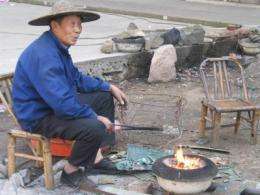
Moreover, most e-waste in China is improperly handled, much of it incinerated by backyard recyclers to recover valuable metals like gold -- practices that release steady plumes of far-reaching toxic pollution and yield very low metal recovery rates compared to state-of-the-art industrial facilities.
"This report gives new urgency to establishing ambitious, formal and regulated processes for collecting and managing e-waste via the setting up of large, efficient facilities in China," says UN Under-Secretary-General Achim Steiner, Executive Director of UNEP. "China is not alone in facing a serious challenge. India, Brazil, Mexico and others may also face rising environmental damage and health problems if e-waste recycling is left to the vagaries of the informal sector.
"In addition to curbing health problems, boosting developing country e-waste recycling rates can have the potential to generate decent employment, cut greenhouse gas emissions and recover a wide range of valuable metals including silver, gold, palladium, copper and indium -- by acting now and planning forward many countries can turn an e-challenge into an e-opportunity," he added.
The report was issued at the Simultaneous Extraordinary Meetings of the Conferences of the Parties to the Basel, Rotterdam and Stockholm Conventions on enhancing their cooperation and coordination (ExCOP).
It was co-authored by the Swiss EMPA, Umicore and United Nations University (UNU), part of the global think tank StEP (Solving the E-waste Problem), which includes UNEP and Basel Convention Secretariat among its 50+ members. Hosted by UNU in Bonn, Germany, the think tank convenes experts from industry, government, international organizations, NGOs and science. A grant from the European Commission, Directorate-General for the Environment, funded the report's preparation.
The report cites a variety of sources to illustrate growth of the e-waste problem:
- Global e-waste generation is growing by about 40 million tons a year
- Manufacturing mobile phones and personal computers consumes 3 per cent of the gold and silver mined worldwide each year; 13 per cent of the palladium and 15 per cent of cobalt
- Modern electronics contain up to 60 different elements -- many valuable, some hazardous, and some both
- Carbon dioxide emissions from the mining and production of copper and precious and rare metals used in electrical and electronic equipment are estimated at over 23 million tonnes - 0.1 percent of global emissions (not including emissions linked to steel, nickel or aluminum, nor those linked to manufacturing the devices)
- In the US, more than 150 million mobiles and pagers were sold in 2008, up from 90 million five years before
- Globally, more than 1 billion mobile phones were sold in 2007, up from 896 million in 2006
- Countries like Senegal and Uganda can expect e-waste flows from PCs alone to increase 4 to 8-fold by 2020.
- Given the infrastructure expense and technology skills required to create proper facilities for efficient and environmentally sound metal recovery, the report suggests facilitating exports of critical e-scrap fractions like circuit boards or btteries from smaller countries to OECD-level, certified end-processors.
Country Situations
The report assesses current policies, skills, waste collection networks and informal recycling in 11 representative developing economies in Asia, Africa and the Americas:
- China, India
- South Africa, Uganda, Senegal, Kenya, Morocco
- Brazil, Columbia, Mexico, Peru
The data includes equipment generated nationally but does not include waste imports, both legal and illegal, which are substantial in India, China and other emerging economies.
Broken down by type, the report estimates e-waste generation today as follows:
- China: 500,000 tonnes from refrigerators, 1.3 million tonnes from TVs, 300,000 tonnes from personal computers
- India: over 100,000 tonnes from refrigerators, 275,000 tonnes from TVs, 56,300 tonnes from personal computers, 4,700 tonnes from printers and 1,700 tonnes from mobile phones
- Colombia: about 9,000 tonnes from refrigerators, over 18,000 tonnes from TVs, 6,500 tonnes from personal computers, 1,300 tonnes from printers, 1,200 tonnes from mobile phones
- Kenya: 11,400 tonnes from refrigerators, 2,800 tonnes from TVs, 2,500 tonnes from personal computers, 500 tonnes from printers, 150 tonnes from mobile phones
The report also includes data on per capita sales of electrical and electronic goods. For example South Africa and Mexico lead in personal computer sales with the equivalent of 24 sold per 1,000 people. Brazil, Mexico and Senegal generate more e-waste per capita from personal computers than the other countries surveyed.
Developing vibrant national recycling schemes is complex and simply financing and transferring high tech equipment from developed countries is unlikely to work, according to the report.
It says China's lack of a comprehensive e-waste collection network, combined with competition from the lower-cost informal sector, has held back state-of-the art e-waste recycling plants.
It also notes a successful pilot in Bangalore, India, to transform the operations of informal e-waste collection and management.
Brazil, Colombia, Mexico, Morocco and South Africa are cited as places with great potential to introduce state of the art e-waste recycling technologies because the informal e-waste sector is relatively small.
Kenya, Peru, Senegal and Uganda have relatively low e-waste volumes today but likely to grow. All four would benefit from capacity building in so-called pre-processing technologies such as manual dismantling of e-waste.
The report recommends countries establish e-waste management centers of excellence, building on existing organizations working in the area of recycling and waste management.
Existing bodies include those supported by the United Nations including the more than 40 National Cleaner Production Centers established by the UN Industrial and Development Organization and the regional centers established under the Basel Convention on the Control of Transboundary Movements of Hazardous Wastes and their Disposal.
Provided by United Nations University


