Neuroscientists find brain system behind general intelligence
February 22, 2010
Caltech neuroscientists find brain system behind general intelligence

Enlarge

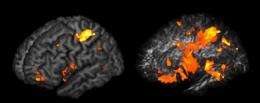
The brain regions important for general intelligence are found in several specific places (orange regions shown on the brain on the left). Looking inside the brain reveals the connections between these regions, which are particularly important to general intelligence. In the image on the right, the brain has been made partly transparent. The big orange regions in the right image are connections (like cables) that connect the specific brain regions in the image on the left. Credit: PNAS

A collaborative team of neuroscientists at the California Institute of Technology, the University of Iowa, the University of Southern California, and the Autonomous University of Madrid have mapped the brain structures that affect general intelligence.

The study, to be published the week of February 22 in the early edition of the , adds new insight to a highly controversial question: What is , and how can we measure it?

The research team included Jan Gläscher, first author on the paper and a postdoctoral fellow at Caltech, and Ralph Adolphs, the Bren Professor of Psychology and Neuroscience and professor of biology. The Caltech scientists teamed up with researchers at the University of Iowa and USC to examine a uniquely large data set of 241 brain-lesion patients who all had taken IQ tests. The researchers mapped the location of each patient's lesion in their brains, and correlated that with each patient's IQ score to produce a map of the regions that influence intelligence.

"General intelligence, often referred to as Spearman's g-factor, has been a highly contentious concept," says Adolphs. "But the basic idea underlying it is undisputed: on average, people's scores across many different kinds of tests are correlated. Some people just get generally high scores, whereas others get generally low scores. So it is an obvious next question to ask whether such a general ability might depend on specific brain regions."

The researchers found that, rather than residing in a single structure, general intelligence is determined by a network of regions across both sides of the brain.

"One of the main findings that really struck us was that there was a distributed system here. Several brain regions, and the connections between them, were what was most important to general intelligence," explains Gläscher.

"It might have turned out that general intelligence doesn't depend on specific brain areas at all, and just has to do with how the whole brain functions," adds Adolphs. "But that's not what we found. In fact, the particular regions and connections we found are quite in line with an existing theory about intelligence called the 'parieto-frontal integration theory.' It says that general intelligence depends on the brain's ability to integrate—to pull together—several different kinds of processing, such as working memory."

The researchers say the findings will open the door to further investigations about how the brain, intelligence, and environment all interact.

Provided by California Institute of Technology (news : web)

4.1 /5 (20 votes)  

Filter


Move the slider to adjust rank threshold, so that you can hide some of the comments.


Display comments: newest first

Birger
Feb 23, 2010

Rank: not rated yet
An interesting question is if failed rivals to H. Sapiens Sapiens such as Neanderthals had a somewhat poorer integration of several regions of the brain. While we now have the Neanderthal genome, it remains to be seen if such questions can be answered by simply comparing genes with humans.
frajo
Feb 23, 2010

Rank: 1 / 5 (1)
An interesting question is if failed rivals to H. Sapiens Sapiens such as Neanderthals had a somewhat poorer integration of several regions of the brain. While we now have the Neanderthal genome, it remains to be seen if such questions can be answered by simply comparing genes with humans.
I doubt that we can jump to such conclusions, even given our growing understanding of brain's chemistry and physiology. As long as we don't even understand Kim Peek's brain or those of other "savants" no genome analysis will help us to understand the Neanderthal's brain.
And this doesn't even take into account the heavy cultural bias hidden in the word "intelligence".
rincewind
Feb 23, 2010

Rank: not rated yet
Exactly frajo, there is an inherent subjectivity & bias in the word "intelligence". A more abstract definition that I prefer is to say that intelligence is "the ability of an entity to adapt & thrive in arbitrary environments". Humans have an uncanny ability to adapt to environments due to the structure of our brain, but this is not the only path to 'intelligence'.

general intelligence depends on the brain's ability to integrate—to pull together—several different kinds of processing, such as working memory


The first Artificial General Intelligence may one day arise from the dynamics of a search engine - something that specializes in integrating different kinds of information processes & memory.
knightcap
Feb 23, 2010

Rank: not rated yet
Mr Goertzel and the team at OpenCog might be interested in this, though if I just found it, I am sure they would have alreay.

According to PNAS - "General intelligence (g) captures the performance variance shared across cognitive tasks and correlates with real-world success...." - http://www.pnas.o...945a520e
It suggests that the distributed and connected regions of the brain that general intelligence draws upon are those that integrate verbal, visuospatial, working memory, and executive processes.

Interesting, but where to from here? Investigation to further understanding the biological factors, effects of drugs and brain damage on general intelligence, the emergence of general intelligence through evolution, perhaps an insight into the neural collerates of 'consciousness', and even more data to develop autonomous intelligent agents, and then true artificial general intelligence...exciting times ahead!
frajo
Feb 24, 2010

Rank: 1 / 5 (1)
It suggests that the distributed and connected regions of the brain that general intelligence draws upon are those that integrate verbal, visuospatial, working memory, and executive processes.
This does not suffice as it doesn't take into account the intelligence of the blind, the deaf, the dumb.
Meet Helen Keller.
VerGreeneyes
Feb 24, 2010

Rank: 3 / 5 (1)
@frajo It might not be entirely unfair - just because the blind, the deaf or the dumb have damaged sensory input, that doesn't mean they don't still use these parts of their brains. Indeed, they might be able to better apply them to whatever 'general intelligence' is due to the decreased sensory activity.
frajo
Feb 24, 2010

Rank: 1 / 5 (1)
just because the blind, the deaf or the dumb have damaged sensory input, that doesn't mean they don't still use these parts of their brains. Indeed, they might be able to better apply them to whatever 'general intelligence' is due to the decreased sensory activity.
Yes, and AFAIK it has already been proven that these parts of the brain are used for other processes when not for the standard ones.
Maybe it is only an unfortunate wording, but in the case of the blind, the dumb, and the deaf there is intelligence although there is no region that integrates verbal and visuospatial processes.
Rank 4.1 /5 (20 votes)
Related Stories
Relevant PhysicsForums posts
  • Is Everyday Technology Killing Us?
    createdFeb 08, 2012
  • Exercise and weight loss
    createdFeb 08, 2012
  • Why do we have head aches? Our brains can't feel anything.
    createdFeb 07, 2012
  • "The end of diseases" by David Agus, interview from Daily Show with Jon Stewart
    createdFeb 04, 2012
  • Oncolytic adenovirus
    createdFeb 04, 2012
  • Nutrition label stuffs and diets
    createdFeb 02, 2012
  • More from Physics Forums - Medical Sciences

More news stories

Complex wiring of the nervous system may rely on a just a handful of genes and proteins

Researchers at the Salk Institute have discovered a startling feature of early brain development that helps to explain how complex neuron wiring patterns are programmed using just a handful of critical genes. ...

Medicine & Health / Research

created 5 hours ago | popularity 5 / 5 (7) | comments 0 | with audio podcast

Both maternal and paternal age linked to autism

Older maternal and paternal age are jointly associated with having a child with autism, according to a recently published study led by researchers at The University of Texas Health Science Center at Houston (UTHealth).

Medicine & Health / Psychology & Psychiatry

created 9 hours ago | popularity 5 / 5 (1) | comments 0 | with audio podcast

New understanding of DNA repair could eventually lead to cancer therapy

A research group in the Faculty of Medicine & Dentistry at the University of Alberta is hoping its latest discovery could one day be used to develop new therapies that target certain types of cancers.

Medicine & Health / Cancer

created 9 hours ago | popularity 4.8 / 5 (4) | comments 0 | with audio podcast

Curry spice component may help slow prostate tumor growth

Curcumin, an active component of the Indian curry spice turmeric, may help slow down tumor growth in castration-resistant prostate cancer patients on androgen deprivation therapy (ADT), a study from researchers ...

Medicine & Health / Cancer

created 10 hours ago | popularity 4.5 / 5 (6) | comments 0 | with audio podcast

Human cognitive performance suffers following natural disasters, researchers find

Not surprisingly, victims of a natural disaster can experience stress and anxiety, but a new study indicates that it might also cause them to make more errors - some serious - in their daily lives. In their upcoming Human Fa ...

Medicine & Health / Psychology & Psychiatry

created 6 hours ago | popularity 4 / 5 (1) | comments 0


Google users warned of threat to smartphone wallets

Users of Google smartphone wallets were being warned on Friday that there is a way to crack pass codes intended to thwart thieves from going on illicit shopping sprees.

Anonymous knocks CIA website offline (Update)

The website of the Central Intelligence Agency was inaccessible on Friday after the hacker group Anonymous claimed to have knocked it offline.

New error-correcting codes guarantee the fastest possible rate of data transmission

Error-correcting codes are one of the triumphs of the digital age. They’re a way of encoding information so that it can be transmitted across a communication channel — such as an optical fiber o ...

The power of estrogen -- male snakes attract other males

A new study has shown that boosting the estrogen levels of male garter snakes causes them to secrete the same pheromones that females use to attract suitors, and turned the males into just about the sexiest ...

Putting the squeeze on planets outside our solar system

(PhysOrg.com) -- Using high-powered lasers, scientists at Lawrence Livermore National Laboratory and collaborators discovered that molten magnesium silicate undergoes a phase change in the liquid state, abruptly ...

Humans may have helped the decline of African rainforests 3000 years ago

(PhysOrg.com) -- Large areas of rainforests in Central Africa mysteriously disappeared over three thousand years ago, to be replaced by savannas. The prevailing theory has been that the cause was a change ...