NASA, NOAA ready GOES-P satellite for launch
February 22, 2010
NASA and NOAA ready GOES-P satellite for launch

Enlarge

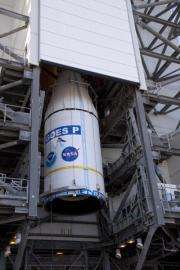
NASA's GOES-P meteorological satellite is lifted into the mobile service tower at Launch Complex 37 on Cape Canaveral Air Force Station. Credit: NASA/Jack Pfaller

NASA is preparing to launch the NOAA Geostationary Operational Environmental Satellite-P (GOES-P) from Space Launch Complex 37 at the Cape Canaveral Air Force Station, Fla. The launch is targeted for March 2, during a launch window from 6:19 to 7:19 p.m. EST.

"GOES are the backbone of NOAA's severe forecasts, monitoring fast-changing conditions in the atmosphere that spawn hurricanes, tornadoes, floods and other hazards," said Steve Kirkner, GOES program manager at NASA's Goddard Space Flight Center, Greenbelt, Md.

GOES-P is the third and final spacecraft to be launched in the GOES N Series of geostationary environmental weather satellites. The GOES satellites continuously provide observations of more than 50 percent of the Earth, including the continental United States, providing weather monitoring and forecast operations and a continuous and reliable stream of environmental information and severe weather warnings.

In addition to weather forecasting on Earth, a key instrument onboard GOES-P, the Solar X-Ray Imager (SXI), will help NOAA continue monitoring solar conditions.

"The SXI is improving our forecasts and warnings for solar disturbances, protecting billions of dollars worth of commercial and government assets in space and on the ground, and lessening the brunt of power surges for the satellite-based electronics and communications industry," said Tom Bodgan, director of NOAA's Space Weather Prediction Center (SWPC) in Boulder, Colo.

GOES-P joins a system of weather satellites that provide timely environmental information to meteorologists and the public. The GOES system provides data used to graphically display the intensity, path and size of storms. Early warning of impending severe weather enhances the public's ability to take shelter and protect property.

GOES-P will be launched on board a United Launch Alliance Delta IV (4, 2) launch vehicle under a FAA commercial license. The satellite will be turned over to NASA after the successful checkout is completed by Boeing Space and Intelligence Systems, El Segundo Calif.

Currently, NOAA operates GOES-12, (GOES East) and GOES-11 (GOES-West.) In late April, NOAA will activate GOES-13 to replace GOES-12 and will drift eastward from 105 degrees West longitude to 75 degrees West longitude. NOAA plans to move GOES-12 to 60 degrees West longitude to provide coverage for South America as part of the Global Earth Observing System of Systems (GEOSS). NASA handed over GOES-14, launched last June, to NOAA on December 14, 2009. It will remain in normal mode at the 105W storage longitude to provide operational X-ray Sensor coverage to NOAA's SWPC.

Once in orbit GOES-P will be designated GOES-15, checked out and then stored on-orbit and ready for activation should one of the operational GOES satellites degrade or exhaust their fuel.

NOAA manages the GOES program, establishes requirements, provides all funding and distributes environmental satellite data for the United States. NASA Goddard procures and manages the design, development and launch of the satellites for NOAA on a cost reimbursable basis. Boeing Space and Intelligence Systems built GOES-P.

Provided by NASA's Goddard Space Flight Center (news : web)

4.5 /5 (2 votes)  

Rank 4.5 /5 (2 votes)
Related Stories
Relevant PhysicsForums posts
  • Scale of the Universe
    created7 hours ago
  • Titan's lack of impact craters
    createdFeb 09, 2012
  • Real pictures of black hole eating a star?
    createdFeb 08, 2012
  • Hypothetical way to travel faster than light, but not technically exceed lightspeed
    createdFeb 06, 2012
  • How do scientists monitor the Sun's activity?
    createdFeb 05, 2012
  • Search patterns in observational studies
    createdFeb 05, 2012
  • More from Physics Forums - General Astronomy

More news stories

Humans may have helped the decline of African rainforests 3000 years ago

(PhysOrg.com) -- Large areas of rainforests in Central Africa mysteriously disappeared over three thousand years ago, to be replaced by savannas. The prevailing theory has been that the cause was a change ...

Space & Earth / Environment

created 18 hours ago | popularity 4.2 / 5 (10) | comments 12 | with audio podcast report

Could Venus be shifting gear?

(PhysOrg.com) -- ESA’s Venus Express spacecraft has discovered that our cloud-covered neighbour spins a little slower than previously measured. Peering through the dense atmosphere in the infrared, the ...

Space & Earth / Space Exploration

created 14 hours ago | popularity 5 / 5 (7) | comments 7 | with audio podcast

NASA budget will axe Mars deal with Europe: scientists

US President Barack Obama's budget proposal to be submitted next week for 2013 will cut NASA's budget by 20 percent and eliminate a major partnership with Europe on Mars exploration, scientists said Thursday.

Space & Earth / Space Exploration

created 17 hours ago | popularity 5 / 5 (2) | comments 18

Mars Science Laboratory computer issue resolved

(PhysOrg.com) -- Engineers have found the root cause of a computer reset that occurred two months ago on NASA's Mars Science Laboratory and have determined how to correct it.

Space & Earth / Space Exploration

created 15 hours ago | popularity 4.7 / 5 (6) | comments 3 | with audio podcast

Two new moons for Jupiter

Advances in technology have lead to the discovery of new planets outside of our Solar System, and now even new moons in our own backyard.

Space & Earth / Space Exploration

created 14 hours ago | popularity 4 / 5 (1) | comments 7


Anonymous knocks CIA website offline (Update)

The website of the Central Intelligence Agency was inaccessible on Friday after the hacker group Anonymous claimed to have knocked it offline.

Google users warned of threat to smartphone wallets

Users of Google smartphone wallets were being warned on Friday that there is a way to crack pass codes intended to thwart thieves from going on illicit shopping sprees.

New error-correcting codes guarantee the fastest possible rate of data transmission

Error-correcting codes are one of the triumphs of the digital age. They’re a way of encoding information so that it can be transmitted across a communication channel — such as an optical fiber o ...

Complex wiring of the nervous system may rely on a just a handful of genes and proteins

Researchers at the Salk Institute have discovered a startling feature of early brain development that helps to explain how complex neuron wiring patterns are programmed using just a handful of critical genes. ...

The power of estrogen -- male snakes attract other males

A new study has shown that boosting the estrogen levels of male garter snakes causes them to secrete the same pheromones that females use to attract suitors, and turned the males into just about the sexiest ...

New power source discovered

(PhysOrg.com) -- Researchers at the Massachusetts Institute of Technology (MIT) and RMIT University have made a breakthrough in energy storage and power generation.