A Stellar, Metal-Free Way to Make Carbon Nanotubes
February 22, 2010 by Elizabeth Zubritsky
A Stellar, Metal-Free Way to Make Carbon Nanotubes

Enlarge

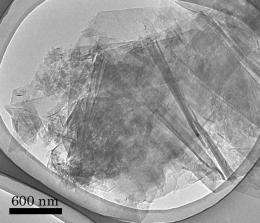
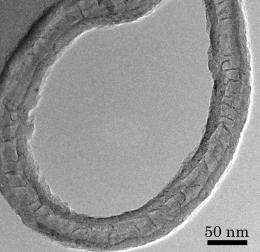
Nanotubes can grow on graphite (top) in an unruly mass (middle) according to "space's recipe." The overlapping segments on a single nanotube (bottom) are a telltale sign of the cup-stacked structure. (Image on bottom reproduced from Astrophysical Journal Letters.) Image credit: Yuki Kimura, Tohoku University

(PhysOrg.com) -- Space apparently has its own recipe for making carbon nanotubes, one of the most intriguing contributions of nanotechnology here on Earth, and metals are conspicuously missing from the list of ingredients.

The finding is the surprising by-product of lab experiments designed by Joseph Nuth at NASA’s Goddard Space Flight Center, Greenbelt, Md. and his colleagues to address the astronomical question of how carbon gets recycled in the regions of space that spawn stars and planets. The work also could help researchers understand puzzling observations about some supernovas.

In a recent paper in , Nuth’s team describes the modest chemical reaction. Unlike current methods for producing carbon nanotubes—tiny yet strong structures with a range of applications in electronics and, ultimately, perhaps even medicine—the new approach does not need the aid of a metal catalyst. "Instead, nanotubes were produced when graphite dust particles were exposed to a mixture of carbon monoxide and gases," explains Nuth.

"I am amazed at the implications of this paper, not only for astrophysics but also for materials science," says Dick Zare, the chair of the chemistry department at Stanford University, Stanford, Calif. "Could Nature know a new chemistry for making carbon nanotubes that we have yet to discover?"

One indication of that possibility came in 2008, when the long, thin carbon structures known as graphite whiskers—essentially, bigger cousins of carbon nanotubes—were identified in three meteorites. That finding offered the tantalizing prospect that a haze of graphite whiskers in space could explain why some supernovas appear dimmer, and therefore farther away, than they should be, according to current models. Yet, "very little is known about graphite whisker formation, and so it is difficult to adequately interpret their discovery," says Marc Fries of NASA’s Jet Propulsion Laboratory, Pasadena, Calif.
A Stellar, Metal-Free Way to Make Carbon Nanotubes
Enlarge


Fries and Andrew Steele at the Carnegie Institution for Science, Washington, reported the findings.

Now, the experiments by Nuth’s team suggest a possible route for forming such structures. This "is exactly the sort of fundamental approach needed for a meaningful understanding of what graphite whiskers are and what their presence means in the larger context of solar system formation and astronomical observations," Fries explains.

Nuth’s approach is a variation of a well-established way to produce gasoline or other liquid fuels from coal. It’s known as Fischer-Tropsch synthesis, and researchers suspect that it could have produced at least some of the simple carbon-based compounds in the early solar system. Nuth proposes that the nanotubes yielded by such reactions could be the key to the recycling of the carbon that gets released when carbon-rich grains are destroyed by explosions.

The structure of the carbon nanotubes produced in these experiments was determined by Yuki Kimura, a materials scientist at Tohoku University, Japan, who examined the samples under a powerful transmission electron microscope. He saw particles on which the original smooth graphite gradually morphed into an unstructured region and finally to an area rich in tangled hair-like masses. A closer look with an even more powerful microscope showed that these tendrils were in fact cup-stacked carbon nanotubes, which resemble a stack of Styrofoam cups with the bottoms cut out.

These observations surprised Kimura because carbon nanotubes are typically grown with platinum or another metal as a catalyst, yet Nuth’s reaction had used no metals. Kimura checked for contamination but "did not find the presence of metallic particles accompanying the nanotube in the sample," he says.

If further testing indicates that the new method is suitable for materials-science applications, it could supplement, or even replace, the familiar way of making nanotubes, explains Kimura. That possibility "is most exciting and invites yet more study," says Zare.

The findings also might open a new realm of investigation in astronomy, because "we can take the whiskers produced by Joe and interrogate their properties," says Steele.

In particular, researchers can evaluate whether graphite whiskers absorb light, he notes. A positive result would lend credence to the proposition that the presence of these molecules in space affects the observations of some supernovas. The ability to test this hypothesis could start a reaction of its own.

Provided by NASA's Goddard Space Flight Center (news : web)

4.8 /5 (12 votes)  

Filter


Move the slider to adjust rank threshold, so that you can hide some of the comments.


Display comments: newest first

gna
Feb 23, 2010

Rank: 5 / 5 (1)
Nice finding, but there is quite substantial literature on carbon nanotube formation from amorphous carbon without a metal catalyst. The work of Botti (circa 2001) is a good starting point
Rank 4.8 /5 (12 votes)
Related Stories
Relevant PhysicsForums posts
  • Corrosion Tests on Magnesium
    created11 hours ago
  • polyethylene copper nanocomposite
    created16 hours ago
  • Output of xrd analysis
    createdFeb 08, 2012
  • Transport phenomena problem based on problems 18.B11 and 19B.6 from Bird, stewart, lw
    createdFeb 06, 2012
  • Help with material selection - Car Piston
    createdFeb 05, 2012
  • Name of the steel alloy?!!?
    createdFeb 02, 2012
  • More from Physics Forums - Materials & Chemical Engineering

More news stories

'Dark plasmons' transmit energy

Microscopic channels of gold nanoparticles have the ability to transmit electromagnetic energy that starts as light and propagates via "dark plasmons," according to researchers at Rice University.

Nanotechnology / Nanophysics

created 6 hours ago | popularity 5 / 5 (4) | comments 0 | with audio podcast

Nanotube therapy takes aim at breast cancer stem cells

Wake Forest Baptist Medical Center researchers have again proven that injecting multiwalled carbon nanotubes (MWCNTs) into tumors and heating them with a quick, 30-second laser treatment can kill them.

Nanotechnology / Bio & Medicine

created 11 hours ago | popularity 5 / 5 (1) | comments 0 | with audio podcast

Inspired by steel, nanomanufacturing gets wear-resistant carbide tip

(PhysOrg.com) -- Scientists at the University of Pennsylvania, the University of Wisconsin-Madison and IBM Research - Zurich have fabricated an ultrasharp silicon carbide tip possessing such high strength ...

Nanotechnology / Nanophysics

created 16 hours ago | popularity 5 / 5 (3) | comments 1 | with audio podcast

New technology platform for molecule-based electronics

Researchers at the Nano-Science Center at the University of Copenhagen have developed a new nano-technology platform for the development of molecule-based electronic components using the wonder material graphene. At the same ...

Nanotechnology / Nanomaterials

created 13 hours ago | popularity 5 / 5 (2) | comments 0

Australians risking skin cancer to avoid nanoparticles

More than three in five Australians are concerned enough about the health implications of nanoparticles in sunscreens to want to know more about their impact. And while the initial scientific information released suggests ...

Nanotechnology / Bio & Medicine

created 15 hours ago | popularity 5 / 5 (1) | comments 0


Hydrogen from acidic water: Researchers develop potential low cost alternative to platinum for splitting water

A technique for creating a new molecule that structurally and chemically replicates the active part of the widely used industrial catalyst molybdenite has been developed by researchers with the Lawrence Berkeley ...

FDA-approved drug rapidly clears amyloid from the brain, reverses Alzheimer's symptoms in mice

Neuroscientists at Case Western Reserve University School of Medicine have made a dramatic breakthrough in their efforts to find a cure for Alzheimer's disease. The researchers' findings, published in the journal Science, show t ...

Ultraviolet protection molecule in plants yields its secrets

Lying around in the sun all day is hazardous not just for humans but also for plants, which have no means of escape. Ultraviolet (UV) radiation from the sun can damage proteins and DNA inside cells, leading ...

Anyone can learn to be more inventive, cognitive researcher says

There will always be a wild and unpredictable quality to creativity and invention, says Anthony McCaffrey, a cognitive psychology researcher at the University of Massachusetts Amherst, because an "Aha moment" is rare and ...

New method makes culture of complex tissue possible in any lab

Scientists at the University of California, San Diego have developed a new method for making scaffolds for culturing tissue in three-dimensional arrangements that mimic those in the body. This advance, published online in ...

Cell biologists describes mechanism by which some people may be more susceptible to colon cancer

An international research team led by cell biologists at the University of California, Riverside has uncovered a new insight into colon cancer, the third leading cause of cancer-related deaths in the United ...