Sound maps reveal whales and noise pollution
February 23, 2010 By Krishna Ramanujan
Sound maps reveal whales and noise pollution

Enlarge

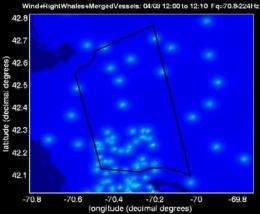
This animation frame shows in color the loudness of calling right whales off the Cape Cod-Boston area with no ships in the area. The blue signifies a quiet ocean. Image: Dimitri Ponirakis

(PhysOrg.com) -- Chris Clark discussed his state-of-the-art acoustic animations and the difficulties facing whales Feb. 21 at the American Association for the Advancement of Science annual meeting in San Diego.

Land areas are not the only places getting busier: so too are the oceans, says a Cornell researcher who uses underwater recorders to create animated maps of the oceans' noise.

Increasingly, the oceans are being polluted by shipping , especially up and down the U.S. eastern and western seaboards. The cacophony interferes with the ability of whales and other to hear each other; they rely on quiet waters to communicate many miles apart.

"People have no idea the world in the ocean off the coast is so urbanized," said Christopher Clark, the I.P. Johnson Director of the Bioacoustics Research Program at the Cornell Lab of Ornithology, who discussed his state-of-the-art acoustic animations and the difficulties facing whales Feb. 21 at the American Association for the Advancement of Science (AAAS) annual meeting in San Diego.

His research not only documents ocean noise and its repercussions but also tracks such endangered species as the North Atlantic right whale.

Clark presented color animations that show time-elapsed maps of the sounds of passing whales and ships. Clark and colleagues placed arrays of recording devices spaced over the ocean floor for three months at a time. The devices were then retrieved, their terabytes of data analyzed at Cornell and transferred into a visual format.

Sound maps reveal whales and noise pollution
Enlarge

This animation frame shows the noise from a single commercial ship entering Boston harbor. The bright yellow-orange signifies a noisy ocean. The loudness (voices) of the calling whales are lost beneath the shipping noise. Image: Dimitri Ponirakis

"Now I can quantify how much [sound is generated] every time a ship comes through," Clark said. "It creates acoustic 'bleaching,' and you can measure how much acoustic space is lost by ships coming through. For example, every day right whales lose 80 to 85 percent of their opportunities to communicate as a result of ship traffic."

Sound travels very efficiently in water and gets trapped in a layer of water known as a deep sound channel about half a mile deep, depending on latitude, Clark said. He likened diving into this channel to a curtain rising so that suddenly you can hear clearer and louder. He hypothesizes that whales' voices and hearing have evolved to communicate with each other over very large distances.

"I can hear a blue whale that's singing off the Grand Banks of Canada while listening off Puerto Rico," Clark said.

Although blue whales use very low frequencies that can travel such great distances, higher-pitched humpback whale singers can be heard only over a few hundred miles, and North Atlantic right whales over only tens of miles.

But manmade sounds are now bleaching whales' underwater communication channels.

"Now we are listening to observe what the whales do as noise levels go up," Clark said.

Some 60 years ago when there was little traffic noise, whales could hear each other pretty much all the time, except when storms came through. Then they would stop chattering, only to resume when the storm passed.

But now, what do whales do amid the steady din? Using his acoustic techniques, Clark has found that as traffic noise increases or oil exploration vessels pound the sea floor, communication among breaks down, and sometimes the animals evacuate the area within hours to days.

Clark also discussed the use of listening buoys off the coast of Massachusetts that automatically detect and inform ship captains to slow down when a whale is in or near the shipping lanes.

Provided by Cornell University (news : web)


Rank 3 /5 (2 votes)
Related Stories
Relevant PhysicsForums posts
  • Pertubance in a model
    created3 hours ago
  • Cancer drugs and Alzheimer's, Oh my!
    created11 hours ago
  • Squishing cells
    created12 hours ago
  • Any books/articles for evolutionary stable strategy models in humans?
    created23 hours ago
  • Science behind the bore feeling?
    createdFeb 09, 2012
  • Homo Sapien vs. Chimpanzee - Divergence Timeline
    createdFeb 09, 2012
  • More from Physics Forums - Biology

More news stories

The power of estrogen -- male snakes attract other males

A new study has shown that boosting the estrogen levels of male garter snakes causes them to secrete the same pheromones that females use to attract suitors, and turned the males into just about the sexiest ...

Biology / Plants & Animals

created 1 hour ago | popularity not rated yet | comments 0 | with audio podcast

Experts reveal how plants don't get sunburn

(PhysOrg.com) -- Experts at the University of Glasgow have discovered how plants survive the harmful rays of the sun.

Biology / Cell & Microbiology

created 1 hour ago | popularity 5 / 5 (1) | comments 0 | with audio podcast

Miami battling invasion of giant African snails

No one knows how they got there. But an invasion of African giant snails has southern Florida in a panic over potential crop damage, disease and general yuckiness surrounding the slimy gastropods.

Biology / Ecology

created 5 hours ago | popularity not rated yet | comments 2

New drugs schedule makes horse racing a sure thing

What do Gai Waterhouse and Anthony Cummings have in common with Queen Elizabeth II?

Biology / Plants & Animals

created 1 hour ago | popularity not rated yet | comments 0

Ultraviolet protection molecule in plants yields its secrets

Lying around in the sun all day is hazardous not just for humans but also for plants, which have no means of escape. Ultraviolet (UV) radiation from the sun can damage proteins and DNA inside cells, leading ...

Biology / Plants & Animals

created 19 hours ago | popularity 5 / 5 (5) | comments 0 | with audio podcast


Fool's gold may prove an unlikely alternative to overexploited catalytic materials

Catalytic materials, which lower the energy barriers for chemical reactions, are used in everything from the commercial production of chemicals to catalytic converters in car engines. However, with current catalytic materials ...

Curry spice component may help slow prostate tumor growth

Curcumin, an active component of the Indian curry spice turmeric, may help slow down tumor growth in castration-resistant prostate cancer patients on androgen deprivation therapy (ADT), a study from researchers ...

What lies beneath: Mapping hidden nanostructures

The ability to diagnose and predict the properties of materials is vital, particularly in the expanding field of nanotechnology. Electron and atom-probe microscopy can categorize atoms in thin sheets of material, ...

Netflix light on flicks as viewers soak up TV shows

Like most fresh faces that arrive in Hollywood, Netflix wanted to be a movie star. But now it's learning what many in Tinseltown have known for decades: Movies are sexy, but the real money is in television.

To avoid early labor and delivery, weight and diet changes not the answer

One of the strongest known risk factors for spontaneous or unexpected preterm birth – any birth that occurs before the 37th week of pregnancy, most often without a known cause – is already having had one. For women ...

Arthritic knees, but not hips, have robust repair response

Researchers at Duke University Medical Center used new tools they developed to analyze knees and hips and discovered that osteoarthritic knee joints are in a constant state of repair, while hip joints are not.