Photons led astray: Investigating the random motion of quantum particles
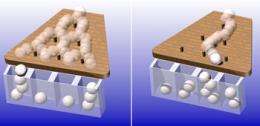
(PhysOrg.com) -- Life would sometimes be so much easier if we were quantum particles. For example, if we were trying to find our way out of a strange town allowing chance telling us which way to go at every intersection. As objects of classical physics, this would mean becoming more and more lost in the centre of the road network. If we were particles that obeyed the laws of quantum mechanics, we would sooner or later find our way to the edge of town on the randomly-chosen route.
An international team headed by researchers at the Max Planck Institute for the Science of Light has now proven this experimentally. They have used polarized light - light waves which oscillate in a particular plane - to design a simple model for a quantum physical random walk. Their experiments could provide new insights into statistical processes such as photosynthesis, and help to accelerate search algorithms. (Physical Review Letters, online publication, February 5, 2010)
An experiment with a Galton board - a board containing vertical pins arranged in a triangular pattern - can demonstrate what a human would experience when wandering through a town on a path determined by chance. When a ball rolls over the board and strikes a pin positioned at a corner of the triangle, its path through the labyrinth of pins is determined by chance until it arrives at the triangle’s base: At every step it takes through the labyrinth it is deflected by a pin to either the left or the right. Since it takes each of the two directions an equal number of times on average, it usually arrives in the centre of the base. Wandering through a labyrinth of streets, chance would similarly bring us to the centre of a town.
A particle with quantum properties would experience something different, as the researchers from the Max Planck Institute for the Science of Light in Erlangen and the Universities of Prague and Edinburgh have now proven. It would not have to decide on a direction at every pin, rather it would take the two possible paths at the same time, as this type of particle also possesses the properties of waves, and waves can do this. The particle’s physical state is therefore then characterized by the fact that it contains all possible positions, i.e. all paths overlap. If the quantum particle finally leaves the labyrinth at the triangle’s base, it is not unambiguously at one gap between two pins but at several - an interference pattern is formed. And its properties include the fact that its intensity at the edges increases in proportion to the number of pins the wave-like particle has passed.
"Light is particularly suitable for experimentally investigating this type of random motion of a quantum particle", says Christine Silberhorn, whose working group carried out the experiment. Silberhorn and her colleagues are working with individual photons to this effect. The light particles produce classic examples of hermaphrodites of particles and waves. The physicists send the individual photons through an experimental set-up that represents a Galton board in principle, yet operates in a completely different way in practice. In this case, it is not chance that decides on the direction which a photon takes at each step, but its polarization, meaning the direction in which its light wave oscillates, therefore determining the photon's subsequent direction of motion.
The photon oscillating either horizontally or vertically corresponds to the classical ball on a Galton board deciding which direction to take. The physicists are therefore much more interested in the case where the photon assumes an overlapping state comprising both oscillation directions. They create this state by using a polarizer to first generate a photon oscillating in a horizontal or vertical direction. This is then moved to the superimposed state by means of a half-wave plate. The half-wave plate acts, to a certain extent, like the pin of a classical Galton board, except that it does not force the photon to adopt a specific direction but ensures that it figuratively continues to move in both directions.
They then separate the photon in this hermaphroditic state into its two halves - one oscillating in a vertical and one in a horizontal direction - and guide them separately through two glass fibre cables. The two halves still form a single photon, however - something which is only possible in the quantum world. The half oscillating in the vertical direction now has to cover a much longer path before the physicists recombine the paths of the two photon halves. The split photon then moves in the form of two wave packets wandering one behind the other through a glass fibre - it has therefore then completed the first step on the Galton board. For the second step, the glass fibre guides the two photon halves back to the half-wave plate, which converts each half back into a hermaphrodite again. And the whole procedure begins anew.
The physicists allowed the photon to pass through the loop five times. They then found that one of the photons had fanned out into a chain of several wave packets which formed a superimposed state. The packets at the edge of the chain were much stronger. According to the laws of quantum physics, this means: When the researchers guide the fanned-out photon to a detector that only registers the photon as a particle, it measures it rather at the beginning or the end of the chain.
"Many of our colleagues did not believe that our experiment would be successful," says Katiuscia Cassemiro, who designed the experiment in collaboration with Christine Silberhorn. After all, superimposed states are very sensitive, even the smallest perturbations can cause it to collapse to a state with classical properties. "We managed to achieve the crucial step, which avoids this, by spreading the photon’s propagation time instead of that of its location, which is what happens on a Galton board," says Christine Silberhorn: This greatly simplified the experimental set-up, as a spatially separated photon would have to pass through a large number of optical instruments, all absolutely precisely matched to each other, which is almost impossible. The Erlangen-based physicists hope that they can also shield the photon in their experiment from any possible interference for more than five steps: "We want to expand the experiment to up to 20 steps by optimizing the individual components," says Katiuscia Cassemiro.
The experiments being conducted by the Erlangen physicists are not about board games in the quantum world, of course. They are primarily interested in the superposition state: whereas we humans have to put up with our classical existence, such quantum states do occur in biology, for example, in photosynthesis in plants: Only recently, researchers have established that molecules transport the energy of the sunlight they absorb through parts of the photosynthesis mechanism in the form of such a hermaphroditic state.
"We still do not know the precise effect that the quantum physical character of the transport has on the process", says Christine Silberhorn. "We can investigate such effects with our set-up because we can very accurately control the superposition state via the half-wave plate." The researchers can use the setting of this instrument to investigate the transition between quantum mechanical and classical behaviour, for example, which is also what happens with photosynthesis, in the final analysis.
In the distant future, the quantum mechanical random walk could also find practical application one day, as it is suitable, in principle, as a search function for a quantum computer. It would be possible to search a database or the Internet much more quickly with photons or electrons, which can move along many paths at the same time, than with classical particles, which have to cover all of the paths, one after the other. Theoretical physicists are still trying to work out the specifics of how this type of search algorithm could operate.
More information: Andreas Schreiber, Katiuscia Cassemiro, Vasek Potocek, Aurel Gabris, Peter Mosely, Erika Andersson, Igor Jex, and Christine Silberhorn, Photons Walking the Line: A Quantum Walk with Adjustable Coin Operations, Physical Review Letters, online publication, February 5, 2010; 10.1103/PhysRevLett.104.050502
Provided by Max-Planck-Gesellschaft


