The sound of melanoma can help doctors find cancer (w/ Video)
February 23, 2010
The sound of melanoma can help doctors find cancer

Enlarge

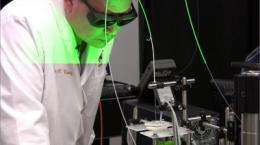
Viator uses the photoacoustic method, a tabletop device scans a lymph node biopsy with laser pulses. This method could help doctors identify the stage of melanoma with more accuracy. Credit: Photo by Pinar Istek

Knowing the stage of a patient's melanoma is important when choosing the best course of treatment. When the cancer has progressed to the lymph nodes, a more aggressive treatment is needed. Examining an entire lymph node for cancer takes much effort and time; a new technique might help make the process more efficient. University of Missouri researchers in the Christopher S. Bond Life Sciences Center are studying how photoacoustics, or a laser-induced ultrasound, could help scientists locate the general area of the lymph node where melanoma cells could be residing. This new technology could help doctors identify the stage of melanoma with more accuracy.

"This method can be used to determine if the cancer has spread from stage 2, where the is still just in the skin lesion, to stage 3, where the melanoma has spread to the ," said John Viator, assistant professor in the Department of Biological Engineering and Department of Dermatology . "If the cancer is still at stage 2, a simple procedure can remove that lesion. If the cancer has progressed from the initial skin lesion into the lymphatic region and possibly the , doctors have to make serious decisions about patient care. The cancer may have possibly spread to other organs, such as the liver, lungs or brain."

Currently, pathologists must perform several specific and detailed tests to determine if there is cancer in the lymph nodes. This new technology could make the search less time-consuming by identifying a general area of the lymph node that might contain cancer.

This video is not supported by your browser at this time.

John Viator, assistant professor in the Department of Biological Engineering and Department of Dermatology, describes how photoacoustics, or a laser-induced ultrasound, could help scientists locate the general area of the lymph node where melanoma cells could be residing. This new technology could help doctors identify the stage of melanoma with more accuracy. Video by Pinar Istek

"It's very similar to identifying a prize inside a cake," Viator said. "Instead of looking through the entire cake, we can use our ultrasound to pinpoint a slice or two that might contain the 'prize.' In the case of the lymph nodes, when you get a signal, this alerts the pathologist that this is an area of the node that might contain cancer cells. At that point, a pathologist would be able to narrow down the search, saving time and money."

In the photoacoustic method, a tabletop device scans a lymph node biopsy with laser pulses. About 95 percent of melanoma cells contain melanin, the pigment that gives skin its color, so they react to the laser's beam, absorbing the light. The laser causes the cells to heat and cool rapidly, which makes them expand and contract. This produces a popping noise that special sensors can detect. This method would examine the entire biopsy and identify the general area of the node that has cancer, giving pathologists a better idea of where to look for the cancer.

"This method is quicker and simpler and could be used to improve the efficiency of how doctors determine if the cancer has spread from the original skin lesion into the lymphatic system," Viator said. "This technology could be an important tool in our fight against cancer."

In the study, Viator took human cancer cells and placed them inside canine lymph nodes. Then, using the laser, he determined the best ways to locate the . The next step is to try the procedure using human lymph nodes.

The study, "Photoacoustic Detection of Melanoma Micrometastatis in Sentinel Lymph Nodes," was published in the Journal of Biomedical Engineering.

Provided by University of Missouri-Columbia (news : web)

4.4 /5 (5 votes)  

Rank 4.4 /5 (5 votes)
Relevant PhysicsForums posts
  • Is Everyday Technology Killing Us?
    createdFeb 08, 2012
  • Exercise and weight loss
    createdFeb 08, 2012
  • Why do we have head aches? Our brains can't feel anything.
    createdFeb 07, 2012
  • "The end of diseases" by David Agus, interview from Daily Show with Jon Stewart
    createdFeb 04, 2012
  • Oncolytic adenovirus
    createdFeb 04, 2012
  • Nutrition label stuffs and diets
    createdFeb 02, 2012
  • More from Physics Forums - Medical Sciences

More news stories

Complex wiring of the nervous system may rely on a just a handful of genes and proteins

Researchers at the Salk Institute have discovered a startling feature of early brain development that helps to explain how complex neuron wiring patterns are programmed using just a handful of critical genes. ...

Medicine & Health / Research

created 10 hours ago | popularity 4.9 / 5 (9) | comments 1 | with audio podcast

Team isolates nerve cells involved in storing long term memory and gene proteins associated with them

(Medical Xpress) -- A research team in Taiwan has succeeded in isolating two nerve cells in fruit fly brains that are believed to be the major players in allowing for the formation of long term memories. Furthermore, ...

Medicine & Health / Neuroscience

created 16 hours ago | popularity 5 / 5 (4) | comments 2 | with audio podcast report

Seeing colors in music, tasting flavors in shapes may happen in life's early months

Famed violinist Itzhak Perlman sees a deep forest green whenever he plays a B-flat on his Stradivarius' G string. The A on the E string is red.

Medicine & Health / Psychology & Psychiatry

created 17 hours ago | popularity 4.5 / 5 (2) | comments 2 | with audio podcast

Both maternal and paternal age linked to autism

Older maternal and paternal age are jointly associated with having a child with autism, according to a recently published study led by researchers at The University of Texas Health Science Center at Houston (UTHealth).

Medicine & Health / Psychology & Psychiatry

created 14 hours ago | popularity 4.3 / 5 (3) | comments 0 | with audio podcast

New understanding of DNA repair could eventually lead to cancer therapy

A research group in the Faculty of Medicine & Dentistry at the University of Alberta is hoping its latest discovery could one day be used to develop new therapies that target certain types of cancers.

Medicine & Health / Cancer

created 14 hours ago | popularity 4.8 / 5 (6) | comments 0 | with audio podcast


Anonymous knocks CIA website offline (Update)

The website of the Central Intelligence Agency was inaccessible on Friday after the hacker group Anonymous claimed to have knocked it offline.

Google users warned of threat to smartphone wallets

Users of Google smartphone wallets were being warned on Friday that there is a way to crack pass codes intended to thwart thieves from going on illicit shopping sprees.

New error-correcting codes guarantee the fastest possible rate of data transmission

Error-correcting codes are one of the triumphs of the digital age. They’re a way of encoding information so that it can be transmitted across a communication channel — such as an optical fiber o ...

Humans may have helped the decline of African rainforests 3000 years ago

(PhysOrg.com) -- Large areas of rainforests in Central Africa mysteriously disappeared over three thousand years ago, to be replaced by savannas. The prevailing theory has been that the cause was a change ...

New power source discovered

(PhysOrg.com) -- Researchers at the Massachusetts Institute of Technology (MIT) and RMIT University have made a breakthrough in energy storage and power generation.

Small modular reactor design could be a 'SUPERSTAR'

(PhysOrg.com) -- Though most of today's nuclear reactors are cooled by water, we've long known that there are alternatives; in fact, the world's first nuclear-powered electricity in 1951 came from a reactor ...