Study reveals ancient rocks linked to old Earth's crust
February 24, 2010
Study reveals ancient rocks linked to old Earth's crust

Enlarge

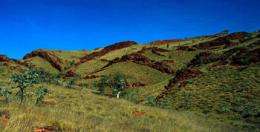
(PhysOrg.com) -- A new geological study which took place in the Pilbara region of Western Australia brings us one step closer to understanding more precisely the timing of when the primordial earth crust was formed and its composition.

The study, published online this week in the prestigious journal Nature Geoscience, was led by Research Associate, Dr Svetlana Tessalina, of the GEMOC ARC National Key Centre, Department of and Planetary Sciences at Macquarie University. The team also included Prof. Pascal Philippot from the Institut de Physique du Globe de Paris, and colleagues from the Geological Survey of Western Australia and Switzerland.

The earliest history of Earth remains obscure because the oldest preserved terrestrial rocks are 4.03 billion years old, leaving a window of almost 500 million years after Earth’s formation at 4.567 billion years with very little recorded history. Nowadays, however, advances in allow us to decipher the isotopic signals that keep the memory of older rocks.

Relics of little deformed and altered ancient rocks are present in some parts of the world, such as the Pilbara Craton in Australia. To go back in time and better understand the early history of our planet, Tessalina and her colleagues looked at the North Pole Dome site of the Pilbara Craton which contains some of the oldest terrestrial rocks and fossils. The remnants found there provided the vital clues indicating some geochemical fingerprints of ancient lithosphere.

Tessalina and her colleagues collected samples including volcanic, sedimentary and hydrothermal rocks from the area - both drilled and from outcrops. The rocks and sediments were then analysed for their . The results showed that the analysed rocks are 3.49 billion years old as was previously thought. However, they were contaminated by much older crustal component during their formation. Geochemical modelling shows the crustal component to be at least 4.3 billion years old.

Until now, the physical remnants of such an old crust have not been found on the Earth’s surface - except for rare zircon crystals which are preserved in another area of Western Australia called the Yilgarn Craton. These crystals have revealed a surprising amount about early Earth conditions, but only tell one side of the crustal evolutionary story - that of granitic crust. The results show that there was another side to the early Earth story - a mafic crustal component.

Based on their findings, Tessalina and her colleagues believe that the evolution of the Pilbara and possibly other Archean cratons began much earlier than recorded by their physical rocks record alone would indicate.

Dr Tessalina said the findings provide further evidence that the crust on Earth started to form between 4.3 and 4.5 billion years ago. This crust may represent a part of the early “skin” covering what is widely considered to have been a magma-ocean . The preservation of geochemical relics of this ancient period of Earth history may help unravel part of the early history of our planet.

Provided by Macquarie University

4.9 /5 (8 votes)  

Filter


Move the slider to adjust rank threshold, so that you can hide some of the comments.


Display comments: newest first

gopher65
Feb 24, 2010

Rank: 3 / 5 (2)
4567 - 4003 > 500. It's not "almost 500 million years", it's MORE than 500 million years. Eeeesh.
SincerelyTwo
Feb 24, 2010

Rank: 5 / 5 (1)
gopher,

"almost 500 million years *AFTER* Earth's formation at 4.567 billion years"

We don't like illiterates around these parts. Do yourself some learns.

500m years AFTER 4.5B is 5.0B years ago.

(*Note to PhysOrg; You guys have the worst web developers on the freaking planet, just FYI.)
SincerelyTwo
Feb 24, 2010

Rank: not rated yet
lol, jeez, in attempting to correct gopher I made an error myself. They gave the 500m range from 4.0B to 4.5B, the 500m was after 4.0B, as stated when you actually read the article. Lulz.
Royale
Feb 24, 2010

Rank: not rated yet
Actually gopher is almost right. 4567-4030>500. They said the earth was 4.567 billion years old and the newest rocks found are 4.03 billion years old. That does leave MORE than 500 million years *AFTER* earths formation.
Loodt
Feb 24, 2010

Rank: 1 / 5 (1)
The newest rocks are 4.03 billion years AND one month old!
SincerelyTwo
Feb 24, 2010

Rank: not rated yet
Never mind, I see, my mistake~

I'm guessing they weren't very confident in the numbers, haha.
Rank 4.9 /5 (8 votes)
Related Stories
Relevant PhysicsForums posts
  • Discrepancy between oxygen and carbon-dioxide levels
    createdFeb 09, 2012
  • where gems are found in the world
    createdFeb 09, 2012
  • Wind Waves in Reservoir ~ Wind run-up and Wind set-up
    createdFeb 08, 2012
  • Balance of oxygen in the atmosphere
    createdFeb 01, 2012
  • The case for a methanol-based economy
    createdJan 30, 2012
  • Weather in a rotating cylinder
    createdJan 25, 2012
  • More from Physics Forums - Earth

More news stories

Humans may have helped the decline of African rainforests 3000 years ago

(PhysOrg.com) -- Large areas of rainforests in Central Africa mysteriously disappeared over three thousand years ago, to be replaced by savannas. The prevailing theory has been that the cause was a change ...

Space & Earth / Environment

created 19 hours ago | popularity 4.3 / 5 (11) | comments 12 | with audio podcast report

Could Venus be shifting gear?

(PhysOrg.com) -- ESA’s Venus Express spacecraft has discovered that our cloud-covered neighbour spins a little slower than previously measured. Peering through the dense atmosphere in the infrared, the ...

Space & Earth / Space Exploration

created 15 hours ago | popularity 5 / 5 (7) | comments 7 | with audio podcast

NASA budget will axe Mars deal with Europe: scientists

US President Barack Obama's budget proposal to be submitted next week for 2013 will cut NASA's budget by 20 percent and eliminate a major partnership with Europe on Mars exploration, scientists said Thursday.

Space & Earth / Space Exploration

created 18 hours ago | popularity 5 / 5 (2) | comments 18

Mars Science Laboratory computer issue resolved

(PhysOrg.com) -- Engineers have found the root cause of a computer reset that occurred two months ago on NASA's Mars Science Laboratory and have determined how to correct it.

Space & Earth / Space Exploration

created 16 hours ago | popularity 4.7 / 5 (6) | comments 3 | with audio podcast

Two new moons for Jupiter

Advances in technology have lead to the discovery of new planets outside of our Solar System, and now even new moons in our own backyard.

Space & Earth / Space Exploration

created 15 hours ago | popularity 4 / 5 (1) | comments 7


Google users warned of threat to smartphone wallets

Users of Google smartphone wallets were being warned on Friday that there is a way to crack pass codes intended to thwart thieves from going on illicit shopping sprees.

Anonymous knocks CIA website offline (Update)

The website of the Central Intelligence Agency was inaccessible on Friday after the hacker group Anonymous claimed to have knocked it offline.

New error-correcting codes guarantee the fastest possible rate of data transmission

Error-correcting codes are one of the triumphs of the digital age. They’re a way of encoding information so that it can be transmitted across a communication channel — such as an optical fiber o ...

New power source discovered

(PhysOrg.com) -- Researchers at the Massachusetts Institute of Technology (MIT) and RMIT University have made a breakthrough in energy storage and power generation.

Complex wiring of the nervous system may rely on a just a handful of genes and proteins

Researchers at the Salk Institute have discovered a startling feature of early brain development that helps to explain how complex neuron wiring patterns are programmed using just a handful of critical genes. ...

The power of estrogen -- male snakes attract other males

A new study has shown that boosting the estrogen levels of male garter snakes causes them to secrete the same pheromones that females use to attract suitors, and turned the males into just about the sexiest ...