Learning sustainability from the rainforest
February 24, 2010
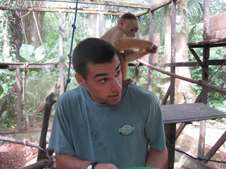
Biology major Zack Kennedy cared for monkeys in the Taricaya Ecological Reserve in Peru’s Amazonian rainforest.
(PhysOrg.com) -- Co-op in Peruvian ecological reserve teaches biology major some unforgettable lessons about caring for the environment at home.
If he wasn’t caring for endangered spider monkeys, junior biology major Zack Kennedy was securing turtle eggs against poachers during a co-op last fall in the Taricaya Ecological Reserve in Peru’s Amazonian rainforest.
The experiential learning opportunity, which also required him to grow his own food and live without electricity, sparked his interest in environmental sustainability. It showed him that the forest is one living organism — one in which each plant, animal and body of water is crucial to the health of the whole.
One of his projects involved rehabilitating spider monkeys that had been domesticated by owners who acquired them through the illegal pet-trading industry. The privately owned ecological reserve took possession of the monkeys from the local government, which had confiscated the animals from the owners. A few of the monkeys had rope burns on their bodies from being tied to trees; others were afraid to socialize with their primate friends.
He checked the animals for diseases, boosted their health by feeding them locally grown papaya, bananas, carrots and apples, and helped them become re-acclimated to their natural habitat.
The reserve plans to release half a dozen spider monkeys back into the local forest by late April. By the end of his co-op, said Kennedy, “they were a lot bigger, there were no more scars around their chests and they were playing and being social with the other monkeys.”
Kennedy also collected turtle eggs and incubated them on private beaches so poachers couldn’t get their hands on them. When they hatched, he marked them and released them into the wild. Over the years, the practice has paid off: an observational survey of the turtles in the spring of 2009 indicated that the turtles are thriving in the sweltering heat of the rainforest.
Kennedy lived a few hours outside of Puerto Maldonado, a city in Southeastern Peru, shacking up in a bungalow made of wood and mosquito netting. He pumped water from a nearby creek, ate homegrown pineapples, tomatoes and avocados, and raised mahogany trees, one of the most valuable — and endangered — tree species in the Amazon basin.
It didn’t take him long to get accustomed to the Amazonian lifestyle. “I felt at home within a few days,” he says. “We don’t necessarily need all the stuff that we have.”
The experience shaped his current outlook on the importance of sustainable living and inspired him to pursue a career in the field upon his graduation next year. “I bought a bicycle, I made furniture from old wood and I have plans to compost my own trash,” Kennedy says. “Little things like that add up.”
He credits Northeastern for connecting him with Projects Abroad, an organization that organizes overseas volunteer work. “I can’t thank Northeastern enough for giving me this opportunity,” he says. “I don’t know where else I would have been able to do this.”
-
Island monkeys do not recognize big cat calls
Jan 17, 2008 |
not rated yet |
0
-
Barbary monkeys going ape on Gibraltar
Apr 18, 2008 |
not rated yet |
0
-
Social imitation found in rhesus monkeys
Sep 05, 2006 |
not rated yet |
0
-
Madagascar's tortoises are crawling toward extinction, groups say
Feb 07, 2008 |
not rated yet |
0
-
Feeding behavior in monkeys and humans have ancient, shared roots
May 20, 2009 |
not rated yet |
0
-
Engineers build first sub-10-nm carbon nanotube transistor
Feb 01, 2012 |
4.9 / 5 (30) |
30
-
Something old, something new: Evolution and the structural divergence of duplicate genes
Jan 31, 2012 |
4.6 / 5 (7) |
1
-
The hidden nanoworld of ice crystals: Revealing the dynamic behavior of quasi-liquid layers
Jan 30, 2012 |
5 / 5 (3) |
1
-
Stock market network reveals investor clustering
Jan 27, 2012 |
3.9 / 5 (23) |
8
-
Of microchemistry and molecules: Electronic microfluidic device synthesizes biocompatible probes
Jan 26, 2012 |
5 / 5 (1) |
0
-
Pertubance in a model
6 hours ago
-
Cancer drugs and Alzheimer's, Oh my!
14 hours ago
-
Squishing cells
14 hours ago
-
Any books/articles for evolutionary stable strategy models in humans?
Feb 09, 2012
-
Science behind the bore feeling?
Feb 09, 2012
-
Homo Sapien vs. Chimpanzee - Divergence Timeline
Feb 09, 2012
- More from Physics Forums - Biology
More news stories
The power of estrogen -- male snakes attract other males
A new study has shown that boosting the estrogen levels of male garter snakes causes them to secrete the same pheromones that females use to attract suitors, and turned the males into just about the sexiest ...
4 hours ago |
not rated yet |
0
|
Grass to gas: Researchers' genome map speeds biofuel development
Researchers at the University of Georgia have taken a major step in the ongoing effort to find sources of cleaner, renewable energy by mapping the genomes of two originator cells of Miscanthus x giganteus, a large perenn ...
1 hour ago |
5 / 5 (2) |
0
|
Experts reveal how plants don't get sunburn
(PhysOrg.com) -- Experts at the University of Glasgow have discovered how plants survive the harmful rays of the sun.
4 hours ago |
5 / 5 (2) |
0
|
Protein libraries in a snap
(PhysOrg.com) -- A Rice University undergraduate will depart with not only a degree but also a possible patent for his invention of an efficient way to create protein libraries, an important component of biomolecular ...
7 hours ago |
5 / 5 (2) |
0
|
Miami battling invasion of giant African snails
No one knows how they got there. But an invasion of African giant snails has southern Florida in a panic over potential crop damage, disease and general yuckiness surrounding the slimy gastropods.
8 hours ago |
not rated yet |
2
Putting the squeeze on planets outside our solar system
(PhysOrg.com) -- Using high-powered lasers, scientists at Lawrence Livermore National Laboratory and collaborators discovered that molten magnesium silicate undergoes a phase change in the liquid state, abruptly ...
India probes Google over 'forex transactions'
Indian authorities are probing whether online giant Google broke domestic foreign-exchange transactions rules while shifting funds abroad, the Press Trust of India reported on Friday.
Germany freezes signing of disputed Internet pact
Germany on Friday halted the signing of a controversial international accord billed as a way to beat online piracy that has sparked angry protests, saying it needed more time to consider it.
Health experts, scientists to discuss bird flu studies
The World Health Organization said Friday it will meet next week to determine whether scientists can publish research on a bird flu virus that may be easily passed among humans.
Employers feel no love for unscrupulous practice of 'service sweethearting'
A new study led by two Florida State University marketing professors finds that some frontline service employees who are rewarded for hikes in customer loyalty and satisfaction also may engage in "service ...
Obama forges compromise birth control plan
US President Barack Obama Friday announced a compromise to defuse a row over access to birth control which prompted election-year Republican critics to claim he was waging a war on religion.
Feb 24, 2010
Rank: 1 / 5 (1)