'Pompeii-like' excavations tell us more about Toba super-eruption
February 24, 2010
'Pompeii-like' excavations tell us more about Toba super-eruption

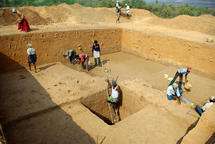
Mapping of stone tool artefacts on a Middle Palaeolithic occupation surface under the Toba ash.

(PhysOrg.com) -- Newly discovered archaeological sites in southern and northern India have revealed how people lived before and after the colossal Toba volcanic eruption 74,000 years ago.

The international, multidisciplinary research team, led by Oxford University in collaboration with Indian institutions, unveiled to a conference in Oxford what it calls ‘Pompeii-like excavations’ beneath the Toba ash.

The seven-year project examines the environment that humans lived in, their , as well as the plants and animal bones of the time. The team has concluded that many forms of life survived the super-eruption, contrary to other research which has suggested significant animal extinctions and genetic bottlenecks.

According to the team, a potentially ground-breaking implication of the new work is that the species responsible for making the stone tools in India was Homo sapiens. Stone tool analysis has revealed that the artefacts consist of cores and flakes, which are classified in India as Middle Palaeolithic and are similar to those made by modern humans in Africa. ‘Though we are still searching for human fossils to definitively prove the case, we are encouraged by the technological similarities. This suggests that human populations were present in India prior to 74,000 years ago, or about 15,000 years earlier than expected based on some genetic clocks,’ said project director Dr Michael Petraglia, Senior Research Fellow in the School of Archaeology at the University of Oxford.

An area of widespread speculation about the Toba super-eruption is that it nearly drove humanity to extinction. The fact that the Middle Palaeolithic tools of similar styles are found right before and after the Toba super-eruption, suggests that the people who survived the eruption were the same populations, using the same kinds of tools, says Dr Petraglia. The research agrees with evidence that other , such as the in Europe and the small brained Hobbits in Southeastern Asia, continued to survive well after Toba.

Although some scholars have speculated that the Toba volcano led to severe and wholesale environmental destruction, the Oxford-led research in India suggests that a mosaic of ecological settings was present, and some areas experienced a relatively rapid recovery after the volcanic event.

The team has not discovered much bone in Toba ash sites, but in the Billasurgam cave complex in Kurnool, Andhra Pradesh, the researchers have found deposits which they believe range from at least 100,000 years ago to the present. They contain a wealth of animal bones such as wild cattle, carnivores and monkeys. They have also identified plant materials in the Toba ash sites and caves, yielding important information about the impact of the Toba super-eruption on the ecological settings.

Dr Petraglia said: ‘This exciting new information questions the idea that the Toba super-eruption caused a worldwide environmental catastrophe. That is not to say that there were no ecological effects. We do have evidence that the ash temporarily disrupted vegetative communities and it certainly choked and polluted some fresh water sources, probably causing harm to wildlife and maybe even humans.’

Provided by Oxford University (news : web)

4.7 /5 (9 votes)  

Rank 4.7 /5 (9 votes)
Related Stories
Relevant PhysicsForums posts

More news stories

Prague gets hold of modern genetics founder Mendel's papers

Germany has handed to the Czech Republic a manuscript of Johann Gregor Mendel, founder of modern genetics, on his plant hybridization experiments, the Czech foreign minister said Thursday.

Other Sciences / Other

created 4 hours ago | popularity not rated yet | comments 1

US workers are 'giving away the store,' costing firms billions

Nearly 70 percent of the nation's service employees give away free goods and services – from hamburgers to cable TV – costing companies billions of dollars a year, according to a groundbreaking study.

Other Sciences / Economics & Business

created 7 hours ago | popularity not rated yet | comments 6

Storm warning: Financial tsunami heading this way

In today's global village, national coffers are more interconnected than ever before. And as the current economic crisis has proven, a downturn in one country can travel in a wave across the globe, like a financial tsunami. ...

Other Sciences / Economics & Business

created 8 hours ago | popularity 1 / 5 (1) | comments 5

'Flipped classroom' teaching model gains an online community

Researchers at Harvard University have launched the Peer Instruction (PI) Network, a new global social network for users of interactive teaching methods.

Other Sciences / Social Sciences

created 8 hours ago | popularity 5 / 5 (2) | comments 0

Kids show cultural gender bias

(PhysOrg.com) -- Talk about gender confusion! A recent study by University of Alberta researchers Elena Nicoladis and Cassandra Foursha-Stevenson in the Journal of Cross-Cultural Psychology into whether speaki ...

Other Sciences / Social Sciences

created 13 hours ago | popularity 2 / 5 (1) | comments 2


'Dark plasmons' transmit energy

Microscopic channels of gold nanoparticles have the ability to transmit electromagnetic energy that starts as light and propagates via "dark plasmons," according to researchers at Rice University.

Ultraviolet protection molecule in plants yields its secrets

Lying around in the sun all day is hazardous not just for humans but also for plants, which have no means of escape. Ultraviolet (UV) radiation from the sun can damage proteins and DNA inside cells, leading ...

Hydrogen from acidic water: Researchers develop potential low cost alternative to platinum for splitting water

A technique for creating a new molecule that structurally and chemically replicates the active part of the widely used industrial catalyst molybdenite has been developed by researchers with the Lawrence Berkeley ...

FDA-approved drug rapidly clears amyloid from the brain, reverses Alzheimer's symptoms in mice

Neuroscientists at Case Western Reserve University School of Medicine have made a dramatic breakthrough in their efforts to find a cure for Alzheimer's disease. The researchers' findings, published in the journal Science, show t ...

Anyone can learn to be more inventive, cognitive researcher says

There will always be a wild and unpredictable quality to creativity and invention, says Anthony McCaffrey, a cognitive psychology researcher at the University of Massachusetts Amherst, because an "Aha moment" is rare and ...

New method makes culture of complex tissue possible in any lab

Scientists at the University of California, San Diego have developed a new method for making scaffolds for culturing tissue in three-dimensional arrangements that mimic those in the body. This advance, published online in ...