Scientists find first physiological evidence of brain's response to inequality
February 24, 2010
Scientists find first physiological evidence of brain's response to inequality

Enlarge

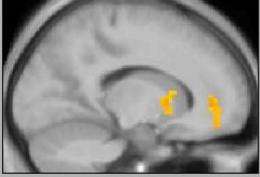
This saggital view of the brain shows activity in both the ventromedial prefrontal cortex and the ventral striatum. Credit: Elizabeth Tricomi, Rutgers University

The human brain is a big believer in equality -- and a team of scientists from the California Institute of Technology and Trinity College in Dublin, Ireland, has become the first to gather the images to prove it.

Specifically, the team found that the reward centers in the human respond more strongly when a poor person receives a than when a rich person does. The surprising thing? This activity pattern holds true even if the brain being looked at is in the rich person's head, rather than the poor person's.

These conclusions, and the (fMRI) studies that led to them, are described in the February 25 issue of the journal Nature.

"This is the latest picture in our gallery of human nature," says Colin Camerer, the Robert Kirby Professor of Behavioral Economics at Caltech and one of the paper's coauthors. "It's an exciting area of research; we now have so many tools with which to study how the brain is reacting."

It's long been known that we humans don't like inequality, especially when it comes to . Tell two people working the same job that their salaries are different, and there's going to be trouble, notes John O'Doherty, professor of psychology at Caltech, Thomas N. Mitchell Professor of at the Trinity College Institute of Neuroscience, and the principal investigator on the Nature paper.

But what was unknown was just how hardwired that dislike really is. "In this study, we're starting to get an idea of where this inequality aversion comes from," he says. "It's not just the application of a social rule or convention; there's really something about the basic processing of rewards in the brain that reflects these considerations."

The "rewards"—things like food, money, and even pleasant music, which create positive responses in the body—in areas such as the (VMPFC) and ventral striatum.

In a series of experiments, former Caltech postdoctoral scholar Elizabeth Tricomi (now an assistant professor of psychology at Rutgers University)—along with O'Doherty, Camerer, and Antonio Rangel, associate professor of economics at Caltech—watched how the VMPFC and ventral striatum reacted in 40 volunteers who were presented with a series of potential money-transfer scenarios while lying in an fMRI machine.

For instance, a participant might be told that he could be given $50 while another person could be given $20; in a second scenario, the student might have a potential gain of only $5 and the other person, $50. The fMRI images allowed the researchers to see how each volunteer's brain responded to each proposed money allocation.

But there was a twist. Before the imaging began, each participant in a pair was randomly assigned to one of two conditions: One participant was given what the researchers called "a large monetary endowment" ($50) at the beginning of the experiment; the other participant started from scratch, with no money in his or her pocket.

As it turned out, the way the volunteers—or, to be more precise, the reward centers in the volunteers' brains—reacted to the various scenarios depended strongly upon whether they started the experiment with a financial advantage over their peers.

"People who started out poor had a stronger brain reaction to things that gave them money, and essentially no reaction to money going to another person," Camerer says. "By itself, that wasn't too surprising."

What was surprising was the other side of the coin. "In the experiment, people who started out rich had a stronger reaction to other people getting money than to themselves getting money," Camerer explains. "In other words, their brains liked it when others got money more than they liked it when they themselves got money."

"We now know that these areas are not just self-interested," adds O'Doherty. "They don't exclusively respond to the rewards that one gets as an individual, but also respond to the prospect of other individuals obtaining a reward."

What was especially interesting about the finding, he says, is that the brain responds "very differently to rewards obtained by others under conditions of disadvantageous inequality versus advantageous inequality. It shows that the basic reward structures in the human brain are sensitive to even subtle differences in social context."

This, O'Doherty notes, is somewhat contrary to the prevailing views about human nature. "As a psychologist and cognitive neuroscientist who works on reward and motivation, I very much view the brain as a device designed to maximize one's own self interest," says O'Doherty. "The fact that these basic brain structures appear to be so readily modulated in response to rewards obtained by others highlights the idea that even the basic reward structures in the human brain are not purely self-oriented."

Camerer, too, found the results thought provoking. "We economists have a widespread view that most people are basically self-interested, and won't try to help other people," he says. "But if that were true, you wouldn't see these sort of reactions to other people getting money."

Still, he says, it's likely that the reactions of the "rich" participants were at least partly motivated by self-interest—or a reduction of their own discomfort. "We think that, for the people who start out rich, seeing another person get money reduces their guilt over having more than the others."

Having watched the brain react to inequality, O'Doherty says, the next step is to "try to understand how these changes in valuation actually translate into changes in behavior. For example, the person who finds out they're being paid less than someone else for doing the same job might end up working less hard and being less motivated as a consequence. It will be interesting to try to understand the brain mechanisms that underlie such changes."

More information: The research has been described in the Nature paper "Neural evidence for inequality-averse social preferences."

Provided by California Institute of Technology (news : web)

4.5 /5 (4 votes)  

Filter


Move the slider to adjust rank threshold, so that you can hide some of the comments.


Display comments: newest first

kasen
Feb 24, 2010

Rank: not rated yet
seeing another person get money reduces their guilt over having more than the others


This begs the question, did morality(religion, etc.) grow out of basic eusociality instincts, or the other way around? Would be useful to have a 10.000 year old active human brain to analyse.

I also wonder if this penchant for balance affects higher cognitive activities. We do have lots of conservation laws.
cakmn
Feb 24, 2010

Rank: not rated yet
If the brains of the "rich" liked it when the "poor" were rewarded, why is it that the "rich" aren't more inclined to help the "poor" by redistributing wealth in order to even out the status of all? It seems that fear of not having enough sufficiently outweighs the desire for all to have enough that those who have way more than enough still try to get more while leaving more with far less than enough.

This, of course, has vast implications regarding all who are homeless, starving, lacking health care, etc.
PinkElephant
Feb 24, 2010

Rank: not rated yet
@kasen,
This begs the question, did morality(religion, etc.) grow out of basic eusociality instincts, or the other way around? Would be useful to have a 10.000 year old active human brain to analyse.
I'll vote for the former, particularly given the wild diversity and long-term instability of religions across the world and through time. And I'll expect that the same dynamics ought to be observed in higher ape (e.g. chimp, bonobo, and gorilla) brains: so no need for old human brains to analyze.
NeilFarbstein
Feb 24, 2010

Rank: not rated yet
If the brains of the "rich" liked it when the "poor" were rewarded, why is it that the "rich" aren't more inclined to help the "poor" by redistributing wealth in order to even out the status of all? It seems that fear of not having enough sufficiently outweighs the desire for all to have enough that those who have way more than enough still try to get more while leaving more with far less than enough.

This, of course, has vast implications regarding all who are homeless, starving, lacking health care, etc.

Charity has existed as long as the human race even if it has been very faulty in character or if money and goods are distributed less that perfectly. Most relgions glorify charitable acts to one extent or another. Identifying with the poor of spirit and giving to the poor are a big part of christianty and before that Jews were required by their
religion to feed the poor with lefover food on the ground after their fields were harvested. (gleaning)
Birger
Feb 25, 2010

Rank: 4 / 5 (1)
Charity has existed and exists in a less formal shape: In tribal societies, there was often great status in generosity, so affluent individuals could "trade" goods for social status -as indeed they can today! Thus, being helpful and generous is not a waste of resources, especially not if you live at a place and in a time when cooperation often is a matter of life and death. High-status individuals will be more likely to survive a crisis.

And the recipients of generosity in a small group are often related to the giver, so the genes are merely redistributing resources from one "survival machine" to another.
Tachyon8491
Feb 25, 2010

Rank: 5 / 5 (1)
Although altruism thus appears to be neurologically hardwired, there seem to be higher cognitive-emotional processes that modulate this where the spectrum of response is very wide, ranging between poles of extreme altruism to extreme egoism. It would be interesting to repeat this series of experiments with a second phase where the subject is made to face a situation of clearly perceived need on the part of another individual or group - then to study activated neurological domains concomitant with a verbalised response describing the elicited motivation.
trucksmart
Feb 26, 2010

Rank: not rated yet
I wonder if these revelations would be the same if fMRI images could be monitored while the charitable act was being acted out.I also wonder if the images show the reactions of the euphoria of the reward for having the feeling of charity, rather than during the act of charity.
Rank 4.5 /5 (4 votes)
Related Stories
Relevant PhysicsForums posts
  • Is Everyday Technology Killing Us?
    createdFeb 08, 2012
  • Exercise and weight loss
    createdFeb 08, 2012
  • Why do we have head aches? Our brains can't feel anything.
    createdFeb 07, 2012
  • "The end of diseases" by David Agus, interview from Daily Show with Jon Stewart
    createdFeb 04, 2012
  • Oncolytic adenovirus
    createdFeb 04, 2012
  • Nutrition label stuffs and diets
    createdFeb 02, 2012
  • More from Physics Forums - Medical Sciences

More news stories

Complex wiring of the nervous system may rely on a just a handful of genes and proteins

Researchers at the Salk Institute have discovered a startling feature of early brain development that helps to explain how complex neuron wiring patterns are programmed using just a handful of critical genes. ...

Medicine & Health / Research

created 13 hours ago | popularity 4.9 / 5 (9) | comments 1 | with audio podcast

Team isolates nerve cells involved in storing long term memory and gene proteins associated with them

(Medical Xpress) -- A research team in Taiwan has succeeded in isolating two nerve cells in fruit fly brains that are believed to be the major players in allowing for the formation of long term memories. Furthermore, ...

Medicine & Health / Neuroscience

created 19 hours ago | popularity 5 / 5 (4) | comments 2 | with audio podcast report

Seeing colors in music, tasting flavors in shapes may happen in life's early months

Famed violinist Itzhak Perlman sees a deep forest green whenever he plays a B-flat on his Stradivarius' G string. The A on the E string is red.

Medicine & Health / Psychology & Psychiatry

created 20 hours ago | popularity 4.5 / 5 (2) | comments 2 | with audio podcast

Both maternal and paternal age linked to autism

Older maternal and paternal age are jointly associated with having a child with autism, according to a recently published study led by researchers at The University of Texas Health Science Center at Houston (UTHealth).

Medicine & Health / Psychology & Psychiatry

created 17 hours ago | popularity 4.3 / 5 (3) | comments 0 | with audio podcast

New understanding of DNA repair could eventually lead to cancer therapy

A research group in the Faculty of Medicine & Dentistry at the University of Alberta is hoping its latest discovery could one day be used to develop new therapies that target certain types of cancers.

Medicine & Health / Cancer

created 16 hours ago | popularity 4.8 / 5 (6) | comments 0 | with audio podcast


Anonymous knocks CIA website offline (Update)

The website of the Central Intelligence Agency was inaccessible on Friday after the hacker group Anonymous claimed to have knocked it offline.

New error-correcting codes guarantee the fastest possible rate of data transmission

Error-correcting codes are one of the triumphs of the digital age. They’re a way of encoding information so that it can be transmitted across a communication channel — such as an optical fiber o ...

Humans may have helped the decline of African rainforests 3000 years ago

(PhysOrg.com) -- Large areas of rainforests in Central Africa mysteriously disappeared over three thousand years ago, to be replaced by savannas. The prevailing theory has been that the cause was a change ...

New power source discovered

(PhysOrg.com) -- Researchers at the Massachusetts Institute of Technology (MIT) and RMIT University have made a breakthrough in energy storage and power generation.

Small modular reactor design could be a 'SUPERSTAR'

(PhysOrg.com) -- Though most of today's nuclear reactors are cooled by water, we've long known that there are alternatives; in fact, the world's first nuclear-powered electricity in 1951 came from a reactor ...

The power of estrogen -- male snakes attract other males

A new study has shown that boosting the estrogen levels of male garter snakes causes them to secrete the same pheromones that females use to attract suitors, and turned the males into just about the sexiest ...