Massive planet is being torn apart by its own tides
February 24, 2010 By James Cohen
Massive planet is being torn apart by its own tides

Enlarge

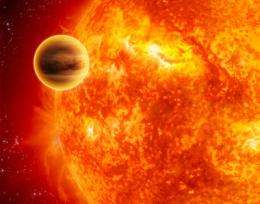
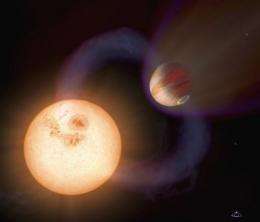
Illustration of WASP-12b in orbit about its host star (Credit: ESA/C Carreau)

(PhysOrg.com) -- An international group of astrophysicists has determined that a massive planet outside our Solar System is being distorted and destroyed by its host star--a finding that helps explain the unexpectedly large size of the planet, WASP-12b.

It's a discovery that not only explains what is happening to WASP-12b, it also means scientists have a one-of-a-kind opportunity to observe how a planet enters this final stage of its life.

"This is the first time that astronomers are witnessing the ongoing disruption and death march of a planet," said Douglas N.C. Lin, professor of astronomy and astrophysics at UC Santa Cruz. Lin is a coauthor of the new study and the founding director of the Kavli Institute for Astronomy and Astrophysics (KIAA) at Peking University, which was deeply involved with the research. The findings are being published in the February 25 issue of Nature.

The research was led by Shu-lin Li of the National Astronomical Observatories of China. A graduate of KIAA, Li and a team of researchers analyzed observational data on the planet to show how the gravity of its parent star is both inflating its size and spurring its rapid dissolution.

WASP-12b, discovered in 2008, is one of the most enigmatic of the 400-plus planets that have been found outside our Solar System over the past 15 years. It orbits a star in the constellation Auriga that is roughly similar in mass to our Sun. Like most known extrasolar planets, it is large and gaseous, resembling Jupiter and Saturn in this respect. But unlike Jupiter, Saturn, or most other extrasolar planets, it orbits its parent star at extremely close range--75 times closer than the Earth is to the Sun, or just over 1 million miles. It is also larger than astrophysical models would predict. Its mass is estimated to be almost 50 percent larger than Jupiter's and its volume is six times Jupiter's. It is also unusually hot, with a daytime temperature of more than 2500 degrees Celsius.

Some mechanism must be responsible for expanding this planet to such an unexpected size, say the researchers. They have focused their analysis on tidal forces, which they say are strong enough to produce the effects observed on WASP-12b.

On Earth, tidal forces between the Earth and the Moon cause local sea levels rise and fall modestly twice a day. WASP-12b, however, is so close to its host star that the gravitational forces are enormous. The tremendous tidal forces acting on the planet completely change its shape into something similar to that of a rugby or American football.

These tides not only distort the shape of WASP-12b. By continuously deforming the planet, they also create friction in its interior. The friction produces heat, which causes the planet to expand. "This is the first time that there is direct evidence that internal heating (or 'tidal heating') is responsible for puffing up the planet to its current size," said Lin.

Huge as it is, WASP-12b faces an early demise, Lin said. In fact, its size is part of its problem. It has ballooned to such a point that it cannot retain its mass against the pull of its parent star's gravity. As the study's lead author Li explained, "WASP-12b is losing its mass to the host star at a tremendous rate of six billion metric tons each second. At this rate, the planet will be completely destroyed by its host star in about ten million years. This may sound like a long time, but for astronomers it's nothing. This planet will live less than 500 times less than the current age of the Earth."

The material that is stripped off WASP-12b does not directly fall onto the parent star. Instead, it forms a disk around the star and slowly spirals inwards. A careful analysis of the orbital motion of WASP-12b suggests circumstantial evidence of the gravitational force of a second, lower-mass planet in the disk. This planet is most likely a massive version of the Earth--a so-called "super-Earth."

The disk of planetary material and the embedded super-Earth are detectable with currently available telescope facilities. Their properties can be used to further constrain the history and fate of the mysterious planet WASP-12b.

In addition to KIAA, support for the WASP-12b research came from NASA, Jet Propulsion Laboratory, and the National Science Foundation. Along with Li and Lin, co-authors include Jonathan Fortney, assistant professor of astronomy and astrophysics at UCSC, and UCSC graduate student Neil Miller.

Provided by UC Santa Cruz

4.4 /5 (19 votes)  

Filter


Move the slider to adjust rank threshold, so that you can hide some of the comments.


Display comments: newest first

Husky
Feb 24, 2010

Rank: 3.5 / 5 (2)
I wonder what it would look look if if you strip a gasgiants envelop and have this solid high pressured core, could you dig up stable metallic hydrogen or huge diamonds or other exotic extremely high pressure formed minerals?
CavemanDev
Feb 24, 2010

Rank: 4.5 / 5 (2)
If you strip the outer gas layers, the inner core would no longer be under pressure. You might be able to get diamond or other compounds that remain stable, but metallic hydrogen would be out.
Royale
Feb 24, 2010

Rank: 4 / 5 (1)
yea, i was gonna say. isnt hydrogen only able to show metallic properties under high pressures? It would be neat if otherwise, but i dont think it works that way husky.
yyz
Feb 24, 2010

Rank: not rated yet
How about this galaxy cannibalizing this galaxy (Minkowski's Object, in blue) in Abell 194 : http://www.rc-ast...157.html . Pretty damn awesome.
Caliban
Feb 24, 2010

Rank: 1.7 / 5 (3)
At that distance, you would think that the stellar wind would positively blow away the atmosphere of the planet- I'm surprised that its gravity is able to overcome the pressure of the wind. Maybe this happened to Mercury early on?
yyz
Feb 24, 2010

Rank: not rated yet
PSR1957+20 may be in a precarious situation wrt it's secondary 'object'.
Skeptic_Heretic
Feb 25, 2010

Rank: 5 / 5 (1)
At that distance, you would think that the stellar wind would positively blow away the atmosphere of the planet-

Or eat the planet, as the article suggests, based upon the mass of the star.
rkolter
Feb 25, 2010

Rank: not rated yet
Maybe this happened to Mercury early on?


You mean, maybe Mercury is the core of what was once a hot jupiter type planet?

I hadn't thought about it. I like it. You should be able to test based on the minerals found, I would think?
Graeme
Feb 25, 2010

Rank: not rated yet
As the planet loses mass and then volume, the effect of tides would be reduced considerably. This would be very likely to leave a much longer lasting core. And how come the artist's picture looks circular when the text describes a football shape in a disk?
Caliban
Feb 26, 2010

Rank: 1 / 5 (2)
@Graeme
Apparently, C. Carreau at ESA disn't have a file "artist's conception" illustration of a football- shaped planet at near-stellar orbit.
Or perhaps was unable to "conceive" of one before the submission deadline.
@rkolter
Now that you mention it- not sure how that would be determined, unless there was some relict chemical differences in crustal material between dayside and nightside, indicative of some former atmosphere. Would be nice to know, though.
in7x
Feb 26, 2010

Rank: not rated yet
How this story used to look:

http://img683.ima...star.jpg

I wonder what was wrong with the old graphic.
Rank 4.4 /5 (19 votes)
Related Stories
Relevant PhysicsForums posts
  • Titan's lack of impact craters
    createdFeb 09, 2012
  • Real pictures of black hole eating a star?
    createdFeb 08, 2012
  • Hypothetical way to travel faster than light, but not technically exceed lightspeed
    createdFeb 06, 2012
  • How do scientists monitor the Sun's activity?
    createdFeb 05, 2012
  • Search patterns in observational studies
    createdFeb 05, 2012
  • Derivation of Pogson's law
    createdFeb 03, 2012
  • More from Physics Forums - General Astronomy

More news stories

Could Venus be shifting gear?

(PhysOrg.com) -- ESA’s Venus Express spacecraft has discovered that our cloud-covered neighbour spins a little slower than previously measured. Peering through the dense atmosphere in the infrared, the ...

Space & Earth / Space Exploration

created 3 hours ago | popularity 5 / 5 (4) | comments 4 | with audio podcast

Humans may have helped the decline of African rainforests 3000 years ago

(PhysOrg.com) -- Large areas of rainforests in Central Africa mysteriously disappeared over three thousand years ago, to be replaced by savannas. The prevailing theory has been that the cause was a change ...

Space & Earth / Environment

created 7 hours ago | popularity 5 / 5 (3) | comments 8 | with audio podcast report

Clam fields found at deep, low-temperature Mariana vents

(PhysOrg.com) -- Scientists have marveled at the unusual life forms thriving at high temperature hydrothermal vents of the deep ocean.

Space & Earth / Earth Sciences

created 4 hours ago | popularity not rated yet | comments 0 | with audio podcast

Mars Science Laboratory computer issue resolved

(PhysOrg.com) -- Engineers have found the root cause of a computer reset that occurred two months ago on NASA's Mars Science Laboratory and have determined how to correct it.

Space & Earth / Space Exploration

created 4 hours ago | popularity 5 / 5 (5) | comments 2 | with audio podcast

Two new moons for Jupiter

Advances in technology have lead to the discovery of new planets outside of our Solar System, and now even new moons in our own backyard.

Space & Earth / Space Exploration

created 3 hours ago | popularity not rated yet | comments 2


New understanding of DNA repair could eventually lead to cancer therapy

A research group in the Faculty of Medicine & Dentistry at the University of Alberta is hoping its latest discovery could one day be used to develop new therapies that target certain types of cancers.

Hovering not hard if you're top-heavy, researchers find

Top-heavy structures are more likely to maintain their balance while hovering in the air than are those that bear a lower center of gravity, researchers at New York University's Courant Institute of Mathematical Sciences ...

Grass to gas: Researchers' genome map speeds biofuel development

Researchers at the University of Georgia have taken a major step in the ongoing effort to find sources of cleaner, renewable energy by mapping the genomes of two originator cells of Miscanthus x giganteus, a large perenn ...

Night, weekend delivery OK for babies with birth defects

Weekday delivery is no better than night or weekend delivery for infants with birth defects, according to a new study presented today at The Pregnancy Meeting, the Society for Maternal-Fetal Medicine's annual conference. ...

Sonic Cradle lands spot in TED exhibition

A Simon Fraser University graduate student project that melds music, meditation and modern technology has landed a rare spot as an exhibit at TEDActive 2012 in Palm Springs, California this month.

Drug halts organ damage in inflammatory genetic disorder

A new study shows that Kineret (anakinra), a medication approved for the treatment of rheumatoid arthritis, is effective in stopping the progression of organ damage in people with neonatal-onset multisystem inflammatory disease ...