Bloom Energy unveils fuel cell of the future (Update)
February 24, 2010
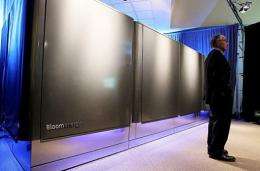
A man stands next to a Bloom Energy server called a "Bloom Box"

Enlarge

A man stands next to a Bloom Energy server called a "Bloom Box" during a product launch at the eBay headquarters in San Jose, California. Bloom Energy, a Silicon Valley start up, introduced the "Bloom Box", a solid oxide fuel cell server that can generate electricity at a cost of 8 to 10 cents per kilowatt hour using natural gas.

Stealth start-up Bloom Energy on Wednesday publicly unveiled an innovative fuel cell that promises to deliver affordable, clean energy to even remote corners of the world.

Compact Bloom Servers built with energy cells made from silicon -- a plentiful element found in sand -- made their formal debut in an eBay building here partially powered by the energy source.

"Bloom fuel cell technology has the potential to revolutionize the energy industry," California governor Arnold Schwarzenegger said while introducing Bloom founder K.R. Sridhar.

"He is someone shaping the future of energy not just for California but for the world," Schwarzenegger said.

A high-powered audience gathered for the invitation-only event included Google co-founder Larry Page, eBay chief executive John Donahoe, and former US secretaries of state George Shultz and Colin Powell.

"The core of our technology simply is sand," Sridhar said pulling a black cloth off a clear glass container of sand and then holding up a greeting-card sized cell made from the material.

"It is available in plenty... and it has the scientific property that enabled us to make a fuel cell," he said.

Fuel cell technology dates back to the mid 1800s, but Bloom found a way to eliminate the need for expensive metals such as platinum and to generate electricity by pushing around oxygen molecules.

Bloom servers work with a variety of fuels, meaning users can freely switch to whatever is locally available or most affordable, according to Sridhar.

The servers, referred to by some as "Bloom boxes" despite Sridhar cringing at the nickname, have been secretly tested in California by a group of major corporations including eBay, Wal-Mart, and Coca Cola.

Google was Bloom's first customer, buying four servers that it installed at its campus in Mountain View, California.

"I'm a big supporter of this," Page said during an on-stage chat with renowned Silicon Valley venture capitalist John Doerr of Kleiner Perkins Caulfield & Byers, a major backer of Bloom.

"I'd love to see us have a whole data center running on this at some point when they are ready," Page said.

Bloom servers capable of pumping out 100 kilowatts of electricity each cost 700,000 to 800,000 dollars but the price is expected to plummet as production ramps up and efficiencies of scale are achieved.

Sridhar predicted it will take about a decade for the technology to get to the point where it can be used in homes.

Bloom servers are 60 percent cleaner than coal-fired power plants and produce reliable energy on-site instead of having electricity routed through wires from far-off generation plants, Schwarzenegger said.

The inspiration for the fuel cell is rooted in Sridhar's decade as a university professor working on ways to sustain a human colony on Mars.

"I was trying to make Mars our second home," Sridhar said. "The technology was robust but, unfortunately, I couldn't say the same thing about the funding and the rockets."

Sridhar focused his inventive energy on Earth's need to curb pollution and sate growing energy demands. "If we continued the way we were going we would be handing our children a broken planet," he said.

The cells are described as being twice as efficient as the US electricity grid, meaning it takes half the fuel to produce the same amount of energy.

Sridhar hefted a brick-sized fuel cell in one hand, saying it could power a standard light bulb but will soon be able to satisfy the electricity needs of a typical US home.

"In a few years we will use it to make a home energy server of the future," Sridhar said.

Sridhar pulled back a curtain to reveal a set of Bloom Servers -- refrigerator-sized metal boxes housing stacks of fuel cells.

"That's my baby," he said. "Isn't she beautiful."

Electricity generated by Bloom servers costs about nine cents per kilowatt/hour as opposed to the 14 or 15 cents typically charged here by utilities.

The cost of the servers is recovered in three to five years by energy savings, according to Sridhar. The servers are guaranteed for 10 years. Sridhar would not disclose the lifespans of the fuel cells.

"We sent our chief financial officer to make sure this thing penciled out," Donahoe said of eBay's decision to try Bloom technology. "It is something that makes good green sense making good business sense."

Former secretary of state Colin Powell, a Bloom board member and retired general, said the servers could be a boon to the military, which has grown increasingly energy-dependent as technology infuses the tools of war.

"This is a breakthrough," Powell said. "Sooner or later it is going to be in homes all across America. Think what it will ultimately do for humankind."

(c) 2010 AFP

4.3 /5 (38 votes)  

Filter


Move the slider to adjust rank threshold, so that you can hide some of the comments.


Display comments: newest first

ralph_wiggum
Feb 24, 2010

Rank: 4.6 / 5 (9)
Here's hoping it's more substance than hype. I'm skeptical, but those are some high caliber backers who presumably don't like to waste their time and money.
Royale
Feb 24, 2010

Rank: 2.5 / 5 (2)
yea. i hope this works out too, but i'm not holding my breath. i'd use one when it would eventually make sense monetarily. i believe a previous article mentioned it could work with solar somehow, (although i really don't know what that would do).
Yevgen
Feb 24, 2010

Rank: 3.4 / 5 (13)
Solid oxid fuel cells (that is what the bloom-box should be called) have been in operation for over 50 years now and have gigawatts of installed
capacitiy all over the world.
This is nothing new. Only the completely clueless journalist could have overlooked that. Here is a review:
http://en.wikiped...uel_cell

Yes they have great power density because they operate at very high temperatures (typically above 500C). Because of high temperature they have long warm-up time, therefore not very suitable for use in cars etc
Why are they not widespread despite very good efficiency?
1) Because they are too expensive to make (as the bloom box also clearly is with
800 000$ price tag).
2) Because they degrade with time, and at the moment
degradation rate is too fast to pay off the investment.

SOFCs will become more widespread as they improve but what makes me cringe is the attempt to represent them as a new invention and to take all the credit for over 50 years of research
lurknsmirk
Feb 24, 2010

Rank: 3.9 / 5 (8)

This is nothing new. Only the completely clueless journalist could have overlooked that. Here is a review:
http://en.wikiped...uel_cell

What you overlooked, is that this solid oxide fuel cell does not require metallic ceramics for the anodes and cathodes. Huge difference in cost cutting ability as the ceramics used in other solid oxide fuel cells use rare, expensive metals. And with very little information having been released on the technical design of these boxes, it is difficult to say honestly, if any of the problems you mentioned have been overcome or not.
Britain
Feb 24, 2010

Rank: 5 / 5 (6)
Regarding the "Works with Solar" claim: It doesn't take solar energy as fuel, it would be used as a component in a system that uses solar panels to create electricity. In this case it would take the electricity made from the solar panels, and then the Bloom servers would run in reverse, turning the electricity into oxygen and fuel.

The reason this would be valuable is that it becomes a way of "storing" solar energy for nights/cloudy days.

Misleading, but still beneficial.
danman5000
Feb 24, 2010

Rank: 1.8 / 5 (5)
The previous article here about these showed the inventor holding two "bloom boxes" that together were about the width of his hand. Now he's standing "next to a Bloom Energy server called a 'Bloom Box'" which looks like it fills an entire room? Were they trying to generate hype or what? If they have different sizes, they need to explain what the differences in efficiency, power output, etc. are. I understand the need to keep your trade secrets, but they really need to be more transparent if they want more support for this.
vivcollins
Feb 24, 2010

Rank: 3 / 5 (7)
Ok very nice, now tell us the performance numbers so we can decide how good they are.
Sciencebee
Feb 24, 2010

Rank: 4.7 / 5 (6)
The 'stack' to power a US home is pretty small. That is probably what you were looking at danman5000. Also one of the big road blocks has been the platinum which their fuel cell doesn't use. I'm not saying Bloom Energy will pan out but they were able to raise over 400 million dollars running in 'stealth' mode in a very bad economy. The box in the picture is the corporate size. Would be great if it works out as this would help the US power grid issues(not a complete solution but I'm sure it could have a positive impact).

One more thing to consider. The U.S. has over 100 years of natural gas in it's borders. Sure it has tons of coal too but natural gas is cleaner than coal.
Shootist
Feb 24, 2010

Rank: 2.4 / 5 (9)
Coal is as clean as natgas; when managed correctly.
otto1923
Feb 24, 2010

Rank: 4.5 / 5 (10)
Coal is as clean as natgas; when managed correctly.
Yeah I saw the commercial
otto1923
Feb 24, 2010

Rank: 4.6 / 5 (5)
long warm-up time, therefore not very suitable for use in cars etc
Thats what they said about diesel. These tech hurdles are tiny compared to the fundamental breakthrough this is.
Now he's standing "next to a Bloom Energy server called a 'Bloom Box'"
Youve really got to visit the website and watch the interview to get an idea of how it works:
http://www.physor...245.html
NotAsleep
Feb 24, 2010

Rank: 4.5 / 5 (8)
If you're saying "this is nothing new" then you probably didn't read the article, where it stated (and I'm paraphrasing) "the only new thing here is that it uses no precious metals"

Pretend they made a rechargeable battery equal in efficiency to all the other car batteries out there but "used no precious metals". Same deal, sort of

Ok very nice, now tell us the performance numbers so we can decide how good they are.


The key number is in the article: 9 cents per kWh vs. 15 the traditional way
AeroEng2
Feb 24, 2010

Rank: 4 / 5 (2)
@ Lurknsmirk

SOFCs don't require expensive metal catalysts because the reaction is helped by thermolysis of the fuel, so more common metals like Nickel can be used (I wonder if this is a key component of his super-scret "inks"?). The biggest improvement I can see with the info that has been released is in the electrolyte since yttria-stablizied zirconia (YSZ) isn't exactly cheap. Still, why all the secrecy surrounding the "inks"? Is the patent still pending after the several years it's been since the company was founded and began researching this product? (we know they have had operational units for at least 18 months).
Yevgen
Feb 24, 2010

Rank: 2.2 / 5 (5)
If you're saying "this is nothing new" then you probably didn't read the article, where it stated (and I'm paraphrasing) "the only new thing here is that it uses no precious metals"


The key number is in the article: 9 cents per kWh vs. 15 the traditional way

Did you read the link I sent about solid oxide fuel cells? Here it is again:
http://en.wikiped...uel_cell
Here is a quote:
"They operate at very high temperatures, typically between 500 and 1,000°C. At these temperatures, SOFCs do not require expensive platinum catalyst material, as is currently necessary for lower temperature fuel cells such as PEMFCs, and are not vulnerable to carbon monoxide catalyst poisoning. "

SOFC NEVER used any noble metals.
So really, there is no obvious difference with all
the solid oxide fuel cells that are presently on the market.
Trim
Feb 24, 2010

Rank: 4.4 / 5 (7)
With modern insulation and computers it should be possible to use them for transport, you can either keep the cell running overnight to keep the temperature up or have programmed to warm up by a certain time, my preferred option would be keep the vehicle running overnight and use the electricity to power the freezer and heat water.
Bloodoflamb
Feb 24, 2010

Rank: 3 / 5 (1)
With modern insulation and computers it should be possible to use them for transport, you can either keep the cell running overnight to keep the temperature up or have programmed to warm up by a certain time, my preferred option would be keep the vehicle running overnight and use the electricity to power the freezer and heat water.

Using your noodle. Good stuff.
retrosurf
Feb 25, 2010

Rank: 3.1 / 5 (8)
Coal is as clean as natgas; when managed correctly.


So, you mean that "manage correctly" is the same thing as "completely avoid", right?

Otherwise, you have to have some kind of carbon sequestration technology somewhere in your pocket or somewhere in your imagination, because it doesn't exist at all yet in the real world. "Clean Coal" is a public relations program, not a technology.
Alphakronik
Feb 25, 2010

Rank: 2 / 5 (4)
If you're saying "this is nothing new" then you probably didn't read the article, where it stated (and I'm paraphrasing) "the only new thing here is that it uses no precious metals"

Pretend they made a rechargeable battery equal in efficiency to all the other car batteries out there but "used no precious metals". Same deal, sort of

Ok very nice, now tell us the performance numbers so we can decide how good they are.


The key number is in the article: 9 cents per kWh vs. 15 the traditional way


No. I pay .03/kwh on my time of use plan.

Fail.
Kedas
Feb 25, 2010

Rank: 4 / 5 (2)
Break even after 16 years?
Assume this is correct: 9 cent versus 14 cent --> 5 cent/kWh profit
Cost: 700 000
Power: 100kW

700 000/0.05 = 14 000 000 kWh
/ 100kW = 140 000 hours
/ 24 / 365 = 16 years at 100% running 24/7

SmartK8
Feb 25, 2010

Rank: 3 / 5 (2)
Kedas: But the price is projected to drop to $3k. So let's be optimistic for a moment, and believe it. Then it's 25 days (24/7) by my calculations.
finitesolutions
Feb 25, 2010

Rank: 1 / 5 (8)
Stupid technology from a stupid country. I see this somehow creating more problems than solving.
CWFlink
Feb 25, 2010

Rank: 2 / 5 (2)
So... in goes natural gas, out comes CO2 and water? ...same as all the natural gas fired power plants all over the country, or am I missing something.

It IS compact, modular, and avoids transmission lines. But advocates of wind turbines and solar farms tell us that transmission lines are a good investment.

I get the distinct impression the advocates are not giving us an honest evaluation of any of these new technologies.
CWFlink
Feb 25, 2010

Rank: 3 / 5 (2)
Looked at the Wikipedia article. Interesting.

Note "Political Correctness" however.... diagram and article studiously avoids pointing out CO2 as a byproduct! ...you'd get the impression the carbon miraculously transforms into O2!
broglia
Feb 25, 2010

Rank: 1 / 5 (1)
The key number is in the article: 9 cents per kWh vs. 15 the traditional way
But how long (I mean lifetime warranty)? What about investments cost?
Bob_Kob
Feb 25, 2010

Rank: 2.5 / 5 (2)
CO2 is not the devil, its a natural chemical. If this is 50% more efficient then thats 50% less CO2 being pumped out.
Skeptic_Heretic
Feb 25, 2010

Rank: 3 / 5 (1)
SOFC NEVER used any noble metals.
So really, there is no obvious difference with all
the solid oxide fuel cells that are presently on the market.

Except the whole running temperature piece. It's suspiciously absent, but future bloom boxes are supposed to run in the sub 200 degree C range.
milad
Feb 25, 2010

Rank: 2 / 5 (1)
I think. The only problem is the fuel system to use. But the amount of electricity and cost. Can be a good alternative for electricity production is
CouchP
Feb 25, 2010

Rank: 3 / 5 (1)
I felt it interesting that the same companies buying his boxes were originally funded by the Same VC as he is. It is not unheard of for that type of synergy, and I'm not sure it's a conflict of interest or not, but, it is does not improve my skepticism...
NotAsleep
Feb 25, 2010

Rank: 5 / 5 (5)
If anyone is still reading this thread, I've requested additional information to present to my employers. Specifically, I've asked about maintenance costs and downtime. If I get a useful response, I'll post it here
jwarrent
Feb 28, 2010

Rank: 3 / 5 (1)
I'd love to read anything you find out, and hopefully they're not too inundated with requests..
Rank 4.3 /5 (38 votes)
Related Stories
Relevant PhysicsForums posts
  • Calling function with no input argument
    created8 hours ago
  • Force free body diagram problem on gym equipment
    created9 hours ago
  • Empirical data regarding shower heads and water
    created17 hours ago
  • feed hold button on CNC lathe
    createdFeb 09, 2012
  • RFAC in Fortran
    createdFeb 09, 2012
  • dynamics 2/32
    createdFeb 08, 2012
  • More from Physics Forums - General Engineering

More news stories

Google users warned of threat to smartphone wallets

Users of Google smartphone wallets were being warned on Friday that there is a way to crack pass codes intended to thwart thieves from going on illicit shopping sprees.

Technology / Internet

created 1 hour ago | popularity 5 / 5 (1) | comments 0

Anonymous knocks CIA website offline (Update)

The website of the Central Intelligence Agency was inaccessible on Friday after the hacker group Anonymous claimed to have knocked it offline.

Technology / Internet

created 3 hours ago | popularity 5 / 5 (6) | comments 9

New error-correcting codes guarantee the fastest possible rate of data transmission

Error-correcting codes are one of the triumphs of the digital age. They’re a way of encoding information so that it can be transmitted across a communication channel — such as an optical fiber o ...

Technology / Computer Sciences

created 11 hours ago | popularity 5 / 5 (4) | comments 5 | with audio podcast

New power source discovered

(PhysOrg.com) -- Researchers at the Massachusetts Institute of Technology (MIT) and RMIT University have made a breakthrough in energy storage and power generation.

Technology / Energy & Green Tech

created 10 hours ago | popularity 4.8 / 5 (17) | comments 6 | with audio podcast

Small modular reactor design could be a 'SUPERSTAR'

(PhysOrg.com) -- Though most of today's nuclear reactors are cooled by water, we've long known that there are alternatives; in fact, the world's first nuclear-powered electricity in 1951 came from a reactor ...

Technology / Energy & Green Tech

created 11 hours ago | popularity 4.2 / 5 (10) | comments 20 | with audio podcast


Complex wiring of the nervous system may rely on a just a handful of genes and proteins

Researchers at the Salk Institute have discovered a startling feature of early brain development that helps to explain how complex neuron wiring patterns are programmed using just a handful of critical genes. ...

NASA sees wide-eyed cyclone Jasmine

Cyclone Jasmine's eye has opened wider on NASA satellite imagery, as it moves through the Southern Pacific Ocean.

NASA sees Giovanna reach cyclone strength, threaten Madagascar

Tropical Storm 12S built up steam and became a cyclone on February 10, 2012 as NASA's Terra satellite passed overhead. Residents of east-central Madagascar should prepare for this cyclone to make landfall ...

Putting the squeeze on planets outside our solar system

(PhysOrg.com) -- Using high-powered lasers, scientists at Lawrence Livermore National Laboratory and collaborators discovered that molten magnesium silicate undergoes a phase change in the liquid state, abruptly ...

The power of estrogen -- male snakes attract other males

A new study has shown that boosting the estrogen levels of male garter snakes causes them to secrete the same pheromones that females use to attract suitors, and turned the males into just about the sexiest ...

Grass to gas: Researchers' genome map speeds biofuel development

Researchers at the University of Georgia have taken a major step in the ongoing effort to find sources of cleaner, renewable energy by mapping the genomes of two originator cells of Miscanthus x giganteus, a large perenn ...