CDF and D0 joint paper puts a further squeeze on the Higgs
February 24, 2010
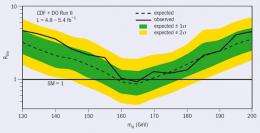
Fig. 1. The ratio (Rlim) of the excluded Higgs production cross-section over the theoretical Standard Model cross-section. The mass range where the observed curve falls below one is excluded at the 95% confidence level.
Almost a decade after the experiments at CERN’s Large Electron-Positron (LEP) collider set a limit on the mass of the Higgs boson of 114.4 GeV/c2, the two experiments at Fermilab’s Tevatron, CDF and D0 have been able to reduce further the allowed mass range for the missing particle in their first joint Run II publication.
In the proton-antiproton collisions observed at the Tevatron, the Higgs boson could be produced in the fusion of two gluons. If its mass is more than 140 GeV/c2, it will usually decay into a pair of W bosons. The decay of the W bosons into a charged lepton (electron or muon) and a neutrino leads to three different signatures in the detectors: two electrons, two muons or an electron and a muon, in addition to “missing energy" from the undetected neutrinos. This is the key to reducing the background from the jets, which are copiously produced in hadronic collisions.
The Higgs boson is a scalar particle, i.e. it carries no spin. This fundamental property helps to distinguish the decays of the Higgs to two W bosons from other events that contain pairs of W bosons. The two charged leptons from the W boson decays in Higgs events are more likely to be close together than back-to-back in the detector. As a final step in seeking the Higgs, artificial neural networks are trained to distinguish a Higgs signal from background using a large number of kinematic variables.
Both Tevatron experiments have their best sensitivity at a Higgs mass of about 165 GeV/c2, i.e. just around the combined mass of the two W bosons. With about 5 fb-1 of collision data analysed, each experiment alone does not yet have sensitivity to exclude a Higgs boson if it is produced at the rate predicted by the Standard Model. Putting their data together, CDF and DŘ can double the number of collisions used, breaking the “Standard Model barrier" for the first time since LEP.
Together, the experiments would expect about 70 Higgs events for a mass of around 165 GeV/c2 but their combined data are consistent with the assumption that no Higgs events have been produced. This observation is translated into a limit that excludes a Higgs boson in the mass range 162-166 GeV/c2 at the 95% confidence level.
The paper describing the combination is the first joint publication of the two collaborations using data from Run II of the Tevatron, which started in 2001. The publication, with 1042 authors, will appear in Physics Review Letters together with the individual results in separate letters. The data used represent about half the number of collisions that will eventually be recorded by CDF and DŘ. This will give them the opportunity to increase significantly the sensitivity of Higgs searches in the future.
Together with the precision electroweak data that favour a low-mass Higgs boson, these new results indicate that the most likely mass for the Higgs boson - if it exists - is somewhere between the LEP and Tevatron limits of 114 and 162 GeV/c2.
More information: Further reading
CDF and DŘ Collaboration, arXiv:1001.4162, accepted by Phys. Rev. Lett.
CDF Collaboration, arXiv:1001.4468, accepted by Phys. Rev. Lett.
DŘ Collaboration, arXiv:1001.4481, accepted by Phys. Rev. Lett.
Source: CERN
-
New experiments constrain Higgs mass (w/Videos)
Mar 13, 2009 |
not rated yet |
0
-
The hunt for the Higgs steps up a gear
Aug 28, 2008 |
not rated yet |
0
-
New Results Change Estimate of Higgs Boson Mass
Jun 09, 2004 |
not rated yet |
0
-
Precision measurement of W boson mass portends stricter limits for Higgs particle
Mar 11, 2009 |
not rated yet |
0
-
Fermilab collider experiments discover rare single top quark
Mar 09, 2009 |
not rated yet |
0
-
Engineers build first sub-10-nm carbon nanotube transistor
Feb 01, 2012 |
4.9 / 5 (31) |
30
-
Something old, something new: Evolution and the structural divergence of duplicate genes
Jan 31, 2012 |
4.6 / 5 (7) |
1
-
The hidden nanoworld of ice crystals: Revealing the dynamic behavior of quasi-liquid layers
Jan 30, 2012 |
5 / 5 (3) |
1
-
Stock market network reveals investor clustering
Jan 27, 2012 |
3.9 / 5 (23) |
8
-
Of microchemistry and molecules: Electronic microfluidic device synthesizes biocompatible probes
Jan 26, 2012 |
5 / 5 (1) |
0
-
changing electric flux caused by a resistor
1 hour ago
-
Does path integral and loop integral in a Feynman diagram violate special relativity?
1 hour ago
-
Simple Torque from Gravity Problem
3 hours ago
-
Books To Inspire a Beginnig Physics Student
5 hours ago
-
Pith balls problem
6 hours ago
-
Electrostatics
6 hours ago
- More from Physics Forums - General Physics
More news stories
Putting the squeeze on planets outside our solar system
(PhysOrg.com) -- Using high-powered lasers, scientists at Lawrence Livermore National Laboratory and collaborators discovered that molten magnesium silicate undergoes a phase change in the liquid state, abruptly ...
16 hours ago |
4.3 / 5 (7) |
0
|
Hovering not hard if you're top-heavy, researchers find
Top-heavy structures are more likely to maintain their balance while hovering in the air than are those that bear a lower center of gravity, researchers at New York University's Courant Institute of Mathematical Sciences ...
17 hours ago |
5 / 5 (2) |
1
|
SLAC, Stanford team focuses on high-energy electrons to treat cancer
Accelerator physicists at SLAC and cancer specialists from Stanford are working on a new technology that could dramatically reduce the time needed for cancer radiation treatments. The team ran an initial experiment ...
20 hours ago |
5 / 5 (2) |
0
Measurements from high-energy collisions lead to better understanding of why meson particles disappear
For several years, physicists at the Relativistic Heavy Ion Collider (RHIC) at Brookhaven National Laboratory (BNL), USA, have studied an unusual state of matter called the quarkgluon plasma, which they ...
21 hours ago |
4.5 / 5 (4) |
0
Explained: Sigma
It's a question that arises with virtually every major new finding in science or medicine: What makes a result reliable enough to be taken seriously? The answer has to do with statistical significance -- but ...
Feb 09, 2012 |
5 / 5 (16) |
53
Anonymous knocks CIA website offline (Update)
The website of the Central Intelligence Agency was inaccessible on Friday after the hacker group Anonymous claimed to have knocked it offline.
New error-correcting codes guarantee the fastest possible rate of data transmission
Error-correcting codes are one of the triumphs of the digital age. Theyre a way of encoding information so that it can be transmitted across a communication channel such as an optical fiber o ...
Small modular reactor design could be a 'SUPERSTAR'
(PhysOrg.com) -- Though most of today's nuclear reactors are cooled by water, we've long known that there are alternatives; in fact, the world's first nuclear-powered electricity in 1951 came from a reactor ...
New power source discovered
(PhysOrg.com) -- Researchers at the Massachusetts Institute of Technology (MIT) and RMIT University have made a breakthrough in energy storage and power generation.
The power of estrogen -- male snakes attract other males
A new study has shown that boosting the estrogen levels of male garter snakes causes them to secrete the same pheromones that females use to attract suitors, and turned the males into just about the sexiest ...
Advanced power-grid model finds low-cost, low-carbon future in West
(PhysOrg.com) -- The least expensive way for the Western U.S. to reduce greenhouse gas emissions enough to help prevent the worst consequences of global warming is to replace coal with renewable and other ...
Feb 24, 2010
Rank: not rated yet
This is ludicrous!
Feb 25, 2010
Rank: 1 / 5 (1)
Feb 25, 2010
Rank: 5 / 5 (1)
Feb 25, 2010
Rank: not rated yet
Feb 26, 2010
Rank: not rated yet
http://theoryofev.../ToE.pdf
Feb 27, 2010
Rank: 5 / 5 (1)
But regarding the linked document - haven't read it all, but:
They use parameters like age of the universe and gravitational constant (expansion of universe) in their calculations for "normalization" purposes, as they say.. Thats a bit too much for me to digest, sorry..
Feb 28, 2010
Rank: not rated yet
Feb 28, 2010
Rank: not rated yet
http://physics.ap...1/e1.png