Nouns and verbs are learned in different parts of the brain
February 25, 2010
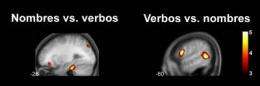
Nouns and verbs are learned in different parts of the brain. Credit: Mestres-Misse et al.
Two Spanish psychologists and a German neurologist have recently shown that the brain that activates when a person learns a new noun is different from the part used when a verb is learnt. The scientists observed this using brain images taken using functional magnetic resonance, according to an article they have published this month in the journal Neuroimage.
"Learning nouns activates the left fusiform gyrus, while learning verbs switches on other regions (the left inferior frontal gyrus and part of the left posterior medial temporal gyrus)", Antoni Rodríguez-Fornells, co-author of the study and an ICREA researcher at the Cognition and Brain Plasticity Unit of the University of Barcelona, tells SINC.
The Catalan researcher, along with psychologist Anna Mestres-Missé, who is currently working at the Max Planck Institute for Human Cognitive and Brain Sciences in Leipzig, and neurologist Thomas F. Münte from the Otto-von-Guericke University in Magdeburg, in Germany, have just published the results of their study confirming the neural differences in the map of the brain when a person learns new nouns and verbs in the journal Neuroimage.
The team knew that many patients with brain damage exhibit dissociation in processing these kinds of words, and that children learn nouns before verbs. Adults also perform better and react faster to nouns during cognitive tests.
Based on these ideas, the researchers devised an experiment to confirm whether these differences could be seen in the brain. To do this, they set 21 people a test to learn new nouns and verbs, and recorded their neural reactions using functional magnetic resonance imaging. This technique makes it possible to observe how regions of the brain activate while a person is carrying out a specific task.
The test consisted of working out the meaning of a new term based on the context provided in two sentences. For example, in the phrase "The girl got a jat for Christmas" and "The best man was so nervous he forgot the jat", the noun jat means "ring". Similarly, with "The student is nising noodles for breakfast" and "The man nised a delicious meal for her" the hidden verb is "cook".
"This task simulates, at an experimental level, how we acquire part of our vocabulary over the course of our lives, by discovering the meaning of new words in written contexts", explains Rodríguez-Fornells. "This kind of vocabulary acquisition based on verbal contexts is one of the most important mechanisms for learning new words during childhood and later as adults, because we are constantly learning new terms".
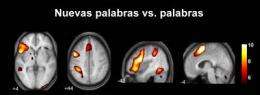
Nouns and verbs are learned in different parts of the brain. Credit: Mestres-Misse et al.
The participants had to learn 80 new nouns and 80 new verbs. By doing this, the brain imaging showed that new nouns primarily activate the left fusiform gyrus (the underside of the temporal lobe associated with visual and object processing), while the new verbs activated part of the left posterior medial temporal gyrus (associated with semantic and conceptual aspects) and the left inferior frontal gyrus (involved in processing grammar).In addition, there was a positive correlation between activation of certain parts of the brain (the bilateral hippocampus and the bilateral putamen) and the efficiency of learning new nouns, but not new verbs.
"These results suggest that the same regions previously associated with the representation of the meaning of nouns and verbs are also associated with establishing correspondences between these meanings and new words, a process that is necessary for learning a second language", says Rodríguez-Fornells.
The researcher explains that the study cannot be used in practice for learning languages, "but it does touch on one of the most important aspects, which is the degree to which we use different information in verbal contexts, as well as possibly different neural networks, in learning different kinds of words with different grammatical functions".
More information: Mestres-Missé, A., Rodriguez-Fornells, A., Münte, T.F. "Neural differences in the mapping of verb and noun concepts onto novel words". Neuroimage 49 (3): 2826, 2010.
Provided by FECYT - Spanish Foundation for Science and Technology
-
How listeners perceive verbs
Jan 29, 2007 |
not rated yet |
0
-
Can You Read My Mind?
Mar 23, 2005 |
not rated yet |
0
-
Familiar and newly learned words are processed by the same neural networks in the brain
Aug 28, 2009 |
not rated yet |
0
-
Study of language use in children suggests sex influences how brain processes words
Nov 27, 2006 |
not rated yet |
0
-
Thinking of prepositions turns brain 'on' in different ways
Jan 25, 2005 |
not rated yet |
0
-
Engineers build first sub-10-nm carbon nanotube transistor
Feb 01, 2012 |
4.9 / 5 (31) |
30
-
Something old, something new: Evolution and the structural divergence of duplicate genes
Jan 31, 2012 |
4.6 / 5 (7) |
1
-
The hidden nanoworld of ice crystals: Revealing the dynamic behavior of quasi-liquid layers
Jan 30, 2012 |
5 / 5 (3) |
1
-
Stock market network reveals investor clustering
Jan 27, 2012 |
3.9 / 5 (23) |
8
-
Of microchemistry and molecules: Electronic microfluidic device synthesizes biocompatible probes
Jan 26, 2012 |
5 / 5 (1) |
0
-
Is Everyday Technology Killing Us?
Feb 08, 2012
-
Exercise and weight loss
Feb 08, 2012
-
Why do we have head aches? Our brains can't feel anything.
Feb 07, 2012
-
"The end of diseases" by David Agus, interview from Daily Show with Jon Stewart
Feb 04, 2012
-
Oncolytic adenovirus
Feb 04, 2012
-
Nutrition label stuffs and diets
Feb 02, 2012
- More from Physics Forums - Medical Sciences
More news stories
Complex wiring of the nervous system may rely on a just a handful of genes and proteins
Researchers at the Salk Institute have discovered a startling feature of early brain development that helps to explain how complex neuron wiring patterns are programmed using just a handful of critical genes. ...
10 hours ago |
4.9 / 5 (9) |
1
|
Team isolates nerve cells involved in storing long term memory and gene proteins associated with them
(Medical Xpress) -- A research team in Taiwan has succeeded in isolating two nerve cells in fruit fly brains that are believed to be the major players in allowing for the formation of long term memories. Furthermore, ...
Seeing colors in music, tasting flavors in shapes may happen in life's early months
Famed violinist Itzhak Perlman sees a deep forest green whenever he plays a B-flat on his Stradivarius' G string. The A on the E string is red.
Medicine & Health / Psychology & Psychiatry
17 hours ago |
4.5 / 5 (2) |
2
|
Both maternal and paternal age linked to autism
Older maternal and paternal age are jointly associated with having a child with autism, according to a recently published study led by researchers at The University of Texas Health Science Center at Houston (UTHealth).
Medicine & Health / Psychology & Psychiatry
14 hours ago |
4.3 / 5 (3) |
0
|
New understanding of DNA repair could eventually lead to cancer therapy
A research group in the Faculty of Medicine & Dentistry at the University of Alberta is hoping its latest discovery could one day be used to develop new therapies that target certain types of cancers.
14 hours ago |
4.8 / 5 (6) |
0
|
Anonymous knocks CIA website offline (Update)
The website of the Central Intelligence Agency was inaccessible on Friday after the hacker group Anonymous claimed to have knocked it offline.
Google users warned of threat to smartphone wallets
Users of Google smartphone wallets were being warned on Friday that there is a way to crack pass codes intended to thwart thieves from going on illicit shopping sprees.
New error-correcting codes guarantee the fastest possible rate of data transmission
Error-correcting codes are one of the triumphs of the digital age. Theyre a way of encoding information so that it can be transmitted across a communication channel such as an optical fiber o ...
Humans may have helped the decline of African rainforests 3000 years ago
(PhysOrg.com) -- Large areas of rainforests in Central Africa mysteriously disappeared over three thousand years ago, to be replaced by savannas. The prevailing theory has been that the cause was a change ...
New power source discovered
(PhysOrg.com) -- Researchers at the Massachusetts Institute of Technology (MIT) and RMIT University have made a breakthrough in energy storage and power generation.
Small modular reactor design could be a 'SUPERSTAR'
(PhysOrg.com) -- Though most of today's nuclear reactors are cooled by water, we've long known that there are alternatives; in fact, the world's first nuclear-powered electricity in 1951 came from a reactor ...

Feb 26, 2010
Rank: 1 / 5 (1)
here are some alternatives:
Jat=kiss, speech; lot; dowry; car;
Nising=eating; preparing; growing; buying; organising; hunting; trying; baking; boiling
Feb 26, 2010
Rank: 1 / 5 (1)
Isn't it a silent assumption that language doesn't matter in language-related experiments?