Does promiscuity prevent extinction?
February 25, 2010
Does promiscuity prevent extinction?

Enlarge

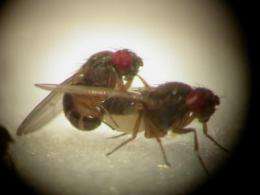
These are Drosophila pseudoobscura mating. A new study by the Universities of Exeter and Liverpool, UK, on these fruitfly suggests promiscuous females may be the key to a species’ survival. Credit: University of Exeter

Promiscuous females may be the key to a species' survival, according to new research by the Universities of Exeter and Liverpool. Published today (25 February) in Current Biology, the study could solve the mystery of why females of most species have multiple mates, despite this being more risky for the individual.

Known as 'polyandry' among scientists, the phenomenon of females having multiple mates is shared across most animal species, from insects to mammals. This study suggests that polyandry reduces the risk of populations becoming extinct because of all-female broods being born. This can sometimes occur as a result of a sex-ratio distortion (SR) chromosome, which results in all of the 'male' sperm being killed before fertilisation. The all-female offspring will carry the SR chromosome, which will be passed on to their sons in turn resulting in more all-female broods. Eventually there will be no males and the population will die out.

For this study, the scientists worked with the fruitfly pseudoobscura. They gave some populations the opportunity to mate naturally, meaning that the females had multiple partners. The others were restricted to having one mate each. They bred several generations of these populations, so they could see how each fared over time.

Over fifteen generations, five of the twelve populations that had been monogamous became extinct as a result of males dying out. The SR chromosome was far less prevalent in the populations in which females had the opportunity to have multiple mates and none of these populations became extinct.

The study shows how having multiple mates can suppress the spread of the SR chromosome, making all-female broods a rarity. This is because males that carry the SR chromosome produce only half as many sperm as normal males. When a female mates with multiple males, their sperm will compete to fertilise her eggs. The few sperm produced by males carrying the SR chromosome are out-competed by the from normal males, and the SR chromosome cannot spread.

Lead author Professor Nina Wedell of the University of Exeter said: "We were surprised by how quickly - within nine generations - a population could die out as a result of females only mating with one partner. Polyandry is such a widespread phenomenon in nature but it remains something of an enigma for scientists. This study is the first to suggest that it could actually save a population from extinction."

Provided by University of Exeter (news : web)


Rank 5 /5 (3 votes)
Related Stories
Relevant PhysicsForums posts
  • Pertubance in a model
    created3 hours ago
  • Cancer drugs and Alzheimer's, Oh my!
    created11 hours ago
  • Squishing cells
    created12 hours ago
  • Any books/articles for evolutionary stable strategy models in humans?
    created23 hours ago
  • Science behind the bore feeling?
    createdFeb 09, 2012
  • Homo Sapien vs. Chimpanzee - Divergence Timeline
    createdFeb 09, 2012
  • More from Physics Forums - Biology

More news stories

The power of estrogen -- male snakes attract other males

A new study has shown that boosting the estrogen levels of male garter snakes causes them to secrete the same pheromones that females use to attract suitors, and turned the males into just about the sexiest ...

Biology / Plants & Animals

created 1 hour ago | popularity not rated yet | comments 0 | with audio podcast

Experts reveal how plants don't get sunburn

(PhysOrg.com) -- Experts at the University of Glasgow have discovered how plants survive the harmful rays of the sun.

Biology / Cell & Microbiology

created 1 hour ago | popularity 5 / 5 (1) | comments 0 | with audio podcast

Miami battling invasion of giant African snails

No one knows how they got there. But an invasion of African giant snails has southern Florida in a panic over potential crop damage, disease and general yuckiness surrounding the slimy gastropods.

Biology / Ecology

created 5 hours ago | popularity not rated yet | comments 2

Ultraviolet protection molecule in plants yields its secrets

Lying around in the sun all day is hazardous not just for humans but also for plants, which have no means of escape. Ultraviolet (UV) radiation from the sun can damage proteins and DNA inside cells, leading ...

Biology / Plants & Animals

created 20 hours ago | popularity 5 / 5 (5) | comments 0 | with audio podcast

Fighting crimes against biodiversity: How to catch a killer weed

Invasive species which have the potential to destroy biodiversity and influence global change could be tracked and controlled in the same way as wanted criminals, according to new research from Queen Mary, University of London.

Biology / Ecology

created 6 hours ago | popularity not rated yet | comments 0


Curry spice component may help slow prostate tumor growth

Curcumin, an active component of the Indian curry spice turmeric, may help slow down tumor growth in castration-resistant prostate cancer patients on androgen deprivation therapy (ADT), a study from researchers ...

Netflix light on flicks as viewers soak up TV shows

Like most fresh faces that arrive in Hollywood, Netflix wanted to be a movie star. But now it's learning what many in Tinseltown have known for decades: Movies are sexy, but the real money is in television.

Antidepressants and pregnancy: Women must consider the impact of drugs on baby, and of depression on baby, themselves

Upon learning they are pregnant, most women dutifully nix the alcohol, sushi and caffeine. But what about antidepressants?

Arthritic knees, but not hips, have robust repair response

Researchers at Duke University Medical Center used new tools they developed to analyze knees and hips and discovered that osteoarthritic knee joints are in a constant state of repair, while hip joints are not.

Fool's gold may prove an unlikely alternative to overexploited catalytic materials

Catalytic materials, which lower the energy barriers for chemical reactions, are used in everything from the commercial production of chemicals to catalytic converters in car engines. However, with current catalytic materials ...

Humans may have helped the decline of African rainforests 3000 years ago

(PhysOrg.com) -- Large areas of rainforests in Central Africa mysteriously disappeared over three thousand years ago, to be replaced by savannas. The prevailing theory has been that the cause was a change ...