Cell-inspired electronics
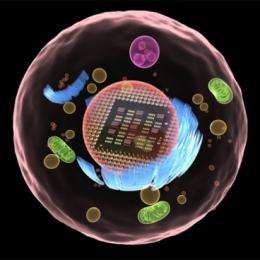
(PhysOrg.com) -- A single cell in the human body is approximately 10,000 times more energy-efficient than any nanoscale digital transistor, the fundamental building block of electronic chips. In one second, a cell performs about 10 million energy-consuming chemical reactions, which altogether require about one picowatt (one millionth millionth of a watt) of power.
MIT's Rahul Sarpeshkar is now applying architectural principles from these ultra-energy-efficient cells to the design of low-power, highly parallel, hybrid analog-digital electronic circuits. Such circuits could one day be used to create ultra-fast supercomputers that predict complex cell responses to drugs. They may also help researchers to design synthetic genetic circuits in cells.
In his new book, Ultra Low Power Bioelectronics (Cambridge University Press, 2010), Sarpeshkar outlines the deep underlying similarities between chemical reactions that occur in a cell and the flow of current through an analog electronic circuit. He discusses how biological cells perform reliable computation with unreliable components and noise (which refers to random variations in signals — whether electronic or genetic). Circuits built with similar design principles in the future can be made robust to electronic noise and unreliable electronic components while remaining highly energy efficient. Promising applications include image processors in cell phones or brain implants for the blind.
"Circuits are a language for representing and trying to understand almost anything, whether it be networks in biology or cars," says Sarpeshkar, an associate professor of electrical engineering and computer science. "There's a unified way of looking at the biological world through circuits that is very powerful."
Circuit designers already know hundreds of strategies to run analog circuits at low power, amplify signals, and reduce noise, which have helped them design low-power electronics such as mobile phones, mp3 players and laptop computers.
"Here's a field that has devoted 50 years to studying the design of complex systems," says Sarpeshkar, referring to electrical engineering. "We can now start to think of biology in the same way." He hopes that physicists, engineers, biologists and biological engineers will work together to pioneer this new field, which he has dubbed "cytomorphic" (cell-inspired or cell-transforming) electronics.
Finding connections
Sarpeshkar, an electrical engineer with many years of experience in designing low-power and biomedical circuits, has frequently turned his attention to finding and exploiting links between electronics and biology. In 2009, he designed a low-power radio chip that mimics the structure of the human cochlea to separate and process cell phone, Internet, radio and television signals more rapidly and with more energy efficiency than had been believed possible.
That chip, known as the RF (radio frequency) cochlea, is an example of "neuromorphic electronics," a 20-year-old field founded by Carver Mead, Sarpeshkar's thesis advisor at Caltech. Neuromorphic circuits mimic biological structures found in the nervous system, such as the cochlea, retina and brain cells.
Sarpeshkar's expansion from neuromorphic to cytomorphic electronics is based on his analysis of the equations that govern the dynamics of chemical reactions and the flow of electrons through analog circuits. He has found that those equations, which predict the reaction's (or circuit's) behavior, are astonishingly similar, even in their noise properties.
Chemical reactions (for example, the formation of water from hydrogen and oxygen) only occur at a reasonable rate if enough energy is available to lower the barriers that prevent such reactions from occurring. A catalyst such as an enzyme can lower such barriers. Similarly, electrons flowing through a circuit in a transistor exploit input voltage energy to allow them to reduce the barrier for electrons to flow from the transistor's source to the transistor's drain. Changes in the input voltage lower the barrier and increase current flow in transistors, just as adding an enzyme to a chemical reaction speeds it up.
Essentially, cells may be viewed as circuits that use molecules, ions, proteins and DNA instead of electrons and transistors. That analogy suggests that it should be possible to build electronic chips — what Sarpeshkar calls "cellular chemical computers" — that mimic chemical reactions very efficiently and on a very fast timescale.
One potentially powerful application of such circuits is in modeling genetic network — the interplay of genes and proteins that controls a cell's function and fate. In a paper presented at the 2009 IEEE Symposium on Biological Circuits and Systems, Sarpeshkar designed a circuit that allows any genetic network reaction to be simulated on a chip. For example, circuits can simulate the interactions between genes involved in lactose metabolism and the transcription factors that regulate their expression in bacterial cells.
In the long term, Sarpeshkar plans to develop circuits that mimic interactions within entire cellular genomes, which are important in enabling scientists to understand and treat complex diseases such as cancer and diabetes. Eventually, researchers may be able to use such chips to simulate the entire human body, he believes. Such chips would be much faster than computer simulations now, which are highly inefficient at modeling the effects of noise in the large-scale nonlinear circuits within cells.
He is also investigating how circuit design principles can help genetically engineer cells to perform useful functions, for example, the robust and sensitive detection of toxins in the environment.
Sarpeshkar's focus on modeling cells as analog rather than digital circuits offers a new approach that will expand the frontiers of synthetic biology, says James Collins, professor of biomedical engineering at Boston University. "Rahul has nicely laid a foundation that many of us in synthetic biology will be able to build on," he says.
Provided by Massachusetts Institute of Technology


