The First T2K Neutrino Event Observed At Super-Kamiokande
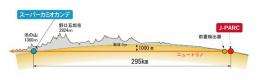
(PhysOrg.com) -- Physicists from the Japanese-led multinational T2K collaboration announced today that they had made the first detection of a neutrino which had travelled all the way under Japan from their neutrino beamline at the J-PARC facility in Tokai village (about an hour north of Tokyo by train) to the gigantic Super-Kamiokande underground detector near the west coast of Japan, 295 km (185 miles) away from Tokai. Stony Brook University has been the leading US institution in the T2K experiment.
Physicists from the Japanese-led multinational T2K collaboration announced today that they had made the first detection of a neutrino which had travelled all the way under Japan from their neutrino beamline at the J-PARC facility in Tokai village (about an hour north of Tokyo by train) to the gigantic Super-Kamiokande underground detector near the west coast of Japan, 295 km (185 miles) away from Tokai. Stony Brook University has been the leading US institution in the T2K experiment.
"It is a big step forward," said T2K spokesperson Takashi Kobayashi. "We've been working hard for more than 10 years to make this happen."
They have constructed their new neutrino beamline, which will deliver the world’s most powerful neutrino beams, to study the mysterious phenomenon known as neutrino oscillations, and the observation of this event proves that their study can now begin.
"Neutrinos are the elusive ghosts of particle physics," Kobayashi explains. "They come in three types, called electron neutrinos, muon neutrinos, and tau neutrinos, which used to be thought to be immutable."
Interacting only weakly with matter, neutrinos can traverse the entire earth with vastly less attenuation than light passing through a window. The very weakness of their interactions allows physicists to make what should be very accurate predictions of their behavior, and thus it came as a shock when measurements of the flux of neutrinos coming from the thermonuclear reactions which power our sun were far lower than predicted."
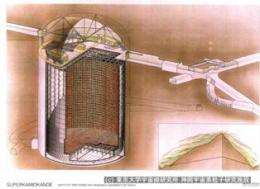
A second anomaly was then demonstrated by Super-Kamiokande, when it showed that the flux of different types of neutrino generated within our atmosphere by cosmic ray interactions was different depending on whether the neutrinos were coming from above or below (which should not have been possible given our understanding of particle physics). Other experiments, such as KamLAND (also performed at Kamioka), have conclusively demonstrated that these anomalies are caused by neutrino oscillations, whereby one type of neutrino turns into another.
"Congratulations from CERN on the first T2K neutrino event seen at Super-Kamiokande," said CERN Director General Rolf Heuer. "Switching on the world's first neutrino superbeam is a great achievement, and is set to bring great advances in the understanding of this most elusive of particles. Even in a time of financial difficulty around the globe, it's important not to lose sight of the fact that basic science is and always will be a crucial element of progress. It is therefore heartening to see such an important new basic science initiative getting underway now."
"Watching this event is as mesmerizing as watching an Olympic athlete skating the perfect program on the way to a Gold Medal; it is stunningly beautiful to my eyes," said Professor Chang Kee Jung of Stony Brook University, leader of the US T2K project. "Of course this is the result of many years of hard work by more than 500 international collaborators."
The T2K experiment has been built to make measurements of unprecedented precision of known neutrino oscillations, and to look for a so-far unobserved type of oscillation which would cause a small fraction of the muon neutrinos produced at J-PARC to become electron neutrinos by the time they reach Super-Kamiokande.
"This first neutrino event marks a great achievement for T2K and a milestone for the fast-growing field of neutrino physics worldwide," said Fermilab Director Pier Oddone. "We send warmest congratulations from Fermilab, along with our best wishes for the exciting science that will follow."
Prof. Dr. Joachim Mnich, Director in charge of High Energy Physics and Astroparticle Physics at DESY also notes: "Warmest congratulations from DESY on seeing the first neutrino event and thus becoming leader in the race to understand the elusive neutrino! Through our long history of collaboration with Japanese scientists and labs we value your work most highly and hope that the T2K project will help make the neutrino less elusive."
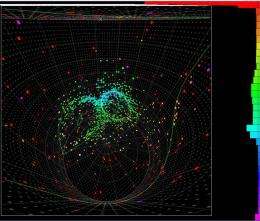
Observing the new type of oscillation would open the prospect of comparing the oscillations of neutrinos and anti-neutrinos, which many theorists believe may be related to one of the great mysteries in fundamental physics -- why is there more matter than anti-matter in the universe? The observation of this first neutrino (see figure) means that the hunt has just begun!
The T2K collaboration consists of 508 physicists from 62 institutes in 12 countries (Japan, South Korea, Canada, the United States, the United Kingdom, France, Spain, Italy, Switzerland, Germany, Poland, and Russia). The experiment consists of a new neutrino beamline using the recently constructed 30 GeV synchrotron at the J-PARC laboratory in Tokai, Japan, a set of near detectors constructed 280m from the neutrino production target, and the Super-Kamiokande detector in western Japan.
Provided by Stony Brook University


