Mammoth iceberg could alter ocean circulation: study
February 25, 2010 by Marlowe Hood
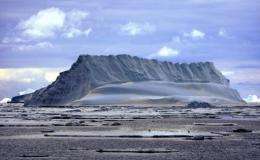
Penguins (C) drift on an ice floe beneath a cathedral iceberg in the Southern Ocean in the Australian Antarctic Territory in 2006. An iceberg the size of Luxembourg knocked loose from the Antarctic continent earlier this month could disrupt the ocean currents driving weather patterns around the globe, researchers said Thursday.
An iceberg the size of Luxembourg knocked loose from the Antarctic continent earlier this month could disrupt the ocean currents driving weather patterns around the globe, researchers said Thursday.
While the impact would not be felt for decades or longer, a slowdown in the production of colder, dense water could result in less temperate winters in the north Atlantic, they said.
The 2550 square-kilometre (985 square-mile) block broke off on February 12 or 13 from the Mertz Glacier Tongue, a 160-kilometer spit of floating ice protruding into the Southern Ocean from East Antarctica due south of Melbourne, researchers said.
Some 400 metres (1300 feet) thick, the iceberg could fill Sydney Harbour more than 100 times over.
It could also disturb the area's exceptionally rich biodiversity, including a major colony of emperor penguins near Dumont d'Urville, site of a French scientific station, according to the scientists.
"The ice tongue was almost broken already. It was hanging like a loose tooth," said Benoit Legresy, a French glaciologist who has been monitoring the Metz Glacier via satellite images and on the ground for a decade in cooperation with Australian scientists.
The billion-tonne mass was dislodged by another, older iceberg, known as B9B, which split off in 1987.
Jammed against the Antarctic continent for more than 20 years, B9B smashed into the Metz tongue like a slow-motion battering ram after it began to drift.
Both natural cycles and manmade climate change contribute to the collapse ice shelves and glaciers.
Tide and ocean currents constantly beat against exposed areas, while longer summers and rising temperatures also take a toll.
"Obviously when there is warmer water, these ice tongues will become more fragile," said Legresy, who works at the Laboratory for Geophysics and Oceanographic Space Research in Toulouse, southern France.
The Metz Glacier Tongue, fitted with GPS beacons and other measurement instruments, could provide crucial insights into how these influences should be apportioned.
"For the first time, we will have a detailed record of the full cycle of a major calving event -- before, during and after," he said.
Since breaking off, the iceberg -- along with the newly mobile B9B, which is about the same size -- have moved into an ajoining area called a ploynya.
Distributed across the Southern Ocean, ploynyas are zones that produce dense water, super cold and rich in salt, that sinks to the bottom of the sea and drives the conveyor-belt like circulation around the globe.
If these icebergs move east and run aground, or drift north into warmer climes, they will have no impact on these currents.
"But if they stay in this area -- which is likely -- they could block the production of this dense water, essentially putting a lid on the polynya," Legresy explained.
The Metz Glacier Polynya is particularly strong, and accounts for 20 percent of the "bottom water" in the world, he added.
Eventually, the icebergs will die a natural death, but their lifespan depends on where they go.
Adrift, they could melt in a could of decades. If they remain lodged against the Antarctic landmass, they could persist far longer.
(c) 2010 AFP
-
Icebergs head from Antarctica for New Zealand
Nov 24, 2009 |
not rated yet |
0
-
Giant iceberg spotted south of Australia
Dec 09, 2009 |
not rated yet |
0
-
New collision looks imminent for B-15A iceberg
May 18, 2005 |
not rated yet |
0
-
Ships warned about icebergs headed for New Zealand
Nov 25, 2009 |
not rated yet |
0
-
'Monster' iceberg shedding hundreds of offshoots
Dec 14, 2009 |
not rated yet |
0
-
Engineers build first sub-10-nm carbon nanotube transistor
Feb 01, 2012 |
4.9 / 5 (31) |
30
-
Something old, something new: Evolution and the structural divergence of duplicate genes
Jan 31, 2012 |
4.6 / 5 (7) |
1
-
The hidden nanoworld of ice crystals: Revealing the dynamic behavior of quasi-liquid layers
Jan 30, 2012 |
5 / 5 (3) |
1
-
Stock market network reveals investor clustering
Jan 27, 2012 |
3.9 / 5 (23) |
8
-
Of microchemistry and molecules: Electronic microfluidic device synthesizes biocompatible probes
Jan 26, 2012 |
5 / 5 (1) |
0
-
Discrepancy between oxygen and carbon-dioxide levels
Feb 09, 2012
-
where gems are found in the world
Feb 09, 2012
-
Wind Waves in Reservoir ~ Wind run-up and Wind set-up
Feb 08, 2012
-
Balance of oxygen in the atmosphere
Feb 01, 2012
-
The case for a methanol-based economy
Jan 30, 2012
-
Weather in a rotating cylinder
Jan 25, 2012
- More from Physics Forums - Earth
More news stories
Humans may have helped the decline of African rainforests 3000 years ago
(PhysOrg.com) -- Large areas of rainforests in Central Africa mysteriously disappeared over three thousand years ago, to be replaced by savannas. The prevailing theory has been that the cause was a change ...
Could Venus be shifting gear?
(PhysOrg.com) -- ESAs Venus Express spacecraft has discovered that our cloud-covered neighbour spins a little slower than previously measured. Peering through the dense atmosphere in the infrared, the ...
Space & Earth / Space Exploration
13 hours ago |
5 / 5 (7) |
7
|
NASA budget will axe Mars deal with Europe: scientists
US President Barack Obama's budget proposal to be submitted next week for 2013 will cut NASA's budget by 20 percent and eliminate a major partnership with Europe on Mars exploration, scientists said Thursday.
Space & Earth / Space Exploration
16 hours ago |
5 / 5 (2) |
18
Mars Science Laboratory computer issue resolved
(PhysOrg.com) -- Engineers have found the root cause of a computer reset that occurred two months ago on NASA's Mars Science Laboratory and have determined how to correct it.
Space & Earth / Space Exploration
14 hours ago |
4.7 / 5 (6) |
3
|
NASA sees wide-eyed cyclone Jasmine
Cyclone Jasmine's eye has opened wider on NASA satellite imagery, as it moves through the Southern Pacific Ocean.
Space & Earth / Earth Sciences
5 hours ago |
3.5 / 5 (2) |
1
Google users warned of threat to smartphone wallets
Users of Google smartphone wallets were being warned on Friday that there is a way to crack pass codes intended to thwart thieves from going on illicit shopping sprees.
Anonymous knocks CIA website offline (Update)
The website of the Central Intelligence Agency was inaccessible on Friday after the hacker group Anonymous claimed to have knocked it offline.
New error-correcting codes guarantee the fastest possible rate of data transmission
Error-correcting codes are one of the triumphs of the digital age. Theyre a way of encoding information so that it can be transmitted across a communication channel such as an optical fiber o ...
Complex wiring of the nervous system may rely on a just a handful of genes and proteins
Researchers at the Salk Institute have discovered a startling feature of early brain development that helps to explain how complex neuron wiring patterns are programmed using just a handful of critical genes. ...
The power of estrogen -- male snakes attract other males
A new study has shown that boosting the estrogen levels of male garter snakes causes them to secrete the same pheromones that females use to attract suitors, and turned the males into just about the sexiest ...
New power source discovered
(PhysOrg.com) -- Researchers at the Massachusetts Institute of Technology (MIT) and RMIT University have made a breakthrough in energy storage and power generation.
Feb 25, 2010
Rank: 1.8 / 5 (15)
Yea right, blame AGW. I believe it was Atlantian who contributed to the collapse of the ice shelves using their spaceships. Please anyone disprove this theory.
Feb 25, 2010
Rank: 3.4 / 5 (10)
Why? Sounds solid to me =P
Feb 25, 2010
Rank: 3.9 / 5 (11)
Feb 26, 2010
Rank: 3.7 / 5 (3)
Feb 26, 2010
Rank: 4.5 / 5 (2)
Checkout this South Dakota House resolution 1009. The telling quote (my emphasis)is:
" 2) That there are a variety of climatological, meteorological, ASTROLOGICAL, thermological, cosmological, and ecological dynamics that can effect world weather phenomena and that the significance and interrelativity of these factors is largely speculative"
I'd love to know what they mean by Thermological!
Feb 26, 2010
Rank: 4.3 / 5 (3)
Feb 26, 2010
Rank: 4.8 / 5 (4)
Feb 26, 2010
Rank: 2.3 / 5 (6)
I'm assuming this means, 99.9999% natural cycles and .00001% manmade CC. That would satisfy the "both" "contribut[ing]" criteria.