Nanotechnologists form near-frictionless diamond material
February 25, 2010
Nanotechnologists form near-frictionless diamond material

Enlarge

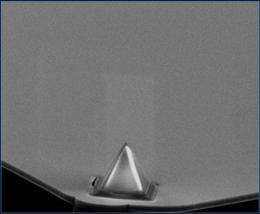
This is an SEM image of a silicon microcantilever with an ultrasharp tip of diamond-like carbon with silicon. Credit: Harish Bhaskaran, IBM

Researchers at the University of Pennsylvania, the University of Wisconsin-Madison and IBM Research-Zürich have fabricated an ultra sharp, diamond-like carbon tip possessing such high strength that it is 3,000 times more wear-resistant at the nanoscale than silicon.

The end result is a diamond-like carbon material mass-produced at the that doesn't wear. The new nano-sized tip, researchers say, wears away at the rate of one atom per micrometer of sliding on a substrate of , much lower than that for a tip which represents the current state-of-the-art. Consisting of carbon, hydrogen, silicon and oxygen molded into the shape of a nano-sized tip and integrated on the end of a silicon microcantilever for use in , the material has technological implications for atomic imaging, probe-based and as emerging applications such as nanolithography, nanometrology and nanomanufacturing.

The importance of the discovery lies not just in its size and resistance to wear but also in the hard substrate against which it was shown to perform well when in sliding contact: silicon dioxide. Because silicon -- used in almost all integrated circuit devices -- oxidizes in atmosphere forming a thin layer of its oxide, this system is the most relevant for nanolithography, nanometrology and nanomanufacturing applications.

Probe-based technologies are expected to play a dominant role in many such technologies; however, poor wear performance of many materials when slid against silicon oxide, including silicon oxide itself, has severely limited usefulness to the laboratory.

Researchers built the material from the ground up, rather than coating a nanoscale tip with wear-resistant materials. The collaboration used a molding technique to fabricate monolithic tips on standard silicon microcantilevers. A bulk processing technique that has the potential to scale up for commercial manufacturing is available.

Robert Carpick, professor in the Department of Mechanical Engineering and Applied Mechanics at Penn, and his research group had previously shown that carbon-based thin films, including diamond-like carbon, had low friction and wear at the nanoscale; however, it has been difficult to fabricate nanoscale structures made out of diamond-like carbon until now.

Understanding friction and wear at the nanoscale is important for many applications that involve nanoscale components sliding on a surface.

"It is not clear that materials that are wear-resistant at the macroscale exhibit the same property at the nanoscale," lead author Harish Bhaskaran, who was a postdoctoral research at IBM during the study, said.

Defects, cracks and other phenomena that influence material strength and wear at macroscopic scales are less important at the nanoscale, which is why nanowires can, for example, show higher strengths than bulk samples.

The study is published in the current edition of the journal Nature Nanotechnology.

Provided by University of Pennsylvania (news : web)

4.8 /5 (16 votes)  

Filter


Move the slider to adjust rank threshold, so that you can hide some of the comments.


Display comments: newest first

danman5000
Feb 26, 2010

Rank: not rated yet
So where was the part about it being frictionless like the title says?
eachus
Feb 27, 2010

Rank: not rated yet
danman5000 asked: So where was the part about it being frictionless like the title says?

"The new nano-sized tip, researchers say, wears away at the rate of one atom per micrometer of sliding on a substrate of silicon dioxide, much lower than that for a silicon oxide tip which represents the current state-of-the-art."

One million atoms lost per meter may sound like a lot, but think of running a phonograph needle over a piece of sandpaper. How many millimeters before you have no point left? With the phonograph needle, even a diamond stylus you would be losing material a million or more times as fast.
NeilFarbstein
Mar 01, 2010

Rank: not rated yet
so what? silicon is soft and easily abraded.
3000 times the hardness if silicon is not impressive
macroguru
Mar 25, 2010

Rank: not rated yet
so what? silicon is soft and easily abraded.
3000 times the hardness if silicon is not impressive

actually, silicon is an impressively hard material, it is not soft at all. in fact in vacuum, silicon probes are incredibly wear resistant. also soft has little to do with wear. rubber is soft too but it is used in tires.
Rank 4.8 /5 (16 votes)
Relevant PhysicsForums posts
  • polymer nanocomposites
    created20 hours ago
  • Corrosion Tests on Magnesium
    createdFeb 09, 2012
  • polyethylene copper nanocomposite
    createdFeb 09, 2012
  • Output of xrd analysis
    createdFeb 08, 2012
  • Transport phenomena problem based on problems 18.B11 and 19B.6 from Bird, stewart, lw
    createdFeb 06, 2012
  • Help with material selection - Car Piston
    createdFeb 05, 2012
  • More from Physics Forums - Materials & Chemical Engineering

More news stories

What lies beneath: Mapping hidden nanostructures

The ability to diagnose and predict the properties of materials is vital, particularly in the expanding field of nanotechnology. Electron and atom-probe microscopy can categorize atoms in thin sheets of material, ...

Nanotechnology / Nanophysics

created 13 hours ago | popularity 5 / 5 (1) | comments 1

New kind of solar cell could capture significantly more energy than current cells

New solar cells could increase the maximum efficiency of solar panels by over 25%, according to scientists from the University of Cambridge.

Nanotechnology / Nanophysics

created Feb 08, 2012 | popularity 4.5 / 5 (12) | comments 14 | with audio podcast

Nanoshell whispering galleries improve thin solar panels

Visitors to Statuary Hall in the U.S. Capitol Building may have experienced a curious acoustic feature that allows a person to whisper softly at one side of the cavernous, half-domed room and for another on ...

Nanotechnology / Nanomaterials

created Feb 07, 2012 | popularity 4.3 / 5 (6) | comments 6 | with audio podcast

'Dark plasmons' transmit energy

Microscopic channels of gold nanoparticles have the ability to transmit electromagnetic energy that starts as light and propagates via "dark plasmons," according to researchers at Rice University.

Nanotechnology / Nanophysics

created Feb 09, 2012 | popularity 5 / 5 (6) | comments 1 | with audio podcast

Revealing how a battery material works

Since its discovery 15 years ago, lithium iron phosphate (LiFePO4) has become one of the most promising materials for rechargeable batteries because of its stability, durability, safety and ability to deliver ...

Nanotechnology / Nanomaterials

created Feb 08, 2012 | popularity 5 / 5 (5) | comments 0 | with audio podcast


Google users warned of threat to smartphone wallets

Users of Google smartphone wallets were being warned on Friday that there is a way to crack pass codes intended to thwart thieves from going on illicit shopping sprees.

Anonymous knocks CIA website offline (Update)

The website of the Central Intelligence Agency was inaccessible on Friday after the hacker group Anonymous claimed to have knocked it offline.

New error-correcting codes guarantee the fastest possible rate of data transmission

Error-correcting codes are one of the triumphs of the digital age. They’re a way of encoding information so that it can be transmitted across a communication channel — such as an optical fiber o ...

Complex wiring of the nervous system may rely on a just a handful of genes and proteins

Researchers at the Salk Institute have discovered a startling feature of early brain development that helps to explain how complex neuron wiring patterns are programmed using just a handful of critical genes. ...

Humans may have helped the decline of African rainforests 3000 years ago

(PhysOrg.com) -- Large areas of rainforests in Central Africa mysteriously disappeared over three thousand years ago, to be replaced by savannas. The prevailing theory has been that the cause was a change ...

The power of estrogen -- male snakes attract other males

A new study has shown that boosting the estrogen levels of male garter snakes causes them to secrete the same pheromones that females use to attract suitors, and turned the males into just about the sexiest ...