Scientist eyes 39-day voyage to Mars
February 26, 2010 by Jean-Louis Santini
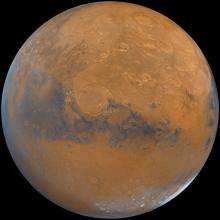
A handout image from the US Geological Survey in 2008 shows a mosaic of the Schiaparelli hemisphere of the planet Mars projected into point perspective, a view similar to that which one would see from a spacecraft. A journey from Earth to Mars could soon take just 39 days, cutting current travel time nearly six times, according to a rocket scientist who has the ear of the US space agency.
A journey from Earth to Mars could in the future take just 39 days -- cutting current travel time nearly six times -- according to a rocket scientist who has the ear of the US space agency.
Franklin Chang-Diaz, a former astronaut and a physicist at the Massachusetts Institute of Technology (MIT), says reaching the Red Planet could be dramatically quicker using his high-tech VASIMR rocket, now on track for liftoff after decades of development.
The Variable Specific Impulse Magnetoplasma Rocket -- to give its full name -- is quick becoming a centerpiece of NASA's future strategy as it looks to private firms to help meet the astronomical costs of space exploration.
NASA, still reeling from a political decision to cancel its Constellation program that would have returned a human to the moon by the end of the decade, has called on firms to provide new technology to power rovers or even future manned missions.
Hopes are now pinned on firms like Chang-Diaz's Texas-based Ad Astra Rocket Company.
"In the early days... NASA support for the project was rather minimal because the agency did not emphasize advanced technologies as much as it's doing now," Chang-Diaz told AFP.
NASA was focused instead on the series of Apollo missions that delivered men to the moon for the first, and so far last, times.
"They were mesmerized by the Apollo days and lived in the Apollo era for 40 years, and they just forgot developing something new," he said.
Chang-Diaz, 60, hopes that "something" is a non-chemical rocket that eventually allow for a manned trip to Mars -- long the Holy Grail for Apollonians.
His rocket would use electricity to transform a fuel -- likely hydrogen, helium or deuterium -- into plasma gas that is heated to 51.8 million degrees Fahrenheit (11 million degrees Celsius). The plasma gas is then channeled into tailpipes using magnetic fields to propel the spacecraft.
That would send a shuttle hurtling toward the moon or Mars at ever faster speeds up to an estimated 35 miles (55 kilometers) per second until the engines are reversed.
Chang-Diaz, a veteran of seven space missions, said this rapid acceleration could allow for trips of just 39 days instead of the current anticipated round trip voyage to Mars that would last three years, including a forced stay of 18 months on the Red Planet, as astronauts await an opening to return to Earth.
The distance between the Earth and Mars varies between 35 and 250 million miles (55 million and 400 million kilometers) depending on their points of orbit.
And the use of ionized fuel could have the extra benefit of helping create a magnetic field around the spacecraft to protect against radiation.
Scaled-down models of the VASIMR craft have been built and tested in a vacuum, under a deal with NASA.
The next major step, according to Chang-Diaz, will be orbital deployment at the end of 2013 of a vessel using the 200-kilowatt prototype VASIMR engine, the VX-200.
Talks are underway with fellow space firms SpaceX and Orbital Science Corp to make that a reality.
Despite the hurdles ahead, Chang-Diaz sees the potential for a vast market for his technology -- maintaining and repairing fixing satellites or launching robotic and commercial missions to Mars.
His rocket may just launch NASA's brave new, commercial, world of space exploration.
(c) 2010 AFP
-
Plasma Rocket Could Travel to Mars in 39 Days
Oct 06, 2009 |
not rated yet |
0
-
To Mars and Beyond: Plasma Rocket Research
Jul 15, 2004 |
not rated yet |
0
-
New rocket aims for cheaper nudges in space: Plasma thruster is small, runs on inexpensive gases (Video)
Feb 23, 2009 |
not rated yet |
0
-
For NASA no easy answer for next space destination
Feb 23, 2010 |
not rated yet |
0
-
NASA awards propulsion technology grant
Dec 07, 2005 |
not rated yet |
0
-
Engineers build first sub-10-nm carbon nanotube transistor
Feb 01, 2012 |
4.9 / 5 (31) |
30
-
Something old, something new: Evolution and the structural divergence of duplicate genes
Jan 31, 2012 |
4.6 / 5 (7) |
1
-
The hidden nanoworld of ice crystals: Revealing the dynamic behavior of quasi-liquid layers
Jan 30, 2012 |
5 / 5 (3) |
1
-
Stock market network reveals investor clustering
Jan 27, 2012 |
3.9 / 5 (23) |
8
-
Of microchemistry and molecules: Electronic microfluidic device synthesizes biocompatible probes
Jan 26, 2012 |
5 / 5 (1) |
0
-
Scale of the Universe
4 hours ago
-
Titan's lack of impact craters
Feb 09, 2012
-
Real pictures of black hole eating a star?
Feb 08, 2012
-
Hypothetical way to travel faster than light, but not technically exceed lightspeed
Feb 06, 2012
-
How do scientists monitor the Sun's activity?
Feb 05, 2012
-
Search patterns in observational studies
Feb 05, 2012
- More from Physics Forums - General Astronomy
More news stories
Humans may have helped the decline of African rainforests 3000 years ago
(PhysOrg.com) -- Large areas of rainforests in Central Africa mysteriously disappeared over three thousand years ago, to be replaced by savannas. The prevailing theory has been that the cause was a change ...
NASA sees wide-eyed cyclone Jasmine
Cyclone Jasmine's eye has opened wider on NASA satellite imagery, as it moves through the Southern Pacific Ocean.
Space & Earth / Earth Sciences
3 hours ago |
not rated yet |
1
NASA sees Giovanna reach cyclone strength, threaten Madagascar
Tropical Storm 12S built up steam and became a cyclone on February 10, 2012 as NASA's Terra satellite passed overhead. Residents of east-central Madagascar should prepare for this cyclone to make landfall ...
Space & Earth / Earth Sciences
3 hours ago |
not rated yet |
0
Could Venus be shifting gear?
(PhysOrg.com) -- ESAs Venus Express spacecraft has discovered that our cloud-covered neighbour spins a little slower than previously measured. Peering through the dense atmosphere in the infrared, the ...
Space & Earth / Space Exploration
11 hours ago |
5 / 5 (7) |
7
|
Mars Science Laboratory computer issue resolved
(PhysOrg.com) -- Engineers have found the root cause of a computer reset that occurred two months ago on NASA's Mars Science Laboratory and have determined how to correct it.
Space & Earth / Space Exploration
12 hours ago |
4.7 / 5 (6) |
3
|
Google users warned of threat to smartphone wallets
Users of Google smartphone wallets were being warned on Friday that there is a way to crack pass codes intended to thwart thieves from going on illicit shopping sprees.
Anonymous knocks CIA website offline (Update)
The website of the Central Intelligence Agency was inaccessible on Friday after the hacker group Anonymous claimed to have knocked it offline.
Complex wiring of the nervous system may rely on a just a handful of genes and proteins
Researchers at the Salk Institute have discovered a startling feature of early brain development that helps to explain how complex neuron wiring patterns are programmed using just a handful of critical genes. ...
New error-correcting codes guarantee the fastest possible rate of data transmission
Error-correcting codes are one of the triumphs of the digital age. Theyre a way of encoding information so that it can be transmitted across a communication channel such as an optical fiber o ...
The power of estrogen -- male snakes attract other males
A new study has shown that boosting the estrogen levels of male garter snakes causes them to secrete the same pheromones that females use to attract suitors, and turned the males into just about the sexiest ...
Putting the squeeze on planets outside our solar system
(PhysOrg.com) -- Using high-powered lasers, scientists at Lawrence Livermore National Laboratory and collaborators discovered that molten magnesium silicate undergoes a phase change in the liquid state, abruptly ...
Feb 26, 2010
Rank: 3.4 / 5 (5)
Link: http://nextbigfut...cts.html
Feb 26, 2010
Rank: 4 / 5 (4)
Our goal should be a permanent manned settlement on Mars with continually rotating crews by 2030.
I the meantime, we should use the Moon as a lab for testing robotic mining and construction techniques.
Feb 26, 2010
Rank: 1.7 / 5 (13)
Feb 26, 2010
Rank: 5 / 5 (6)
that would probably kill the astronaunts inside the craft as they are accelerated to 14,000,000 m / s in under 1 sec. they would be a puddle of goo.
Feb 26, 2010
Rank: 4.3 / 5 (9)
Feb 26, 2010
Rank: 2.8 / 5 (6)
Maybe if it had three motors it would be a 27 round cylinder colt. LOL
Feb 26, 2010
Rank: 4.2 / 5 (5)
But we just finished the first space station -- lets keep building on that and moving forward - men on Mars while scientifically challenging and a game changer is like the failure of the Apollo missions -- yes we went to the moon a few times, but we never set up infrastructure to stay there. It is easier to fly away from a moon or space station than a planet. -- Fuel is a limiting factor
Feb 26, 2010
Rank: 4.7 / 5 (10)
Feb 26, 2010
Rank: 5 / 5 (3)
I think Probes' point was that a pulsed nuclear rocket isn't that special and is, in fact, a fairly messy way to power a ship. Still, they'll probably end up using a nuclear reactor to power the VASIMR... I look forward to the orbital test!
Probes, looks like your favorite, the VASIMR, is getting closer to reality
Feb 26, 2010
Rank: 5 / 5 (4)
WHAT????????????????
Feb 26, 2010
Rank: 4.6 / 5 (7)
Apart from the fact that the astronaut would convert to goo cause of the acceleration.
It works like this.
If the rocket would go very fast, then time would dilate and space would contract for the astronaut. For the astronaut it takes 3.9 seconds to get to mars. For the observer on earth still a bit more than distance/c seconds.
Feb 26, 2010
Rank: 5 / 5 (6)
Feb 26, 2010
Rank: 3 / 5 (4)
Feb 26, 2010
Rank: 2.9 / 5 (8)
But why build the first operational skyhook on the moon or Mars? Uniform carbon nanotubes on the order of one inch long (3 cm) have now been constructed. For good spun nanotube fiber with cross-linking one to ten meter long nanotubes would be better, but the process can easily be scaled up to that point. Now all you need to do is fabricate a few hundred tons of such fibers, convert them into a cable (or tape) and get the cable into orbit.
Notice that shipping the cable in sections to the space station and deploying it from there is probably the best possible use of the space station. Do it right and the space station ends up as a depot 100 to 300 km up, and easily resupplied from the ground.
Feb 26, 2010
Rank: 1.6 / 5 (7)
Put your feet firm on the ground.
Or are your feet hanging from your legs that hang from your corps to reach the ground?
Feb 26, 2010
Rank: 4.8 / 5 (4)
Feb 26, 2010
Rank: 5 / 5 (3)
http://selenianbo...ing.html
VASIMR, oh, yes.
Feb 26, 2010
Rank: 3 / 5 (2)
Feb 26, 2010
Rank: 1.8 / 5 (6)
And, yet, unless we have space stations or bases in space, we still will need a post-Apollo rocket booster technology to get it up into space in the first place.
We needed to get to a low-gravity or zero-gravity location in space from which to launch something like this. Obama is trying to kill such programs as the moon base. No one thus far has built a spacebase, either.
And VASIMIR to Mars in 3.9 seconds? Impossible. Even with current estimates for the VX-200 it still will need to include acceleration time and deceleration time. Calculations I have read in source material give approximately 6-7 days from LEO to LMO. That is to the Moon, much less Mars.
120,000,000 (distance at closest Mars encounter) / 186,000 (~c) = 645.1612903225806 (Seconds)
120,000,000 / 186,000
----------------------------- = 10.75268817204301 (min)
60
Even with light speed 3.9 seconds is impossible.
Feb 26, 2010
Rank: 1.8 / 5 (5)
By the way, before someone chooses to attack my use of the term spacebase, consider that a spacebase, which we have never built, is somewhat of a different thing than something we have built--space stations.
Feb 26, 2010
Rank: 2 / 5 (3)
I would disagree. People are flying around the Earth for too long now. More than 40 years after landing on the Moon humankind is not even able to repeat this achievement. I see the benefits of 'small steps', but I am afraid that this attitude will keep us with the chemical propulsion for many decades to come. I hope that VASIMR will find its use in deep space probes, and orbital haul robots. I also hope that the nuclear reactors will find its way to space. Without these steps we will keep dreaming about the space era.
Feb 26, 2010
Rank: 5 / 5 (2)
http://www.adastr...c/VASIMR
Note that this info comes direct from the company that builds it so probably a little biased
Feb 26, 2010
Rank: 5 / 5 (4)
Feb 26, 2010
Rank: 5 / 5 (3)
Feb 26, 2010
Rank: 5 / 5 (6)
You're quite right, in that we need to get into LEO. The crucial part you're missing, is COST. What NASA ought to be focusing on, is reducing cost of launch to orbit. They had this priority in the late 90's, but Bush scrapped the efforts.
If we could bring down the costs of launch from $10,000/lb to $100/lb, then all sorts of things become possible: from space bases, to moon bases, to Mars bases. Until then, all these dreams are just multi-trillion-dollar, unrealistic/unfundable fantasies.
Feb 26, 2010
Rank: 1 / 5 (7)
Feb 27, 2010
Rank: 4.8 / 5 (5)
The only way a manned Moon program (never mind manned Mars programs) can ever be anything other than a ridiculously wasteful PR campaign, is if we find a way to reduce launch costs by a couple orders of magnitude. Then, and only then, could a Moon base be constructed, maintained, expanded, and sustained indefinitely without breaking the bank.
Feb 27, 2010
Rank: 4.7 / 5 (3)
Its hard to justify massive spending on putting men on the moon in our current economic climate. It saddens me a lot, but its political suicide to pursue it now.
Feb 27, 2010
Rank: 5 / 5 (4)
I do agree with the poster above about the economics of the space elevator, but we need to reduce the cost of achieving LEO to less than $1k/lb before even thinking about trying to do that. But at $1k/lb, it would be cost effective to launch solar power satellites, a much larger permanent human presence in LEO, and moon bases. I believe that reducing the LEO cost right now should be the overwhelming priority. I think this is also the goal of Obama via his support of the private space program.
Feb 27, 2010
Rank: 5 / 5 (2)
I was wondering who would point that out, lol.
As you can tell, people don't put a lot of thought into what they write.
Feb 28, 2010
Rank: 5 / 5 (2)
And when the station becomes obsolete, leave that engine on until the station reaches geosyncronous orbit.
Feb 28, 2010
Rank: 1.7 / 5 (3)
Feb 28, 2010
Rank: 1.7 / 5 (3)
Feb 28, 2010
Rank: 5 / 5 (2)
Wow, so it would be going about 50 times the speed of light! What a revelation! I want one....
Feb 28, 2010
Rank: 5 / 5 (2)
Feb 28, 2010
Rank: 4.3 / 5 (3)
Mar 01, 2010
Rank: 3 / 5 (4)
Mar 01, 2010
Rank: 5 / 5 (2)
Mar 01, 2010
Rank: 3.7 / 5 (3)
http://www.youtub...FowOge_M
http://www.crossf...iew.html
Mar 01, 2010
Rank: 5 / 5 (1)
The ISS generates a maximum of 260 kWe. Assuming that half of this power is used for life support, computers, etc, then that leaves 130 kW for the VASIMR.
It would take between 10-20 MWe to have a 39 day Mars mission. How do you generate this power in current or future space power technology. The first and only space nuclear reactor to orbit the earth (SNAP-10a) was designed to produce 30 kW of power and had 88 ft2 of radiator area. Paper designs for advanced reactors were between 100 and 300 kW. That means they would need around 35 advanced space nuclear reactors(300 kW ea) for a 10 MWe VASIMR and around 30,000 ft2 of radiator. This doesn't include pump power or life support power. I would like to see it built...but definitely have be done on orbit.
Mar 01, 2010
Rank: 5 / 5 (5)
http://www.physor...552.html
Quoting:
Mar 01, 2010
Rank: 5 / 5 (4)
From the same article:
http://www.physor...552.html
Note the mention of 10-20 MW. You said 200 MW. You're off by a factor of 10.
Mar 03, 2010
Rank: 1.7 / 5 (3)
120,000,000 / 186,000
----------------------------- = 10.75268817204301 (min)
60
So, we would need at least 186,000 sq.ft of radiators. Impossible!
Mar 03, 2010
Rank: 3 / 5 (1)
Mar 03, 2010
Rank: 3 / 5 (1)
Mar 03, 2010
Rank: 1.5 / 5 (2)
Mar 06, 2010
Rank: 5 / 5 (1)
Once the network is in place, using the old fashioned way in say 30 years, you could realistically speak about trip times of 20-30 days to the next planet and every now and then send some uranium to refuel the reactors.
Mar 07, 2010
Rank: 4.5 / 5 (2)
If you think about space, it was built for the stuff. Solar power from stars, while running your quantum procs in the planet shadows at -2.7K. intelligence that can beam itself at light speed from earth to orbit and beyond, and upon arrival at a planet can build machinery at a nano level form raw elements, no payload necessary. A giant, interconnected brain spanning galaxies increasing computation power at the speed of light, but more importantly, able to imagine more and more things. like 'crossing' into other dimensions/universes. or downloading itself into human or animal body's on earth to hang out with friends, to experience life as we do. to think, touch and feel the immedcacy of life, even as its hive mind is aware of everything that has happened (complete assimilation of internet/human culture histroy) and aware of everything always.
Mar 08, 2010
Rank: 4 / 5 (1)
I agree. Every increase in our machine's sophistication and intelligence makes human space exploration more and more pointless. But I can see how we may wish to modify ourselves to keep up with our machines and join them in space some day: In the really long run, Earth is a death trap for us.
Mar 11, 2010
Rank: 1.8 / 5 (4)
Umm...no. It would be 6-7 days for a 200-kW VASIMIR, which includes acceleration and deceleration times.
In addition, you will never break light speed with a VASIMIR, no matter how large the radiator. And, I nowhere said that it would require 186,000 sq. ft. of radiator. The 186,000 figure I gave above is roughly the speed of light.
The point I made is that even at light speed (not happening with a VASIMIR of any size) a ship could not reach mars in your claimed 3.9 seconds. Even at light speed, the trip would take at least 10.75268817204301 minutes (or, 645.1612903225806 seconds) one way at closest Mars encounter.
VASIMIR is NOT a FTL technology. The best one could do is to approximate light speed and even that claim would be pushing things.
Still, 39 days for a larger VASIMIR would be cool enough for now.
Mar 15, 2010
Rank: 5 / 5 (1)
I like your calculations that round off the speed of light to the nearest thousand m/s yet yield results accurate to .000000000001 seconds
Mar 15, 2010
Rank: 1 / 5 (3)
Want more precision in miles per second? Ok. Here:
120,000,000 / 186282.3970512209
--------------------------------------------------- = 10.73638750445149 (minutes)
60
That is 644.1832502670897 seconds for light to travel to Mars at encounter. Better? Doesn't make much difference in the long run, though.
There still is no way any VASIMIR will get anyone to Mars in 3.9 seconds.
Mar 15, 2010
Rank: 1 / 5 (3)
http://www.bipm.o...8_en.pdf
See page 112 (page 20 in the PDF) of the above document.
299,792,458 meters/second = 186,282.3970512209 miles/second.
But, if you want me to get more units of precision, here is a more precise calculation of minutes for an object traveling at the speed of light to reach Mars at encounter:
10.736387504451494519223093550704
Mar 15, 2010
Rank: 1 / 5 (3)
299,792,458 (meters/s) / 1,609.344 (meters in a mile) = 186,282.3970512208701185079137835 miles/s
One could get even more precise but what would be the point overall when discussing things like this in a public forum? Really? :)
Mar 15, 2010
Rank: 5 / 5 (2)
this should get you up to speed
http://www.chem.s...dex.html
Mar 15, 2010
Rank: not rated yet
Mar 15, 2010
Rank: 1 / 5 (4)
You are kidding, right? It is not like I am writing a scientific paper requiring greater precision to get the main thrust of a point across. When I went to school (probably before you were born) Physical Science was a requirement both in the Middle School and High School systems in order to graduate.
(Does this date me? One of my old textbooks in High School was on the subject Latin).
Even in the textbooks of the day the numbers for the speed of light were given imprecisely for a general audience. Nonetheless, perhaps I am giving you too much credit by replying at all... :)
As to paying attention to "probes," it is more for the benefit of those who may be misled by his inanity that I posted what I did. Wherever he is getting his material obviously is a crank source.
Mar 15, 2010
Rank: 5 / 5 (1)
When you did your calculation you used 186,000 mi/sec and got an asnwer of "645.1612903225806" seconds anything beyond the 645 has no physical meaning whatsoever because you estimated the speed of light to only three sig figs. I wouldn't normally call someone out for it but it just looked so rediculous that I had to say something.
I was just joking with my first post because I figured that you just copy and pasted your answers from the calculator and expected you to just respond with a "haha" or an "lol", I wasn't trying to be a dick or anything so sorry if I offended you.
Good point with the probes issue though, some people might not know that he was just trying to get a rise out of people and might have taken him seriously.
Mar 15, 2010
Rank: 1 / 5 (3)
You are right that I should have rounded. Such numbers are meaningless to the public. So, here is my revised figuring for the general public, rounded to the nearest tenth.
~120,000,000 / ~186,282.4
------------------------------------------- = ~10.7 (minutes)
60
Or, 644.2 seconds.
Still doesn't change the initial point, however, as I hope you would acknowledge. :)
Mar 15, 2010
Rank: not rated yet
This VASIMR rocket has one newton of thrust per 100 kilowatt. So this 200 kilowatt version has two newton of thrust. If they put three of these motors to a spaceship it has about 1 pound of thrust.
A normal space shuttle rocket has the thrust of about 400000 pounds during 6 minutes.
Imagine the ship weighs 1000 kg. This is just an example of
While a=F/m, a is about 2e6/1e3 is about 2000 m/s2
While the gained speed is V=Vo+at, the ship will gain 2000m/s speed every second during 360 seconds.
While VASIMR will have an a is about 5/1e3 is 5mm/s2
The advantage of VASIMR is that it will work 86400 seconds per day, so that means that in order to burn one equivalent spaceshuttle fuel tank it must work during many days and need very tiny amounts of actual fuel. So the advantage is that you do not need to bring so much fuel into space.
High acceleration values are not the goal. Uninterrupted functionality is the goal
Mar 18, 2010
Rank: 1 / 5 (1)
Mar 19, 2010
Rank: 1 / 5 (2)
Nope. VASIMIR cannot do what you think it can.