Nanotube Thermocells Hold Promise as Energy Source
February 26, 2010
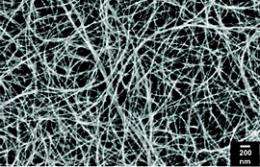
A view from an electron microscope shows the multiwalled carbon nanotube "buckypaper" used in the new thermocells.
(PhysOrg.com) -- A study published in the American Chemical Society's journal Nano Letters reveals that thermocells based on carbon nanotube electrodes might eventually be used for generating electrical energy from heat discarded by chemical plants, automobiles and solar cell farms. Dr. Ray Baughman, director of the Alan G. MacDiarmid NanoTech Institute, collaborated with an international team of researchers on the findings.
Efficiently harvesting the thermal energy currently wasted in industrial plants or along pipelines could create local sources of clean energy that in turn could be used to lower costs and shrink an organization’s energy footprint.
The new thermocells use nanotube electrodes that provide a threefold increase in energy conversion efficiency over conventional electrodes.
One of the demonstrated thermocells looks just like the button cell batteries used in watches, calculators and other small electronics. One key difference, however, is that these new thermocells can continuously generate electricity, instead of running down like a battery. The research netted other thermocells, as well, including electrolyte-filled, textile-separated nanotube sheets that can be wrapped around pipes carrying hot waste streams of manufacturing or electrical power plants. The temperature difference between the pipe and its surroundings produces an electrochemical potential difference between the carbon nanotube sheets, which thermocells utilize to generate electricity.
Dr. Ray Baughman, the Robert A. Welch Chair in Chemistry and director of the Alan G. MacDiarmid NanoTech Institute, collaborated with an international team of researchers from the U.S., Australia, China, India and the Philippines.
“We have long been the Energy State, because Texas has oil and gas in the ground and Texans have invented key technologies for bringing them to the surface,” Baughman said. “But, being the Energy State in the future must increasingly include discovering new means for extracting all forms of energy. Harvesting waste thermal energy is just one direction our NanoTech Institute has taken with our international team to help provide an energy enabled future for Texas and the world.”
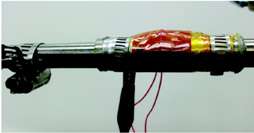
A thermocell is wrapped around a stainless steel pipe to generate electrical power.
The research team estimates that multi-walled carbon nanotubes in large thermocells could eventually produce power at a cost of about $2.76 per watt from freely available waste energy, compared with a cost of $4.31 per watt for solar cells, which can only be used when the sun is shining. On a smaller scale, button cell sized thermocells could be used to power sensors or electronic circuits.
The new thermocells take advantage of the exceptional electronic, mechanical, thermal and chemical properties of carbon nanotubes. The nanotubes’ giant surface area and unique electronic structure afforded by their small diameter and nearly one-dimensional structure offer high current densities, which enhance the output of electrical power and the efficiency of energy harvesting.
“International collaboration with teammates from four universities in the United States, Australia and India enabled our initial breakthrough,” Baughman said. “Researchers from Dr. Gordon Wallace’s Intelligent Polymer Research Institute in Wollongong Australia have long worked side-by-side with us to solve key technological problems. Dr. Baratunde Cola’s NanoEngineered Systems and Transport Lab at the Georgia Institute of Technology, provided a key missing link. We will together work in the future to realize the full commercial potential of our technology, which requires further breakthroughs. I am especially proud that Stephanie Stoughton earned her place as a co-author while a Texan high school student in our NanoExplorers program.”
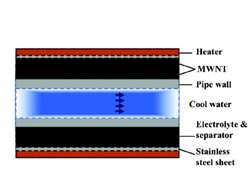
Schematics show assembly of the thin thermocell wrapped around a pipe carrying cool, flowing liquid.
Stoughton, a former George A. Jeffrey NanoExplorer, is a sophomore studying materials science and engineering at Cornell University.“My contribution was near the project’s beginning,” Stoughton said. “I did some of the early testing and helped create the buckypaper used in the nanotube electrodes.”
Stoughton credits her experience at the NanoTech Institute for offering her access to hands-on research as early as high school.
“UT Dallas and the NanoTech Institute have time and again given students unique opportunities to participate in cutting-edge research and work with top notch scientists,” Stoughton said. “My generation is one likely to face profound energy issues, and I’m proud to be a part of achieving sustainable solutions now as opposed to later, when energy issues are likely to be even more problematic.”
More information: Paper: http://www.me.gate … l903267n.pdf
-
Major Award for Carbon Natotube Partners
Jun 10, 2005 |
not rated yet |
0
-
Carbon Nanotube Artificial Muscles for Extreme Temperatures
Mar 20, 2009 |
not rated yet |
0
-
Race for Superconductors Shrinks to Nanoscale
Oct 09, 2009 |
not rated yet |
0
-
Solar Cell Researcher Explores Nanotech Ideas
Oct 05, 2009 |
not rated yet |
0
-
Scientists Track Heat in Tiny Rolls of Carbon Atoms
Mar 02, 2009 |
not rated yet |
0
-
Engineers build first sub-10-nm carbon nanotube transistor
Feb 01, 2012 |
4.9 / 5 (30) |
30
-
Something old, something new: Evolution and the structural divergence of duplicate genes
Jan 31, 2012 |
4.6 / 5 (7) |
1
-
The hidden nanoworld of ice crystals: Revealing the dynamic behavior of quasi-liquid layers
Jan 30, 2012 |
5 / 5 (3) |
1
-
Stock market network reveals investor clustering
Jan 27, 2012 |
3.9 / 5 (23) |
8
-
Of microchemistry and molecules: Electronic microfluidic device synthesizes biocompatible probes
Jan 26, 2012 |
5 / 5 (1) |
0
-
polymer nanocomposites
1 hour ago
-
Corrosion Tests on Magnesium
14 hours ago
-
polyethylene copper nanocomposite
20 hours ago
-
Output of xrd analysis
Feb 08, 2012
-
Transport phenomena problem based on problems 18.B11 and 19B.6 from Bird, stewart, lw
Feb 06, 2012
-
Help with material selection - Car Piston
Feb 05, 2012
- More from Physics Forums - Materials & Chemical Engineering
More news stories
'Dark plasmons' transmit energy
Microscopic channels of gold nanoparticles have the ability to transmit electromagnetic energy that starts as light and propagates via "dark plasmons," according to researchers at Rice University.
10 hours ago |
5 / 5 (4) |
0
|
Nanotube therapy takes aim at breast cancer stem cells
Wake Forest Baptist Medical Center researchers have again proven that injecting multiwalled carbon nanotubes (MWCNTs) into tumors and heating them with a quick, 30-second laser treatment can kill them.
Nanotechnology / Bio & Medicine
15 hours ago |
5 / 5 (1) |
0
|
Inspired by steel, nanomanufacturing gets wear-resistant carbide tip
(PhysOrg.com) -- Scientists at the University of Pennsylvania, the University of Wisconsin-Madison and IBM Research - Zurich have fabricated an ultrasharp silicon carbide tip possessing such high strength ...
20 hours ago |
5 / 5 (3) |
1
|
New technology platform for molecule-based electronics
Researchers at the Nano-Science Center at the University of Copenhagen have developed a new nano-technology platform for the development of molecule-based electronic components using the wonder material graphene. At the same ...
Nanotechnology / Nanomaterials
17 hours ago |
5 / 5 (2) |
0
New kind of solar cell could capture significantly more energy than current cells
New solar cells could increase the maximum efficiency of solar panels by over 25%, according to scientists from the University of Cambridge.
Feb 08, 2012 |
4.5 / 5 (11) |
14
|
FDA-approved drug rapidly clears amyloid from the brain, reverses Alzheimer's symptoms in mice
Neuroscientists at Case Western Reserve University School of Medicine have made a dramatic breakthrough in their efforts to find a cure for Alzheimer's disease. The researchers' findings, published in the journal Science, show t ...
Hydrogen from acidic water: Researchers develop potential low cost alternative to platinum for splitting water
A technique for creating a new molecule that structurally and chemically replicates the active part of the widely used industrial catalyst molybdenite has been developed by researchers with the Lawrence Berkeley ...
Ultraviolet protection molecule in plants yields its secrets
Lying around in the sun all day is hazardous not just for humans but also for plants, which have no means of escape. Ultraviolet (UV) radiation from the sun can damage proteins and DNA inside cells, leading ...
Soraa LED light may dim 50-watt halogen rivals
(PhysOrg.com) -- Soraa, a Fremont, California company founded in 2008, this week launched its first product, a light that uses LEDS (light emitting diodes). The "Soraa LED MR16 lamp" is the "perfect" replacement ...
Anyone can learn to be more inventive, cognitive researcher says
There will always be a wild and unpredictable quality to creativity and invention, says Anthony McCaffrey, a cognitive psychology researcher at the University of Massachusetts Amherst, because an "Aha moment" is rare and ...
Engineers find inspiration for new materials in Piranha-proof armor
(PhysOrg.com) -- Its a matchup worthy of a late-night cable movie: put a school of starving piranha and a 300-pound fish together, and who comes out the winner?
Feb 26, 2010
Rank: not rated yet
Feb 26, 2010
Rank: 3 / 5 (2)
Here is an actual explanation (specifically look at the figure showing ferri-ferrocyanide ions shuttling between cold and hot areas with electron given away at hot anode):
http://www.greenc...220.html
Feb 26, 2010
Rank: not rated yet
Feb 27, 2010
Rank: not rated yet
Feb 27, 2010
Rank: not rated yet
Feb 28, 2010
Rank: not rated yet
Mar 01, 2010
Rank: not rated yet
thermocells pasted to the backs of solar cells will not solve the excess heat problem, they will hold the heat in and slow down its' transfer from the solar cells.