Bio-inspired computer networks self-organise and learn
(PhysOrg.com) -- Powerful computers made up of physically separate modules, self-organising networks, and computing inspired by biological systems are three hot research topics coming together in one European project.
European researchers have developed an innovative computing platform. At the heart of the system are many small modules, each made from chips with an inbuilt ability to learn. A self-configuring wireless network connects the modules, allowing them to operate as a coherent group.
Evolving to suit the task in hand and acting on information about their environment, such systems are described by their developers as “bio-inspired”. They are well suited to building mathematical models of scientific problems in which complexity arises from simple building blocks, such as in brains, stock markets, and the spread of new ideas.
Researchers already use programs that can learn - neural networks - to study problems like these. Their simulations would run faster if they could hard-wire instructions into computer chips rather than load them as software, but normally this would stop the machines from learning. Chips that learn by physically reconfiguring themselves therefore offer the best of both worlds.
Large numbers of computers working in parallel to solve complex problems is not a new idea. Such networks are not very flexible, however, since the computers must be set up individually with software tailored to each task.
The European PERPLEXUS project therefore draws on another hot topic in research: self-organising wireless networks which can adapt to the job in hand.
Ubidules and ubichips
In principle, such networks could provide “ubiquitous computing” by assembling themselves from any wireless-equipped devices within reach: computers, smart phones, robots, even electronic toys, explains Andrés Pérez-Uribe, spokesperson for the EU-funded PERPLEXUS project.
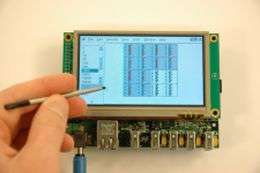
In this project, the researchers confined themselves to a model network built up from one basic building block: the ubidule, a purpose-designed module about the size of a personal digital assistant (PDA). Ubidules can take information from their environments, share data wirelessly, and adapt their behaviour to the circumstances. In a large network, for instance, some ubidules may evolve to specialise in a particular task, which other ubidules then delegate to them.
Key to every ubidule is a processor chip, the ubichip, which can learn and evolve. This idea began with an earlier European project, POEtic, which developed a processor based on a large number of identical sub-units or cells. Depending on the current task, each cell can vary its function by changing its internal wiring; at a higher level, links between cells can also be made or broken. Until now, such flexibility has only been available from chips that are externally programmed. The ubichip, in contrast, works out the necessary wiring for itself.
Modelling brains and cultures
The researchers say ubidules can model both grid-based problems in the physical sciences, and the harder-to-formulate challenges of biological systems and social sciences. They have used ubidules to develop biologically-plausible neural network models of the brain, for instance, and to study how ideas spread between people.
Problems which can be visualised as grids or networks are often studied with the help of autonomous programs known as agents, which collect and exchange information from different parts of the network. At the moment this exchange is often quite basic, with agents simply passing on all the information that comes their way. Pérez-Uribe explains that a network of ubidules could give each agent its own neural network. By interpreting data and being more selective about what they pass on, these intelligent agents could yield better models.
Another branch of the project involved a fleet of small but sophisticated all-terrain robots fitted with ubichips. The researchers developed a new strategy in the field known as collective robotics, whose premise is that groups of robots which communicate with one another are more effective than the same robots acting individually.
In this case, the researchers looked at how foraging robots locate an important place such as a collection point for items they have picked up. Each robot displays a coloured beacon and carries a video camera which can see other robots’ beacons. Robots change the colour of their beacons to signal that they have successfully found the target, and nearby robots copy this behaviour.
The result is a gradient of beacon colours which guides other robots towards the target, rather as in an unfamiliar shopping mall where you might locate a particular store by following a trail of people carrying distinctive plastic bags. According to Pérez-Uribe, this technique is promising for situations where navigation by fixed coordinates or GPS is impossible.
Reflecting its forward-looking nature, PERPLEXUS is dominated by academic institutions in Switzerland, France, Poland and Spain. PERPLEXUS received funding from the ICT strand (FET Proactive) of the Sixth Framework Programme for research.
More information: PERPLEXUS project - www.perplexus.org/
Provided by ICT Results


