Shooting Meteorites in a Barrel
February 26, 2010 by Jeremy Hsu
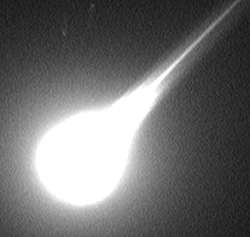
A Leonid meteorite imaged in 2002 from the NASA DC-8 aircraft. When meteorites enter the Earth's atmosphere, the extreme heat causes minerals and organic matter on their outer crusts to be released. This creates the familiar 'shooting star' effect. Image Credit: NASA/George Varros
High-impact lab experiments simulate whether the building blocks of life could have survived the rough arrival on Earth via meteorite impact.
Recreating how the seeds of life might have survived aboard an ancient meteorite that crashed to Earth is no small feat, but scientists have begun doing just that in their labs. Their high-impact experiments could help indicate whether life on Earth got its start from alien organic material that hitched a ride aboard space rocks.
Perhaps one of the likeliest building blocks of primordial life on Earth came in the form of amino acids, which are the basic components of proteins. And so a team of U.S. and European researchers focused on trying to replicate how well amino acids could fare when a meteorite slams into the ground.
"This study is the first which tested amino acid quantities similar to those found in real meteorites," said Marylene Bertrand, a biophysicist funded by the National Center for Scientific Research (CNRS) in France and lead author on the work published in the December issue of the journal Astrobiology.
More than 70 different amino acids have been found in meteorites that fell to Earth. Past studies have tested the survivability of many amino acids, but did not try to replicate the concentrations of organic molecules found in actual meteorites.
Bertrand's group also took the new step of testing the amino acids embedded inside saponite, a clay material found in carbonaceous chondrite meteorites that represents a possible signature of water.
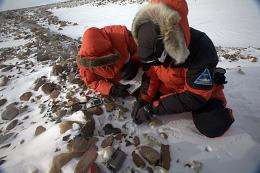
ANSMET team members collect a meteorite in Antarctica during the 2006-07 field season. Field teams have sent back about 17,500 space rocks to the United States in the last 30-plus years. The meteorites contain important information about the evolution of the early solar system. Image credit: Ralph Harvey / Antarctic Search for Meteorites (ANSMET)
How to recreate a falling meteoriteSimulating a meteorite impact involved firing cylindrical plugs from a 20 mm gun at a target holding the amino acid-saponite samples in place. Researchers fired the gun inside a vacuum chamber to allow the projectiles to strike the samples at the highest possible speed, and tested a range of low to high impact pressures.
"It is easier to launch a projectile than to launch the samples," Bertrand told Astrobiology Magazine, and noted that the resulting shock from hitting the samples with a projectile was the same as if the team had shot the samples out of the gun.
The toughest amino acid survivors, including the smallest amino acid glycine, turned out to have a molecular alkyl side chain. A second group of amino acids with structures that include a functional side chain and dipeptide proved less resistant, and failed to survive the highest impact pressures.
A failure of many amino acids in the experiment to resist higher shocks seems puzzling, because many of the same amino acids appear to have survived in meteorites. Bertrand's group suggested that the samples containing the amino acids could not expand inside the metal target containers, causing them to endure higher pressures and temperatures than what they would have experienced inside falling meteorites.
Also, amino acids may have been better able to survive the shock of impact if they arrived on Earth billions of years ago, when the atmosphere was more dense and was mainly comprised nitrogen, carbon dioxide, and methane.
"The atmosphere was very different in primitive Earth and the conditions and effects of the impacts on organic matter could have been very different than now," Bertrand explained.
Amino acids also might evaporate upon impact and then eventually condense once more inside meteorites, the team noted. Or larger organic compounds could have been destroyed by the impact shock and broke apart into amino acids.
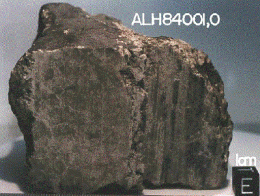
Martian meteorite ALH 84001. This 4.5 billion-year old meteorite contains microscopic structures that NASA scientists interpreted to be remnants of ancient fossilized life from Mars. Image credit: NASA
Stirring the primordial soupSuch studies raise plenty of new questions to join the unknowns already swirling around regarding how life on Earth first arose. For instance, scientists still do not know the rate of meteorites that fell at low or medium velocities, which would have made survival more likely for amino acids and other organic molecules.
Still, they know that roughly 20,000 tons of meteorites and other space particles fall to Earth each year. Any organic-bearing rocks could have made a big difference during the first 500 million years of the Earth's existence as a planet.
"I think that all organic matter present on Earth in living organisms could come from the meteorites, micrometeorites or [interplanetary dust particles]," Bertrand said. "The major question now is how the organic matter could have been processed and organized to lead to living organisms."
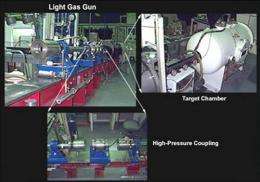
The scientists in this study simulated a meteorite impact by firing cylindrical plugs from a 20 mm gun at a target holding the amino acid-saponite samples in place. Image credit: Marylene Bertrand
Scientists agree that life somehow emerged from the water around four billion years ago, and also agree that such organisms mainly consisted of liquid water and organic molecules. But they still debate whether the organic building blocks arose from the sun's radiation providing energy for the early ocean "soup," or whether undersea hydrothermal vents provided the necessary biochemistry touch.If meteorites provided a third way by bringing life's ingredients to Earth, then their precious organic cargo must have somehow survived an even more daunting prospect than impact — the long journey through space.
Bertrand's group also wants to check out the effects of space conditions on organic molecules. They have already conducted experiments that exposed amino acids to ultraviolet light in the harsh vacuum outside the International Space Station, as well as in lab settings on Earth.
Source: Astrobio.net
-
Scientists Find Clues to a Secret of Life
Mar 17, 2009 |
not rated yet |
0
-
Could salt crusts be key ingredient in cooking up prebiotic molecules?
Sep 18, 2009 |
not rated yet |
0
-
Space Hand-Me-Downs
Sep 18, 2009 |
not rated yet |
0
-
NASA funds instrument to probe life on Mars
Jan 12, 2007 |
not rated yet |
0
-
Michigan Astronomer to Search in Space for Precursors of Life
Apr 30, 2009 |
not rated yet |
0
-
Engineers build first sub-10-nm carbon nanotube transistor
Feb 01, 2012 |
4.9 / 5 (31) |
30
-
Something old, something new: Evolution and the structural divergence of duplicate genes
Jan 31, 2012 |
4.6 / 5 (7) |
1
-
The hidden nanoworld of ice crystals: Revealing the dynamic behavior of quasi-liquid layers
Jan 30, 2012 |
5 / 5 (3) |
1
-
Stock market network reveals investor clustering
Jan 27, 2012 |
3.9 / 5 (23) |
8
-
Of microchemistry and molecules: Electronic microfluidic device synthesizes biocompatible probes
Jan 26, 2012 |
5 / 5 (1) |
0
-
Titan's lack of impact craters
Feb 09, 2012
-
Real pictures of black hole eating a star?
Feb 08, 2012
-
Hypothetical way to travel faster than light, but not technically exceed lightspeed
Feb 06, 2012
-
How do scientists monitor the Sun's activity?
Feb 05, 2012
-
Search patterns in observational studies
Feb 05, 2012
-
Derivation of Pogson's law
Feb 03, 2012
- More from Physics Forums - General Astronomy
More news stories
Could Venus be shifting gear?
(PhysOrg.com) -- ESAs Venus Express spacecraft has discovered that our cloud-covered neighbour spins a little slower than previously measured. Peering through the dense atmosphere in the infrared, the ...
Space & Earth / Space Exploration
4 hours ago |
5 / 5 (5) |
7
|
Humans may have helped the decline of African rainforests 3000 years ago
(PhysOrg.com) -- Large areas of rainforests in Central Africa mysteriously disappeared over three thousand years ago, to be replaced by savannas. The prevailing theory has been that the cause was a change ...
Mars Science Laboratory computer issue resolved
(PhysOrg.com) -- Engineers have found the root cause of a computer reset that occurred two months ago on NASA's Mars Science Laboratory and have determined how to correct it.
Space & Earth / Space Exploration
5 hours ago |
5 / 5 (5) |
3
|
Clam fields found at deep, low-temperature Mariana vents
(PhysOrg.com) -- Scientists have marveled at the unusual life forms thriving at high temperature hydrothermal vents of the deep ocean.
Space & Earth / Earth Sciences
5 hours ago |
not rated yet |
0
|
Two new moons for Jupiter
Advances in technology have lead to the discovery of new planets outside of our Solar System, and now even new moons in our own backyard.
Space & Earth / Space Exploration
4 hours ago |
not rated yet |
2
Putting the squeeze on planets outside our solar system
(PhysOrg.com) -- Using high-powered lasers, scientists at Lawrence Livermore National Laboratory and collaborators discovered that molten magnesium silicate undergoes a phase change in the liquid state, abruptly ...
India probes Google over 'forex transactions'
Indian authorities are probing whether online giant Google broke domestic foreign-exchange transactions rules while shifting funds abroad, the Press Trust of India reported on Friday.
Germany freezes signing of disputed Internet pact
Germany on Friday halted the signing of a controversial international accord billed as a way to beat online piracy that has sparked angry protests, saying it needed more time to consider it.
Health experts, scientists to discuss bird flu studies
The World Health Organization said Friday it will meet next week to determine whether scientists can publish research on a bird flu virus that may be easily passed among humans.
Employers feel no love for unscrupulous practice of 'service sweethearting'
A new study led by two Florida State University marketing professors finds that some frontline service employees who are rewarded for hikes in customer loyalty and satisfaction also may engage in "service ...
Obama forges compromise birth control plan
US President Barack Obama Friday announced a compromise to defuse a row over access to birth control which prompted election-year Republican critics to claim he was waging a war on religion.


Feb 28, 2010
Rank: not rated yet
ok....
But doesn't the fact that we have amino acids that survived in meteorites that have crashed sort of prove that amino acids survive? I mean to start with?