'Nature' Paper Refigures the Evolution of Altruism
February 26, 2010
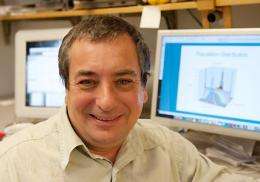
Why do some animals sacrifice themselves for the good of their group? The battle between the theories of kin selection and group selection has raged for decades. Biologist Charles Goodnight completed the math work needed to argue that they are, really, much the same. His calculations appeared this month in the journal 'Nature.'
(PhysOrg.com) -- In 1871, Charles Darwin puzzled over the evolution of altruism. "He who was ready to sacrifice his life, as many a savage has been," he wrote in The Descent of Man, "rather than betray his comrades, would often leave no offspring to inherit his noble nature."
To this day, biologists debate about how altruistic behaviors evolve and persist. Sterile ants faithfully tend their queen with no chance of reproducing themselves. Vervet monkeys scream to other monkeys about approaching predators, drawing attention to themselves and risking their own safety. Bees lay down their lives to defend the hive.
"Why do they do that?" asks University of Vermont biologist Charles Goodnight. "Doesn't natural selection drive animals to behaviors that increase their own chances of survival, not those of others?"
This question underlies the decades-long debate -- sometimes rancorous -- between two camps of scientists. On one side, are those who argue in favor of "kin selection," in which individuals are altruistic to those who share their genes. In defending the hive, a self-sacrificing bee increases the chances that the genes she shares with her sisters will get passed down.
On the other side, are those who argue in favor of "group selection," (or, in its modern form, "multilevel selection") in which altruism arises from being part of a group. The self-sacrificing behavior of the bee persists and spreads across generations because the whole hive, a group, competes more successfully, leaving more offspring than others.
In the February 18 edition of the journal Nature a team of 18 scientists, including UVM's Goodnight, show that the two traditional approaches are actually mathematically equivalent.
One in the same
How can this be? In order for kin selection to be important, the related kin have to be in groups that preferentially confer altruistic behaviors on each other. In order for group selection to operate, the members of a group have to be closer kin than they are to other groups. The two ideas are close enough that they can actually be converted to each other mathematically. This understanding has been stated in technical research articles for more than 30 years, but the broader scientific community has not often recognized it.
"What we did in this paper was take the equations of a group that was very strongly kin selectionist and we worked through them and translated them back into classic equations," says Goodnight. "and they're the same."
"It is remarkable that kin selection has been widely accepted and group selection widely disparaged," says Michael Wade, a biologist at Indiana University, and the lead author on the paper, "when they are actually equivalent mathematically."
Evolution at all levels
A good bit of the fight between kin and group selection proponents is a product of history. (What fight isn't?) In the 1960's, some ideas about group selection were introduced that, in cartoon fashion, looked something like birds choosing not to reproduce for the good of their fellow birds. "There was this big rash of 'for the good of the group', naďve versions of evolution," says Goodnight.
But birds can't choose not to reproduce, nor can bacteria choose to be less virulent -- because it's good for their group. "Evolution doesn't work that way; evolution works by who leaves the most offspring," says Goodnight. Richard Dawkins and many other theorists largely dismantled this first wave of group selection ideas, and kin selection was ascendant. But in recent decades a new group-selection camp -- including Goodnight, David Sloan Wilson and others -- has emerged.
"The point is that evolution can work at many levels: the gene level, the cell level, the organismal level, the group level," Goodnight says, "and it probably works on all these levels at once."
The new paper in Nature considers the evolutionary mechanisms that would lead some parasites to have reduced virulence. From the kin selection (or individual-level selection) perspective, as presented in an earlier Nature paper by Geoff Wild at the University of Western Ontario and his colleagues, this lower virulence can be explained entirely by individual selection -- no group effect needed.
But Goodnight and his colleagues make a mathematical rebuttal, sketching out in their paper an argument for why two forms of opposing group selection -- "within-group" versus "among-group" -- are needed to explain how this seemingly disadvantageous trait nevertheless evolves in the whole parasite population.
"Those of us working on multilevel selection models have started seeing kin selection as subset of multilevel selection," Goodnight says, "The debate should no longer be whether it's individual or multilevel selection. The debate is how strong is each level of selection?" Or, as their paper concludes, "it's time to put the anachronistic debate between single-level and multilevel selection behind us."
Individual preference
Goodnight's colleague in the UVM biology department, Sara Cahan, agrees with this conclusion. But she doesn't agree with everything in Goodnight's paper -- and is more in the kin selection camp. "Charles and I really enjoy one another -- I respect Charles very highly -- but we do tend to argue a lot," she says, with a laugh. (Perhaps it's no wonder the students she and Goodnight had in their co-taught graduate seminar "Levels of Selection" called the course "Crossfire.")
"In this case of virulence, and in many cases where this altruism argument has been battled," she says, "the trait of interest is an individual-level trait. And if it's an individual-level trait, we really need to think about it as an individual-level adaptation -- regardless of what kind of selection, group or otherwise, has acted it."
"This debate is far from over," says Charles Goodnight.
More information: Paper: http://www.nature. … re08809.html
Provided by University of Vermont
-
Altruism in social insects is a family affair
May 29, 2008 |
not rated yet |
0
-
Insects' 'giant leap' reconstructed by founder of sociobiology
Jan 02, 2008 |
not rated yet |
0
-
The hitchhiker's guide to altruism -- Study explains how costly traits evolve
Jan 19, 2007 |
not rated yet |
0
-
Disease resistance may be genetic
Aug 30, 2007 |
not rated yet |
0
-
Natural selection is not the only process that drives evolution
Jan 27, 2009 |
not rated yet |
0
-
Engineers build first sub-10-nm carbon nanotube transistor
Feb 01, 2012 |
4.9 / 5 (31) |
30
-
Something old, something new: Evolution and the structural divergence of duplicate genes
Jan 31, 2012 |
4.6 / 5 (7) |
1
-
The hidden nanoworld of ice crystals: Revealing the dynamic behavior of quasi-liquid layers
Jan 30, 2012 |
5 / 5 (3) |
1
-
Stock market network reveals investor clustering
Jan 27, 2012 |
3.9 / 5 (23) |
8
-
Of microchemistry and molecules: Electronic microfluidic device synthesizes biocompatible probes
Jan 26, 2012 |
5 / 5 (1) |
0
-
Mitosis
1 hour ago
-
Stem cell question.
3 hours ago
-
Protease cleavage
9 hours ago
-
Pertubance in a model
16 hours ago
-
Cancer drugs and Alzheimer's, Oh my!
Feb 09, 2012
-
Squishing cells
Feb 09, 2012
- More from Physics Forums - Biology
More news stories
The power of estrogen -- male snakes attract other males
A new study has shown that boosting the estrogen levels of male garter snakes causes them to secrete the same pheromones that females use to attract suitors, and turned the males into just about the sexiest ...
14 hours ago |
4.8 / 5 (6) |
1
|
Grass to gas: Researchers' genome map speeds biofuel development
Researchers at the University of Georgia have taken a major step in the ongoing effort to find sources of cleaner, renewable energy by mapping the genomes of two originator cells of Miscanthus x giganteus, a large perenn ...
11 hours ago |
3.8 / 5 (5) |
0
|
Experts reveal how plants don't get sunburn
(PhysOrg.com) -- Experts at the University of Glasgow have discovered how plants survive the harmful rays of the sun.
14 hours ago |
4.8 / 5 (5) |
0
|
Miami battling invasion of giant African snails
No one knows how they got there. But an invasion of African giant snails has southern Florida in a panic over potential crop damage, disease and general yuckiness surrounding the slimy gastropods.
18 hours ago |
4 / 5 (1) |
4
Protein libraries in a snap
(PhysOrg.com) -- A Rice University undergraduate will depart with not only a degree but also a possible patent for his invention of an efficient way to create protein libraries, an important component of biomolecular ...
17 hours ago |
4.8 / 5 (4) |
0
|
Google users warned of threat to smartphone wallets
Users of Google smartphone wallets were being warned on Friday that there is a way to crack pass codes intended to thwart thieves from going on illicit shopping sprees.
Anonymous knocks CIA website offline (Update)
The website of the Central Intelligence Agency was inaccessible on Friday after the hacker group Anonymous claimed to have knocked it offline.
New error-correcting codes guarantee the fastest possible rate of data transmission
Error-correcting codes are one of the triumphs of the digital age. Theyre a way of encoding information so that it can be transmitted across a communication channel such as an optical fiber o ...
Complex wiring of the nervous system may rely on a just a handful of genes and proteins
Researchers at the Salk Institute have discovered a startling feature of early brain development that helps to explain how complex neuron wiring patterns are programmed using just a handful of critical genes. ...
Humans may have helped the decline of African rainforests 3000 years ago
(PhysOrg.com) -- Large areas of rainforests in Central Africa mysteriously disappeared over three thousand years ago, to be replaced by savannas. The prevailing theory has been that the cause was a change ...
New power source discovered
(PhysOrg.com) -- Researchers at the Massachusetts Institute of Technology (MIT) and RMIT University have made a breakthrough in energy storage and power generation.
Feb 26, 2010
Rank: 1 / 5 (9)
You evolutionists sure believe a lot of crap. All I can say to this is, "Goodnight".
Feb 26, 2010
Rank: 1 / 5 (5)
Feb 26, 2010
Rank: 5 / 5 (2)
I hear a lot of complaining about evolutionary theories. Would you like to present a better scientifically supported theory? Don't just tear down theories you don't agree with. If you think there are so many holes in it and have a better idea please enlighten the community. And you better not say what I think you're going to say.
Feb 26, 2010
Rank: 5 / 5 (5)
Broadhead - Please address your comments in another forum. Its quite ok with everyone if you do not believe in science, or think the world is flat or any other such nonsense, but this is a science forum. You belong in a religious forum or faith based institution, not here. Your not going to convince anyone here that the theory of evolution isn't correct.
Feb 27, 2010
Rank: 5 / 5 (4)
Dolphins save human lives. Just because creatures of other species have no social, moral, or economic value to you, doesn't mean the same is true of everyone. As for how many, of each, no one knows.
Feb 27, 2010
Rank: 5 / 5 (7)
Yeah, the fools. Next they'll be claiming that the earth orbits the sun rather than the sun orbiting God's earth as we are clearly told Ps. 93:1, Ps. 19:1-6, Joshua 10:12-14. Crazy talk.
Feb 27, 2010
Rank: 3.7 / 5 (3)
Feb 27, 2010
Rank: not rated yet
Great point and along side it is the fact that life can recognize and distinguish between other life and non-life. There is always benefit in being in proximity to other life regardless of the inherent danger.
Feb 27, 2010
Rank: 3 / 5 (2)
I have been told that is is what good science is all about, falsifying theories.
Feb 27, 2010
Rank: 5 / 5 (1)
Feb 27, 2010
Rank: 5 / 5 (1)
No, theories are constructs of science, they are never torn down, merely changed. New science that adds dimension to theories and expands knowledge is the goal. Your definition would leave us ignorant of the world, more akin to religion.
Feb 27, 2010
Rank: 1 / 5 (1)
"the shift in Popper's own basic position is taken by some critics as an indicator that falsificationism, for all its apparent merits, fares no better in the final analysis than verificationism. "
http://plato.stan...noHisPre
I would like to encourage all those promoting 'falsification' as the benchmark for 'science', consider the above.
Feb 27, 2010
Rank: 1 / 5 (2)
It seems that the definition of 'science' is quite flexible as it suits the needs of its practitioners.
Feb 27, 2010
Rank: not rated yet
Feb 27, 2010
Rank: not rated yet
Not true. Even your dear Bible holds some of the science of the time. Their observations led them to believe that everything was created by a human like organism that was oniscient and omnipotent. Since then we've refined our measuring tools and refined our observations and discovered that isn't the case. You're reading a 2000 year old book and assuming that it's current events. If you want to deny the advances of science, feel free to enjoy polio, the death of 50% of your children, that is if you aren't sterilized by cholera or rampant parasitic infections.
Feb 27, 2010
Rank: 1 / 5 (1)
Planck said it: "A new scientific truth does not triumph by convincing its opponents and making them see the light, but rather because its opponents eventually die, and a new generation grows up that is familiar with it. "
I am disappointed with the ego and arrogance of many in science.
Feb 28, 2010
Rank: 3 / 5 (1)
Nature is happy to settle for marginally adequate in most cases.
What determines the cut is extinction of the unfit.
In the case of human beings, the history of the species is replete with genocidal customs from local, tribal level to regional.
What makes it worth your while to risk your life in war is the threat of extinction as the alternative.
When there is deadly predation the prey needs a group to survive extinction and the group becomes the superset of characteristics, not independent of he individuals, which is the crux of survival.
Feb 28, 2010
Rank: not rated yet
Which is more arrogant:
Finding out a deeper truth and evidencing it to the masses with calculated observation
or
Telling everyone God did it and saying that's the end of the story?
Feb 28, 2010
Rank: not rated yet
Science is an epistemology that can lead to truth and not a job description or title or, worst of all, a fixed body of knowledge.
Mar 06, 2010
Rank: not rated yet