Researchers Rediscover the Structure of Water
February 26, 2010 by Kelen Tuttle
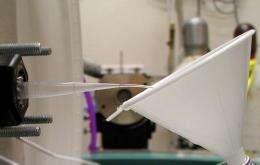
Researchers at SSRL recently determined the distances between the molecules in this jet of flowing water. (Image courtesy the research team)
(PhysOrg.com) -- A team of researchers at the Stanford Synchrotron Radiation Lightsource has found the molecular structure of water to be more complex than recently thought, suggesting that molecular models that went out of fashion decades ago may be in fact more accurate than recent ones.
"The study of water has a very long history," said lead author Ling Fu, who is a postdoc at the Centre National de la Recherche Scientifique in France and who wrote her PhD thesis on these results. "Other researchers have done a very good job in their measurements; I hope that this work helps advance the field."
By recording how SSRL's X-ray beam scattered off a flowing jet of water, Fu and colleagues Arthur Bienenstock and Sean Brennan were able to determine the distances between the water molecules in the jet. As recent models predicted, they saw molecules 0.28 and 0.45 nanometers apart. These measurements confirm the current commonly accepted model, which describes liquid water as a group of water molecules held together in tetrahedral shapes, with the molecule at the center of the tetrahedron separated from four others at the shorter distance and each of these four molecules separated from one another at the longer distance.
Yet the researchers saw some molecules at a third distance as well: 0.34 nanometers. The existence of this third separation length, though not included in the current model, was first seen in 1938. Additional experiments in the 1960s and 1970s first confirmed, but later rejected, that this length exists, concluding that its detection was due to shortcomings in the analysis. As a result, models including this intermediate distance fell out of favoruntil now.
That the SSRL researchers have now observed this intermediate separation length using modern-day technology suggests that "there's something more going on here" beyond the currently accepted model, Fu said.
These results suggest that liquid water's structure is not completely tetrahedral, but rather has some added complexity. But they do not fully solve the mystery of water's structure because the data taken at SSRL only reveal the distances between water molecules, not the angles of the bonds. "More research is needed to see the complete picture," said Brennan.
Fully understanding the structure of water is a surprisingly difficult task. In water's solid form, ice, the molecules are known to form a tight tetrahedral lattice. The current model holds that liquid water should be similar to ice but less structured since heat creates disorder and breaks bonds. In liquid water, then, the tetrahedral structures would loosen their grip, breaking apart as the temperature rises, but still inclined to remain as tetrahedral as possible. This new research adds a kink in this theory, requiring some sort of secondary structure. The greater density of liquid water implies that the molecules are more closely packed than the simple tetrahedra seen in ice. These data help explain how that can happen.
The baton, Brennan said, is now in the hands of the theorists. "I think of this type of research as a relay race: The experimentalists run for a while until they can't explain something they've seen, and then the theorists run for a while until they can't go any farther without more data, and then it's back to the experimentalists," he said. "So, this time, we're saying that it's time for the theorists to run their leg."
Provided by Stanford Synchrotron Radiation Lightsource
-
Researchers reveal the internal dance of water
Aug 12, 2009 |
not rated yet |
0
-
Why Does Water Expand When it Cools? A New Explanation
Jul 17, 2009 |
not rated yet |
0
-
By tracking water molecules, physicists hope to unlock secrets of life
Feb 08, 2010 |
not rated yet |
0
-
Scientists Observe Liquid Water Below Freezing
Jun 24, 2009 |
not rated yet |
0
-
How Cagey Electrons Keep Hydrated
Dec 20, 2007 |
not rated yet |
0
-
Engineers build first sub-10-nm carbon nanotube transistor
Feb 01, 2012 |
4.9 / 5 (29) |
30
-
Something old, something new: Evolution and the structural divergence of duplicate genes
Jan 31, 2012 |
4.6 / 5 (7) |
1
-
The hidden nanoworld of ice crystals: Revealing the dynamic behavior of quasi-liquid layers
Jan 30, 2012 |
5 / 5 (3) |
1
-
Stock market network reveals investor clustering
Jan 27, 2012 |
3.9 / 5 (23) |
8
-
Of microchemistry and molecules: Electronic microfluidic device synthesizes biocompatible probes
Jan 26, 2012 |
5 / 5 (1) |
0
-
states and energy of paired electrons in BCS
19 hours ago
-
difference between longitudinal and transverse refractive indices
23 hours ago
-
Monte Carlo simulation
Feb 07, 2012
-
Condensed Matter Super-Radiant Phase Transition
Feb 06, 2012
-
nonlinear susceptibility in graphene
Feb 06, 2012
-
Energy-dependent cross ection and mean free path
Feb 06, 2012
- More from Physics Forums - Atomic, Solid State, Comp. Physics
More news stories
Physics research suggests new pathways for cancer progression
Observing that certain cancer cells may exhibit greater flexibility than normal cells, some scientists believe that this capability promotes rapid tumor growth. Now computer simulations developed by Boston University Biomedical ...
1 hour ago |
5 / 5 (1) |
0
Borexino Collaboration succeeds in spotting pep neutrinos emitted from the sun
(PhysOrg.com) -- To learn more about how the sun works, scientists study particles that are emitted from it into space due to thermonuclear reactions that occur inside; by applying known physics principles, ...
Transparent iron? For the first time, an experiment shows that atomic nuclei can become transparent
At the high-brilliance synchrotron light source PETRA III, a team of DESY scientists headed by Dr. Ralf Röhlsberger has succeeded in making atomic nuclei transparent with the help of X-ray light. At the ...
22 hours ago |
5 / 5 (9) |
3
|
Physicists build highly efficient 'no-waste' laser
A team of University of California, San Diego researchers has built the smallest room-temperature nanolaser to date, as well as an even more startling device: a highly efficient, "thresholdless" laser that ...
22 hours ago |
5 / 5 (17) |
4
|
Explained: Sigma
It's a question that arises with virtually every major new finding in science or medicine: What makes a result reliable enough to be taken seriously? The answer has to do with statistical significance -- but ...
3 hours ago |
5 / 5 (4) |
2
Apple to debut 'iPad 3' in March: report
Apple will unveil a new version of its market-ruling iPad table computer in March, according to a report in Dow Jones-owned technology blog All Things D.
Physically abused children report higher levels of psychosomatic symptoms
Children who display multiple psychosomatic symptoms, such as regular aches and pains and sleep and appetite problems, are more than twice as likely to be experiencing physical abuse at home than children who do not display ...
Facebook sees slowing growth
Few experts were surprised when Facebook disclosed in its recent IPO filing that its user growth had slowed in the U.S. and Canada. But a deeper look at Facebook's user numbers shows its growth is also slowing ...
New technology platform for molecule-based electronics
Researchers at the Nano-Science Center at the University of Copenhagen have developed a new nano-technology platform for the development of molecule-based electronic components using the wonder material graphene. At the same ...
60 percent of Spanish adolescents state they do not take drugs and rarely drink alcohol
Despite the clichés surrounding the habits of adolescents, the results of a study by the University of Seville show that most young people do not fit the risk profile of taking substances. Some 60% of ...
NFC aid for the visually and hearing impaired
As the proportion of senior citizens grows, their special needs are gaining momentum. Human eyesight, for example, weakens with age. VTT Technical Research Centre of Finland has been developing new NFC-based applications ...
Feb 26, 2010
Rank: 5 / 5 (1)
http://arxiv.org/...46v1.pdf
The whole trick at the case of water is, these phenomena applies only to quite tiny distance, to which hydrogen bonds are relevant - so that at the macroscopic scale the water behavior doesn't differ very much from common fluid behavior.
Feb 26, 2010
Rank: 5 / 5 (1)
http://www.lsbu.a...rct.html
http://www.pnas.o.../21/7973
I believe, this behavior would be rather easy to simulate by ab-initio calculations of interactions of water molecules inside of water clusters - only the relatively large number of particle involved makes it difficult to describe by formal math. Mainstream physics isn't really good in description of multiparticle emergent phenomena, for example the formal description of HT superconductivity is a problem of similar category.
Feb 26, 2010
Rank: 2.6 / 5 (5)
Feb 26, 2010
Rank: 3 / 5 (2)
Feb 26, 2010
Rank: 3 / 5 (6)
troll
Feb 26, 2010
Rank: 5 / 5 (1)
In this way I imagine the splitting of hydrogen bounds in water during passing of quite low frequency radiowaves.
http://en.wikiped..._Kanzius
Without presence of clusters the water would behave like sand in box, during shaking of which no observable abrasion occurs, because of low inertia of tiny particles.
BTW In this way we could explain the cold fusion of deuterions in palladium lattice, where these particles are forming more compact clusters, too. Maybe the energizing of palladium lattice saturated by deuterium would be the key to cold fusion. For example, prof. Arata used laser pulses for these purposes.
Feb 26, 2010
Rank: 3.5 / 5 (2)
http://www.engine...re_2.png
The huge intrinsic pressure between water molecules manifests for example by slipperiness of ice, which is covered by thin layer of liquid watter even bellow -53 °C.
http://people.vir...ay05.pdf
Inside of this thin layer of water ballistic transport of water molecules occurs - the water is partially in superfluous state here. This could explain crackling and crunching of fresh cold snow under your feet. In hellium with perfectly spherical atoms such supersolidity could be observed just bellow few Kelvin temperature!
Feb 27, 2010
Rank: not rated yet
Go read the article, then read your comments and you tell me.
Feb 27, 2010
Rank: not rated yet
Feb 27, 2010
Rank: not rated yet
Feb 27, 2010
Rank: not rated yet
http://www.pnas.o...973.full
http://www.ch.ic....etra.gif
Horizontal water jet was used, because it eliminates scattering from a container and precludes radiation-induced bubble formation from the intensive X-ray SPEAR3 source.
Feb 27, 2010
Rank: 5 / 5 (1)
http://www.aps.an...cule.jpg
Feb 27, 2010
Rank: 3 / 5 (2)
http://www.youtub...cjPSZeAg
It's apparent, under stress emergent linear pattern emerge in packing structure of beads. In water these patterns are of sparse icosahedral structure.
http://images.goo...clusters
This phase transition has a deeper meaning in aether theory and in string heterotic theories, which are based on most effective hypersphere packing density. The high internal stress of water molecules results into compactification of octahedral structure into icosahedral one in process of so called heterosis. In LQG theory this process is described by dynamic causual triangulation. Compare the Aristotelian theory of four elements, where watter is assigned just to icosahedron Platonic solid.
Feb 28, 2010
Rank: not rated yet
Snooze---you loose. Alternate takes and research have always been ahead of the mainstream, and always will be. The leading edge is never in the textbooks, and never will be.