Iceberg breaks in Antarctica not where expected
February 26, 2010 By SETH BORENSTEIN , AP Science Writer
Iceberg breaks in Antarctica not where expected (AP)

Enlarge

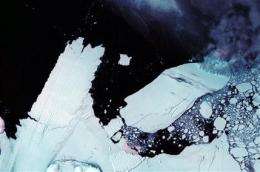
In this satellite image released by Commonwealth of Australia, a 97-kilometer (60 mile) long iceberg known as B9B, right, is about to crash into the Mertz Glacier Tongue, left, in the Australian Antarctic Territory on Jan. 7, 2010. The collision created a new 78-kilometer (48 mile) long iceberg. (AP Photo/Commonwealth of Australia)

(AP) -- With the dramatic crash of an iceberg against a glacier that dislodged a massive new chunk of ice, the mysterious continent of Antarctica once again did the unexpected.

A big chunk of , slightly smaller than Oahu, broke off from a place it wasn't supposed to and in a way that wasn't quite anticipated, scientists reported Friday.

The new iceberg broke off from the cooler eastern end of Antarctica, the result of tidal forces that caused a longer but thinner iceberg that stretches for 60 miles to hammer it free. The new chunk broke off a long tongue of ice that had been building for decades, but will unlikely cause future problems on the continent, scientists said.

This happened as researchers have focused attention on the western side of Antactica, a continent about 1 1/2 times larger than the United States. Concern has grown over warmer temperatures there and especially the region's shrinking peninsula, which sticks out into the water like a broken pinky finger.

Remarkably, that peninsula, where last year one was said to be hanging by a thread, has had an unusually cool summer. It's hit pause on ice loss, said Ted Scambos, senior scientist with the National Snow and Ice Data Center.

In a satellite phone interview this week from the western peninsula where he's working, Scambos predicted no major ice calving. His comments were made Thursday.

The next day Australian researchers alerted the world to the iceberg crash with the Mertz Glacier on the other side of the continent. They said it had probably occurred around Feb. 12 or 13.

"There are some crazy things going down in Antarctica," said Mark Serreze, director of the snow and ice data center, based in Boulder, Colo. "It seems kind of weird, but weird things happen."

Scientists have been tracking global warming's influence in Antarctica, a place more complicated than the Arctic. Scambos was placing instruments on the dwindling Larsen ice shelf in the peninsula to measure its disintegration in a scientific version of a deathwatch.

The ice loss that happened a couple of weeks ago was not due to global warming, but a natural process taking place in a region that has been relatively stable over the years.

For decades the tongue of the Mertz Glacier in the eastern part of the continent has grown further out into the water until it was about 60 miles long by 18 miles wide, said Benoit Legresy, a researcher with the LEGOS laboratory for geophysical studies in Toulouse, France.

Then an called B9B, which had broken off from another part of Antarctica in 1987, came by and "gave it a pretty big nudge," said Australian Antarctic Division glaciologist Neal Young.

"It was a slow process," Legresy said. He said B9B was "sitting there, it must have been pushed and pulled by the current every day and used as a hammer to bang on the other one by the ocean currents."

The dislodging occurred because of the iceberg's latest location and water that had warmed during Antarctica's summer, leaving less sea ice, Legresy said.

This happened "behind our backs," said NASA glaciologist Robert Bindschadler. "It's a good thing to be reminded that it's not all about west ."

Tongues like the one on the Mertz "ultimately are going to have to break off, making some big pieces of ice, and the ocean moves them around and occasionally they get in each other's way," Bindschadler said.

A couple scientists worried that this region around the Antarctic coast could fill with sea ice, which would disrupt the sinking ability of the dense and cold water. This sinking water is what spills into ocean basins and feeds the global ocean currents with oxygen, said Steve Rintoul, an oceanographer at Australia's national science agency. The fear is that it could starve areas of oxygen.

But other scientists from NASA, Penn State and the British Antarctic Survey said that's not a very likely scenario and not to worry.

"Icebergs whacking each other has happened for millions of years and life is still down there and pretty robust," NASA's Bindschandler said.

More than anything, it's a shift from the usual worries about Antarctic ice.

Data and new detailed maps from the U.S. Geological Survey, the British Survey and the snow and ice data center show that the western Antarctic peninsula has been shrinking noticeably. Since the first measurements were made more than 50 years ago, the peninsula has lost about 8,000 square miles of ice - slightly less than the size of New Jersey - said USGS scientist Jane Ferrigno. The peninsula itself is about the size of Montana.

And every ice shelf on that peninsula has shrunk, with the losses accelerating since the 1990s, Ferrigno said.

"It may be a red flag about what may be happening in the future if this warming continues," Ferrigno said. "This is way beyond anything we've seen before" in centuries of ice core data.

With that in mind, snow and ice data center's Scambos and a team of researchers put measuring devices all over the threatened Larsen ice shelf, where he said "it does look like it's an ice shelf that's really in its last years of existence."

But it won't disappear this year, he said.

Cooler-than-normal temperatures have paused the melt, Scambos said, a development he views as only temporary. "There's no big recovery in progress."

More information: The Antarctic Climate and Ecosystems' report on the Mertz Glacier break: http://tinyurl.com/mertzglacier

The U.S. Geological Survey's report and map on ice shelf loss: http://pubs.usgs.gov/imap/i-2600-c/

The National Snow and Ice Data Center's State of the Cyrosphere: http://nsidc.org/sotc/iceshelves.html

©2010 The Associated Press. All rights reserved. This material may not be published, broadcast, rewritten or redistributed.

4.7 /5 (18 votes)  

Filter


Move the slider to adjust rank threshold, so that you can hide some of the comments.


Display comments: newest first

fixer
Feb 26, 2010

Rank: 2.7 / 5 (6)
And every ice shelf on that peninsula has shrunk, with the losses accelerating since the 1990s, Ferrigno said.

Well now,it looks like the AGW debate is about to become irrellevant.
seneca
Feb 26, 2010

Rank: 3.2 / 5 (5)
It would be great to drag it into some bay and use it as a source of fresh watter... Anyway, it's interesting, the melting of ice continues even after long period of solar inactivity. Couldn't ocean be heated from bottom?
Parsec
Feb 27, 2010

Rank: 2.4 / 5 (9)
And every ice shelf on that peninsula has shrunk, with the losses accelerating since the 1990s, Ferrigno said.

Well now,it looks like the AGW debate is about to become irrellevant.


Not at all. Didn't you know that all those satellite photos and data are faked? All those ice sheets were breaking off because of influence from the sun!

Besides which, we all know that human beings are too puny and limited in number to affect anything as big and awesome as the global climate. And remember that increased CO2 is a good thing, because it makes plants grow big.

Bleh!

Someday all of those AGW deniers will get too embarrassed to post, but I doubt any amount of reality will change their minds.

fixer
Feb 27, 2010

Rank: 3 / 5 (7)
True, but the point is that the wheels are falling off the planet regardless of what people think!
And talking about it or even posting here isn't making a blind bit of difference.
Action is long overdue, saying "I told you so" isn't worth a cracker.

Time to buy that plot on Mars...
Nartoon
Feb 27, 2010

Rank: 4.2 / 5 (5)
"Since the first measurements were made more than 50 years ago, the peninsula has lost about 8,000 square miles of ice - slightly less than the size of New Jersey - said USGS scientist Jane Ferrigno. The peninsula itself is about the size of Montana."

Why do scientists talk this way? Who knows what percentage NJ is of Montana? Well according to Wikipedia NJ is 8,721 sq mi while Montana is 147,042 sq mi so the area lost is 5.9% I think that's easier to swallow than state sizes, especially since even most Americans have no clue about their own country in the first place.
dhoffryn
Feb 27, 2010

Rank: 1.5 / 5 (4)
most arguments is see about global warming dont take into facts a few things that affect the worlds average temperature, 1. since the dawn of our Sun, it has been expanding(granted most people will ignore this, but it is affecting our temp's), 2. a little test i did using a wireless thermometer, at night i drilled a hole into the road outside my place (Far North Queensland, Australia) at night the minimum temp the road dropped to was 25 degrees Celcius, so calculate the km's of road (Thats not including buildings) world wide that stay atleast 5 to 10 degrees warmer then ambient temp.

there are other things in this world we humans have done to help warm this planet, and honestly wether we burn or Freeze we deserve it, We have failed as a species, so its time for natural selection to wipe out the stupid race that has destroyed this planet!!!!!
mary_hinge
Feb 27, 2010

Rank: 3.7 / 5 (3)
The Climate septics are getting pretty desperate in their arguments, check this HOUSE CONCURRENT RESOLUTION NO. 1009 from South Dakota: http://legis.stat...009P.htm
The most telling part is this " That there are a variety of climatological, meteorological, astrological, thermological, cosmological, and ecological dynamics that can effect world weather phenomena and that the significance and interrelativity of these factors is largely speculative"
So Astrology and 'Thermology' are also responsible for global warming! This is what they want to teach our schoolkids. If Joseph Palin, sorry, Sarah, was in office this is what they want our kids to learn as well, as creationism and perhaps a new theory on gravity.
The anti-science arguments are getting increasingly ludicrous and, perhaps, even dangerous.
frajo
Feb 27, 2010

Rank: 2.3 / 5 (3)
I can't believe it - "astrological factors"?
Is this an authorized page of the US state of South Dakota? No fake? No hackers' joke?
joefarah
Feb 27, 2010

Rank: 1.8 / 5 (5)
How refreshing - a scientific perspective instead of a global warming one. I think the only thing causing global warming, other than the sun cycles, is global warming. If you saved all the emissions from the GW furor, the GW people would be more than happy - OK, not really, because emissions aren't they're just a means to money and global control.
frajo
Feb 27, 2010

Rank: 2.3 / 5 (3)
How refreshing - a scientific perspective
Just to make sure: You think the inclusion of "astrological factors" is compatibel with a scientific perspective?
mary_hinge
Feb 27, 2010

Rank: 3.7 / 5 (3)
Its 100% genuine, here is the original version instead of the printer friendly version. http://legis.stat...009P.htm
CWFlink
Mar 01, 2010

Rank: 1 / 5 (4)
So far this year, how many people have died from earthquakes rather than Global Warming? I think it is about a thousand to 1. Add to that the deaths due to last year's tsunami. When do we decide to start switching our focus from Global Warming to earthquake detection and damage mitigation? :-)

Another fact from the news today: energy released in the Chile earthquake equal to 10,000 hydrogen bombs. Someone please translate this to miles driven in a gas guzzler and tell me how many SUVs to junk in order to compensate? :-)

I sure hope some AGW enthusiast here doesn't postulate that the tenth of a degree warming over the last X years caused these earthquakes... I've eaten a big supper and don't want to lose it all over my computer.

P.S. Please explain how nuclear winter would result from a war setting off 10,000 nuclear weapons world wide, but roughly the equivalent amount of energy released in each of 3 separate events (Chile, Haiti and Indonesia) has not destroyed us?
CWFlink
Mar 01, 2010

Rank: 1 / 5 (2)
Regarding "astrological events" causing global warming.... Do you understand NOW why we can't expect politicians and governments to solve our problems for us?

The only thing that works is free markets: the ability to "vote with your feet" and walk out of businesses that are run by selfish idiots. I want a world in which I can as easily find a government that actually works!
fixer
Mar 01, 2010

Rank: 5 / 5 (2)
P.S. Please explain how nuclear winter would result from a war setting off 10,000 nuclear weapons world wide, but roughly the equivalent amount of energy released in each of 3 separate events (Chile, Haiti and Indonesia) has not destroyed us?

I haven't noticed any clouds of radioactive dust lately.
Perhaps that's the difference.
Mesafina
Mar 06, 2010

Rank: not rated yet
CWFlink, while I don't think governments are great, and don't think that they (at least in their current form) are capabable of addressing long term issues well... do you really believe businesses can? Both are exactly the same.. they are bureaucracies of men who attempt to aggregate power. Do you really believe that people voting with their dollars will keep them in check? They will be the same people who voted (with their votes) for hacks like Bush and Obama.

The truth is people can't self govern well. They do poorly at understanding things beyond their immediate environment. Unfortunately there is no good solution to this but to make due as best we can and hope we don't kill ourselves. But ideologues who say only capitalism is the way are exactly the same as those who say only communism is the way... people who believe that things would be great if only people behaved in some idealized fashion that is out of touch with reality.
Mesafina
Mar 07, 2010

Rank: not rated yet
Get over yourselves and look at the world around you for once. Capitalism aint so great, and it isn't because of "socialist influence". Socialism failed and people said it was because of "capitalist influence". It's because of human influence.

As far as nuclear winter goes... nuclear winter would happen because of how much dust would be thrown into the air. An earthquake under water does not throw dust in the air. A volcano would, and would be a more appropriate comparison.

Please people, think before you talk. All your little pieces of ignorance add up and result in the world we are in today.
Rank 4.7 /5 (18 votes)
Related Stories
Relevant PhysicsForums posts
  • Discrepancy between oxygen and carbon-dioxide levels
    created10 hours ago
  • where gems are found in the world
    created13 hours ago
  • Wind Waves in Reservoir ~ Wind run-up and Wind set-up
    createdFeb 08, 2012
  • Balance of oxygen in the atmosphere
    createdFeb 01, 2012
  • The case for a methanol-based economy
    createdJan 30, 2012
  • Weather in a rotating cylinder
    createdJan 25, 2012
  • More from Physics Forums - Earth

More news stories

Mars Science Laboratory computer issue resolved

(PhysOrg.com) -- Engineers have found the root cause of a computer reset that occurred two months ago on NASA's Mars Science Laboratory and have determined how to correct it.

Space & Earth / Space Exploration

created 13 minutes ago | popularity not rated yet | comments 0 | with audio podcast

Putin receives 'prehistoric' water from Antarctic lake

Prime Minister Vladimir Putin was given a water sample Friday taken from a pristine lake hidden under Antarctic ice for over a million years, after Russian scientists drilled down to its surface.

Space & Earth / Earth Sciences

created 19 minutes ago | popularity 5 / 5 (1) | comments 0

Rockot to launch two Sentinel satellites

ESA and Eurockot today signed contracts for launching two ESA satellites: Sentinel-2A and Sentinel-3A will fly in 2013 on Rockot vehicles from the Plesetsk Cosmodrome in northern Russia for Europe’s GMES ...

Space & Earth / Space Exploration

created 15 minutes ago | popularity 5 / 5 (1) | comments 0

Probing a link from Sahara dust to climate change

Qilong Min, Ph.D., Senior Research Associate and Professor with the Atmospheric Sciences Research Center (ASRC) at the University at Albany is developing innovative ways to measure how dust in the Sahara Desert ...

Space & Earth / Earth Sciences

created 8 minutes ago | popularity not rated yet | comments 0

Humans may have helped the decline of African rainforests 3000 years ago

(PhysOrg.com) -- Large areas of rainforests in Central Africa mysteriously disappeared over three thousand years ago, to be replaced by savannas. The prevailing theory has been that the cause was a change ...

Space & Earth / Environment

created 3 hours ago | popularity 5 / 5 (2) | comments 0 | with audio podcast report


New error-correcting codes guarantee the fastest possible rate of data transmission

Error-correcting codes are one of the triumphs of the digital age. They’re a way of encoding information so that it can be transmitted across a communication channel — such as an optical fiber o ...

A frank discussion of the power law and linking correlation to causation

(PhysOrg.com) -- Michael Stumpf a mathematics professor at Imperial College in London, and Mason Porter a lecturer at Oxford have teamed together to write and publish a perspective piece in Science regarding the in ...

Advanced power-grid model finds low-cost, low-carbon future in West

(PhysOrg.com) -- The least expensive way for the Western U.S. to reduce greenhouse gas emissions enough to help prevent the worst consequences of global warming is to replace coal with renewable and other ...

Small modular reactor design could be a 'SUPERSTAR'

(PhysOrg.com) -- Though most of today's nuclear reactors are cooled by water, we've long known that there are alternatives; in fact, the world's first nuclear-powered electricity in 1951 came from a reactor ...

High school students test best with 7 hours' rest

(Medical Xpress) -- Whether or not you know any high school students that actually get nine hours of sleep each night, that’s what federal guidelines currently prescribe.

The question of life in the ancient world

There’s a general feeling that we don’t get the Greeks – ancient or modern. Many, including heads of state like Angela Merkel, visibly shake their head in exasperation, rightly or wrongly, at ...