World's most powerful atom smasher restarts: CERN
February 28, 2010
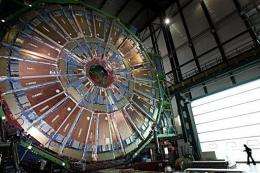
A view of a superconducting solenoid magnet at the European Organization for Nuclear Research (CERN) near Geneva. Scientists have restarted the world's most powerful atom-smasher overnight, the European Organisation for Nuclear Research (CERN) said Sunday, as they launch a new bid to uncover the secrets of the universe.
Scientists have restarted the world's most powerful atom-smasher overnight, the European Organisation for Nuclear Research (CERN) said Sunday, as they launch a new bid to uncover the secrets of the universe.
"The LHC is on its way again. First beam of 2010 circulated in each direction by 04.10 CET (0310 GMT)," said CERN in a tweet on its website on Sunday.
The 3.9 billion euro (5.6 billion dollars) Large Hadron Collider (LHC) was shut down in December to ready it for collisions at unfathomed energy levels. It was run for a few weeks after being successfully revived from a 14 month breakdown.
The particle collider -- inside a 27-kilometre (16.8-mile) tunnel straddling the Franco-Swiss border near Geneva -- is aimed at understanding the origins of the universe by recreating the conditions that followed the Big Bang.
In the weeks before the technical shutdown in December, the collider achieved over a million particle collisions and accelerated proton beams to energy levels never reached before, according to CERN.
Collisions reached a world record energy level of 2.36 teraelectronvolts (TeV), already allowing scientists to gather data.
But CERN now wants to reach 7.0 TeV to try to recreate conditions close to the Big Bang, and run it at those levels for 18 to 24 months.
Subsequently the scientists aim to reach the LHC's design energy of 14 TeV, but only following another long technical shutdown in the second half of 2011.
Before the LHC experiment, no particle accelerator had exceeded 0.98 TeV. One TeV is the equivalent to the energy of motion achieved by a flying mosquito.
The LHC, a global effort, aims to resolve physics problems including "dark matter" and "dark energy", thought to account for 96 percent of the cosmos.
The scientists' Holy Grail is to find a theorised component called the Higgs Boson, commonly called the "God Particle", which would explain how particles acquire mass.
The experiment, the fruit of decades of experiments and research by physicists from around the world, has even attracted Hollywood in recent years with the fictional blockbuster "Angels and Demons".
(c) 2010 AFP
-
LHC Ready for Duty Again
Feb 21, 2010 |
not rated yet |
0
-
CERN atom-smasher restarts after 14-month hiatus: official
Nov 20, 2009 |
not rated yet |
0
-
Giant atom-smasher set to restart this weekend: CERN
Nov 20, 2009 |
not rated yet |
0
-
Large Hadron Collider sets new power world record
Nov 30, 2009 |
not rated yet |
0
-
Atom smasher catches 1st high-energy collisions
Dec 09, 2009 |
not rated yet |
0
-
Engineers build first sub-10-nm carbon nanotube transistor
Feb 01, 2012 |
4.9 / 5 (30) |
30
-
Something old, something new: Evolution and the structural divergence of duplicate genes
Jan 31, 2012 |
4.6 / 5 (7) |
1
-
The hidden nanoworld of ice crystals: Revealing the dynamic behavior of quasi-liquid layers
Jan 30, 2012 |
5 / 5 (3) |
1
-
Stock market network reveals investor clustering
Jan 27, 2012 |
3.9 / 5 (23) |
8
-
Of microchemistry and molecules: Electronic microfluidic device synthesizes biocompatible probes
Jan 26, 2012 |
5 / 5 (1) |
0
-
Gauss' law cubes, how to prove
1 hour ago
-
A grandfather pulls his granddaughter, whose mass is 20.5 kg
3 hours ago
-
what is significance of torque
3 hours ago
-
Difference between volume displaced fluid and volume of the object
4 hours ago
-
Questions about Galileo statement?
4 hours ago
-
Question on Kirchoff's Laws
8 hours ago
- More from Physics Forums - General Physics
More news stories
Borexino Collaboration succeeds in spotting pep neutrinos emitted from the sun
(PhysOrg.com) -- To learn more about how the sun works, scientists study particles that are emitted from it into space due to thermonuclear reactions that occur inside; by applying known physics principles, ...
Explained: Sigma
It's a question that arises with virtually every major new finding in science or medicine: What makes a result reliable enough to be taken seriously? The answer has to do with statistical significance -- but ...
17 hours ago |
5 / 5 (10) |
29
Physics research suggests new pathways for cancer progression
Observing that certain cancer cells may exhibit greater flexibility than normal cells, some scientists believe that this capability promotes rapid tumor growth. Now computer simulations developed by Boston University Biomedical ...
14 hours ago |
5 / 5 (1) |
0
Quantum physicist explains $100K offer for proof scaled-up quantum computing is impossible
(PhysOrg.com) -- MIT researcher Scott Aaronson has certainly riled the physics community with his offer this past Friday, of $100,000 to anyone who can prove that scaled-up quantum computing is impossible. ...
Physicists 'record' magnetic breakthrough
An international team of scientists has demonstrated a revolutionary new way of magnetic recording which will allow information to be processed hundreds of times faster than by current hard drive technology.
Feb 07, 2012 |
4.5 / 5 (39) |
14
|
'Dark plasmons' transmit energy
Microscopic channels of gold nanoparticles have the ability to transmit electromagnetic energy that starts as light and propagates via "dark plasmons," according to researchers at Rice University.
FDA-approved drug rapidly clears amyloid from the brain, reverses Alzheimer's symptoms in mice
Neuroscientists at Case Western Reserve University School of Medicine have made a dramatic breakthrough in their efforts to find a cure for Alzheimer's disease. The researchers' findings, published in the journal Science, show t ...
Hydrogen from acidic water: Researchers develop potential low cost alternative to platinum for splitting water
A technique for creating a new molecule that structurally and chemically replicates the active part of the widely used industrial catalyst molybdenite has been developed by researchers with the Lawrence Berkeley ...
Ultraviolet protection molecule in plants yields its secrets
Lying around in the sun all day is hazardous not just for humans but also for plants, which have no means of escape. Ultraviolet (UV) radiation from the sun can damage proteins and DNA inside cells, leading ...
Anyone can learn to be more inventive, cognitive researcher says
There will always be a wild and unpredictable quality to creativity and invention, says Anthony McCaffrey, a cognitive psychology researcher at the University of Massachusetts Amherst, because an "Aha moment" is rare and ...
New method makes culture of complex tissue possible in any lab
Scientists at the University of California, San Diego have developed a new method for making scaffolds for culturing tissue in three-dimensional arrangements that mimic those in the body. This advance, published online in ...
Feb 28, 2010
Rank: 1 / 5 (5)
http://www.thereg...p_delay/
Feb 28, 2010
Rank: 1 / 5 (10)
From Wikipedia: Mad Scientist:
...Mad scientists also, whilst definitely being intelligent, if not necessarily brilliant, usually fail to think things through to their conclusion...
Some excerpts from the LSAG summary report:
"Collisions at the LHC differ from cosmic-ray collisions with astronomical bodies like the Earth in that new particles produced in LHC collisions tend to move more slowly than those produced by cosmic rays. Stable black holes could be either electrically charged or neutral.
If stable microscopic black holes had no electric charge, their interactions with the Earth would be very weak. Those produced by cosmic rays would pass harmlessly through the Earth into space, whereas those produced by the LHC could remain on Earth."
... So just what do they think stable, neutral black holes, which remain on Earth, might do next?
Feb 28, 2010
Rank: 1 / 5 (1)
http://public.web...-en.html
Feb 28, 2010
Rank: 1.5 / 5 (2)
It's not so "theoretical" as you sugggest. Cosmic black holes are not themselves charged (or expected to be charged).
Blazar magnetic fields are generated by infalling mass. Our galactic black hole, for instance, is not a blazar as it's in a quiet period (no detecable infalling mass).
Feb 28, 2010
Rank: not rated yet
http://www.scienc...3033.htm
http://www.univer...-matter/
http://www.ur.umi...14.shtml
http://www.jhu.ed...les.html
Feb 28, 2010
Rank: 2.5 / 5 (2)
WHAT they found out about Black Holes ...
A) they would be microscopic
B) If .. IF they lasted more that a sec and were stable -- they would accelerate through the earth and out the other side... At most they might grab one -- thats right ONE atom of iron in the core as they travel through the densest part of the planet, other than the extremist's head --
C) they have a chance of interacting with matter along the lines of a nuetrino -- which last I heard after ten years of trying to set up perfect conditions to find a nuetrino we still can't say for sure that we have seen one.
GW - yeah its probably happening
Black holes - yeah, but its easier to get struck by lightning
Aliens - thousands of people have seen these, there are millions of pages of documented reports
Mar 01, 2010
Rank: 5 / 5 (2)
The way politics are going in the world I think it is fair to say we stand a better chance of dieing in a Nuclear Holocaust.
I don't know about you but I would like to know how the Universe began. I also would rather Die being speggitified and sucked into a black hole, then incinerated in a nuke or being one of the sorry bastards left to die of radiation.
Chances are better that absolutely nothing happens then a black hole.
I did get a chuckle out of "Before the LHC experiment, no particle accelerator had exceeded 0.98 TeV. One TeV is the equivalent to the energy of motion achieved by a flying mosquito."
Something counter intuitive about the energy of 7-14 flying mosquito's ending the world.
Mar 01, 2010
Rank: 1 / 5 (2)
Mar 01, 2010
Rank: 1 / 5 (4)
Suggestion: Perhaps you should read more about physics before commenting.
Ah, all is clear to me now.
Mar 01, 2010
Rank: 1 / 5 (2)
Mar 01, 2010
Rank: 1 / 5 (2)
LOL, I about fell out of my chair!
Mar 01, 2010
Rank: 1 / 5 (2)
Mar 01, 2010
Rank: 5 / 5 (2)
It's the way progress is made. Not new, and not going to be the last time. Some risks have to be undertaken. If we were to play 100% safety, we would still be in caves right now.
On the bright side, at least dying "by black hole" would be a quick painless way to go. As addidis also said there ARE worse alternatives.
Mar 01, 2010
Rank: 1 / 5 (4)
If we were to play 0% safety, everyone has nuclear reactor from graphite bricks built in his garage already, as E. Fermi has proved already in 1941, this arrangement works and it doesn't explode...
Mar 01, 2010
Rank: 1 / 5 (3)
Mar 01, 2010
Rank: 1 / 5 (1)
Mar 01, 2010
Rank: not rated yet
talk, talk, talk. It's a waste of 'time' - our most valuable commodity and with variable 'comments', our most wasted byproduct
Mar 01, 2010
Rank: 1 / 5 (3)
My problem simply is, these scientists are openly trying to prove theories, which are predicting stable black holes and strangelets just by attempting to create stable black holes and strangelets at LHC. If they wouldn't succeede with this at LHC, they would ask for money for better accelerator, until they create some. This community simply has no risk limit built in.
Am I the only person, who is concerned with such approach?
Mar 01, 2010
Rank: 5 / 5 (1)
Yes, you are.
Mar 01, 2010
Rank: 1 / 5 (2)
Mar 01, 2010
Rank: 5 / 5 (1)
It took almost 125 years from the documentation of electricity to its wide spread use from a utility company.
It took 150 years from the discovery of radioactive decay to the Atomic bomb, and nuclear reactor
The steam engine was experimented on in 1 AD -- redesigned in 1600's and the started the industrial revolution in 1700's.
It takes time to adapt pure science real world problems. We will not know what the knowledge is useful for, for probably another 50 years.
Mar 01, 2010
Rank: 1 / 5 (3)
It's a simple decision strategy known from Civilization game: you can invest into expensive research of various tools while your culture is still in stone-axe age - but such research would be just a useless waste or your resources, after then.
The problem of relative advantage in collider research is, it's a product of arm race from the last century, being separated from actual needs of civilization in the same way, like managed flights to Moon, for example.
Mar 01, 2010
Rank: 1 / 5 (3)
Mar 01, 2010
Rank: 5 / 5 (1)
The most pressing problem our societies face are resources and living space. If we do not have a steady, stable supply of resources, wars and atrocities will result as the rich nations demand the bounties to which they are accustomed. This has been the unaltered rule of civilization from the beginning.
Not only is space technology vital for the future of mankind, it is important for the near term stability of human civilization as our global commodity system reaches its maxima and can no longer support growing GDPs.
Mars, Mercury, and the asteroids probably contain more precious raw materials than have ever been mined on the Earth. Not only are there no environmental considerations to worry about, but they are virgin deposits completely untouched by anyone.
Only by reaching those untapped resources will we avoid a global resource war in the mid 21st century.
Mar 01, 2010
Rank: 1 / 5 (1)
Mar 01, 2010
Rank: 5 / 5 (1)
The effects of this particular mechanism can be observed at all times in the history of mankind.
For example: In ancient times, you would get stoned to death just for saying that the Earth is not flat.
In medieval times, you would be burned just for mentioning that Earth could be older than ~1500 years.
Nowadays, you get spit on and no one takes you serriously when not going with "the stream". Or you meet with alot of "resistance", when trying to do something revolutionary.
The doomsayers are part of it too.
Mar 01, 2010
Rank: 1 / 5 (1)
On the contrary, it's just the mainstream scientists, who are trying to ignore their own publications. This leads to quite crazy situations, like the above mentioned with Lisa Randall, who believes to prove existence of stable micro-black holes at LHC, although she says in the same sentence, she doesn't believe, LHC will produce them.
Has someone explanation for such stance, other then quite pathological desire for success?
Mar 01, 2010
Rank: 1 / 5 (2)
Mar 01, 2010
Rank: 1 / 5 (1)
http://en.wikiped...n_weapon
http://en.wikiped...Collider
http://costofwar.com/
Mar 01, 2010
Rank: 5 / 5 (2)
Mar 01, 2010
Rank: 5 / 5 (3)
The nature of intelligence isn't as well understood as you so enthusiastically purport. We aren't even in the decade that will see a comprehensive model of the human brain, let alone understanding the phenomenon of intelligence as it arises in the universe.
Intelligence is a product of an evolutionary process which builds upon itself and accelerates. To imply that we have any sort of grasp on that process is quite naive, especially while upon the precipice of the dawn of artificial intelligence and the reverse engineering of the human brain. When computers are several orders of magnitude smarter (smarter being a word compressed from many words that describe malleable intelligence), we'll encounter the same obstacles we do now; except the voices of the emotionally charged and fearful, I think, will be more readily ignored.
Mar 01, 2010
Rank: 5 / 5 (1)
You can "tweak" the equation to get a specific result, and then check with reality wether you were right or wrong.
That is basicaly what's happening in the case of various string theorists. They each have their own "tweakings" and all they are looking for is to compare their calculations with reality (experiment/LHC), which could tell them wether they are right or wrong.
The point here being, that there is ALOT of room for speculation on the ST playground, but only 1 real solution - if any at all.
Mar 01, 2010
Rank: 1 / 5 (2)
Such computers would stop LHC experiments already, despite the various emotionally charged fearful calls referencing to "natural" human inquisitiveness, which are affraiding of "lost of progress" in science.
http://news.scien...-01.html
Mar 01, 2010
Rank: 1 / 5 (2)
Do you know, which one is it?
Mar 01, 2010
Rank: 1 / 5 (1)
http://www.risk-e...fety.pdf
Mar 02, 2010
Rank: 1 / 5 (2)
Yoda: "Size matters not."
It's all about the energy density within the earth, driving the black hole's growth rate. "Exponential" ...comes to mind.
Mar 02, 2010
Rank: 1 / 5 (2)
It seems you think all LHC opponents are "emotionally charged and fearful," whereas LHC proponents are reasoned and courageous. Perhaps there's plenty to go around from both camps?
Do you have any idea how hard it was to convince the LSAG committee that cosmic ray collisions and LHC collisions are not the same relative to the earth? It took years!
LHC proponents still regularly use the, "Cosmic rays happen all the time so it's safe." argument, even though it's been thrown into serious doubt by the LSAG committee themselves (I'd say, it's falsified).
To use an invalid hypothesis to support a personal belief is the epitome of dogma.
Mar 02, 2010
Rank: not rated yet
In 1999, physicists said no particle accelerator for the foreseeable future would have the power to create a black hole. But theoretical work published in 2001 showed that if hidden extra dimensions in space-time did exist, the LHC might create black holes after all. Thereafter, the argument for safety was changed. In 2003, it said that any black holes created would instantly evaporate. But when subsequent theoretical work suggested otherwise, the argument changed again. In 2008, CERN issued a report arguing a safety case based, ultimately, on astrophysical arguments and observations of eight white dwarf stars. These flip-flops on safety might cause to find current assurances less persuasive.
Mar 02, 2010
Rank: 1 / 5 (1)
Mar 02, 2010
Rank: not rated yet
If two or more theories are supporting the same hypothesis, should it be considered as a confirmation of such hypothesis?
Or the fact, we are using a different theories during such reasoning should decrease a trustfullness of such hypothesis?
We are apparently dealing with duality of insintric and exsintric perspectives, which are predicting exactly the opposite results.
Now you can decide freely, which logic is correct by your opinion...
Mar 02, 2010
Rank: 1 / 5 (1)
Mar 02, 2010
Rank: 1 / 5 (1)
In addition, I'm demonstrating, as the understanding of physics deepens, the risk of black hole formation becomes more and more pronounced. There is apparent trend in development of physical models. Now we have explicit computer simulation of stable black hole formation during LHC collisions.
In addition, I'm demonstrating, most of phenomena, which CERN physicists are trying to demonstrate by LHC collisions are connected with formation of dense stable particle clusters (despite physicists are calling them tetraquark, quark-gluon condensate, WIMPs or micro-black holes).
Such arguments have no anti-symmetrical analogy in reasoning of CERN proponents.
Mar 02, 2010
Rank: 5 / 5 (2)
You are welcome to pull your own conclusions out of it.. :)
Mar 02, 2010
Rank: 1 / 5 (1)
For example, relativity is incompatible with quantum mechanics regarding cosmological constant or vacuum (energy) density in many orders of magnitude. Are you implying, if relativity is correct, then the quantum mechanics is probably not, at least in most cases...?
When logic is correct, but the assumptions not, then the result still may not remain correct at all...
Mar 03, 2010
Rank: 1 / 5 (1)
Mar 03, 2010
Rank: 1 / 5 (2)
For example, if one of observers observes the some house from inside, whereas the other one just from outside, then the predictions of both observers could differ, although both predictions will be correct in context of their individual theories. Occasionally both observers could predict the same result, when they're describing a window, for example.
Therefore the correct condition should be:
"if ONE of theories is correct and observation perspective of it will be equivalent to the perspective of other theories, then the others theories definitelly ARE NOT correct".
Mar 05, 2010
Rank: not rated yet
Pluto is not a planet, it is a giant ball of ice.
Mar 05, 2010
Rank: 1 / 5 (3)
Mar 06, 2010
Rank: 5 / 5 (2)
How would a black hole resulting from the collision of two protons act differently than a single particle with the charge of two protons and the mass of less than 15000 of them? (the event horizon would be about the same size as the radius of a proton, I think)
Mar 07, 2010
Rank: 1 / 5 (1)
Mar 07, 2010
Rank: not rated yet
Mar 07, 2010
Rank: not rated yet
Mar 08, 2010
Rank: not rated yet
The wavelength of a particle is inversely proportional to its momentum. Since to about 0.1% the beam energies, and thus the momentum of each proton, are equal, the momentum of a black hole of the type given above would be relatively low, of order a few hundred MeV. So, while the wavelength associated with the black hole would be at least 1/15000th that of a proton moving at the same velocity, it would be about the same or larger than that of (either of) the incoming protons.
Mar 08, 2010
Rank: not rated yet
Mar 08, 2010
Rank: 1 / 5 (1)
Earthquake shakes eastern Turkey; 17 dead - Sunday, March 7, 2010 . physicists will have to revise their theories , it is obvious that the local magnetic field that produces LHC collisIons REBOUNDS IN THE WHOLE earth magnetic field generating expansion contraction strong forces , please its elementary physics, HAITI , CHILE , TAIWAN, ECUADOR ARGENTINA TODAY TURQUEY . tomorrow MR lomed Be probably the geographic area where you live, but dont worried , be happy.
Mar 08, 2010
Rank: not rated yet
http://www.telegr...rth.html
http://www.bwana....kes-hit/
Mar 08, 2010
Rank: not rated yet
Mar 08, 2010
Rank: not rated yet
Mar 14, 2010
Rank: not rated yet
Mar 16, 2010
Rank: not rated yet
Mar 22, 2010
Rank: not rated yet