Antifreeze proteins can stop ice melt, new study finds
March 1, 2010
Antifreeze proteins can stop ice melt, new study finds

Enlarge

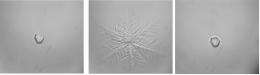
A crystal of ice protected by anti-freeze proteins, can withstand cooling (left) and melting (right). In contrast, ice that grows quickly in a snowflake formation in cold temperatures (middle), is not protected and melts quickly in warm temperatures (right). Credit: Ido Braslavsky, Ohio University

The same antifreeze proteins that keep organisms from freezing in cold environments also can prevent ice from melting at warmer temperatures, according to a new Ohio University and Queen's University study published today in the Early Edition of the journal Proceedings of the National Academy of Sciences.

Antifreeze proteins are found in insects, fish, bacteria and other organisms that need to survive in cold temperatures. These proteins protect the organisms by arresting the growth of crystals in their bodies. The new study not only has implications for understanding this process in nature, but also for understanding the superheating of crystals in technologies that use superconductor materials and nanoparticles.

Twenty years ago, researchers proposed that proteins can create superheating by suppressing melting at temperatures higher than the equilibrium melting point.

"During recrystallization, a larger ice crystal grows while a smaller one melts. Antifreeze proteins can help control both of these processes," explained Ido Braslavsky, an associate professor of physics and astronomy at Ohio University who worked on the study with lead author Yeliz Celik, a doctoral student in physics at Ohio University, and Professor Peter Davies of Queen's University in Canada.

The team's study, supported by the National Science Foundation and the Canadian Institutes for Health Research, presents the first direct measurements of the superheating of in antifreeze protein solutions, Celik said.

In addition, the researchers provide the first experimental evidence that superheated ice crystals can be stabilized above the melting point for hours, at a maximum temperature of about .5 degree Celsius. Superheated crystals rarely stay stable for long periods of time, and previous studies showed that stabilization only occurs under unique conditions, Braslavsky explained.

The researchers used two techniques in the study, and sensitive temperature control of a solution within a thin cell. In order to track the position of the antifreeze protein on an ice crystal, the researchers attached a second protein to the antifreeze protein—the green fluorescent protein, which glows under certain conditions. The scientists then placed the antifreeze protein solution in the thin cell, which allowed them to observe the fluorescence signal from the protein while finely controlling the ice crystal's temperature.

Although the study reveals that these proteins can suppress ice melting up to a certain point, the protein's ability to suppress ice growth is much stronger. The hyperactive antifreeze proteins used in the study were more capable of suppressing melting than the moderately active ones, Braslavsky said.

These findings potentially could make the process of ice recrystallization inhibition more efficient for applications such as maintaining the quality of frozen foods, Braslavsky said.

"Antifreeze proteins that inhibit growth and melt are essential for protection against freeze and thaw damages," he said. "Big crystals (that occur in the recrystalization process) separate cell walls and damage the integrity of the tissue."

Provided by Ohio University (news : web)

Filter


Move the slider to adjust rank threshold, so that you can hide some of the comments.


Display comments: newest first

seneca
Mar 08, 2010

Rank: not rated yet
We could prepare and stabilize hot ice cream in such way - or not? Anyway, I noticed already, certain kinds of ice cream - those smooth ones with tiny crystals and high content of stabilizers - are considerably resistant against melting.
Rank 4 /5 (7 votes)
Relevant PhysicsForums posts
  • excited U-236 decay time in the U235 fission chain
    createdFeb 09, 2012
  • Polar catastrophe?
    createdFeb 09, 2012
  • Large scale field sonication
    createdFeb 09, 2012
  • states and energy of paired electrons in BCS
    createdFeb 08, 2012
  • difference between longitudinal and transverse refractive indices
    createdFeb 08, 2012
  • Monte Carlo simulation
    createdFeb 07, 2012
  • More from Physics Forums - Atomic, Solid State, Comp. Physics

More news stories

Putting the squeeze on planets outside our solar system

(PhysOrg.com) -- Using high-powered lasers, scientists at Lawrence Livermore National Laboratory and collaborators discovered that molten magnesium silicate undergoes a phase change in the liquid state, abruptly ...

Physics / Condensed Matter

created 6 hours ago | popularity 4.7 / 5 (3) | comments 0 | with audio podcast

Hovering not hard if you're top-heavy, researchers find

Top-heavy structures are more likely to maintain their balance while hovering in the air than are those that bear a lower center of gravity, researchers at New York University's Courant Institute of Mathematical Sciences ...

Physics / General Physics

created 7 hours ago | popularity 5 / 5 (1) | comments 1 | with audio podcast

SLAC, Stanford team focuses on high-energy electrons to treat cancer

Accelerator physicists at SLAC and cancer specialists from Stanford are working on a new technology that could dramatically reduce the time needed for cancer radiation treatments. The team ran an initial experiment ...

Physics / General Physics

created 10 hours ago | popularity 5 / 5 (1) | comments 0

Measurements from high-energy collisions lead to better understanding of why meson particles disappear

For several years, physicists at the Relativistic Heavy Ion Collider (RHIC) at Brookhaven National Laboratory (BNL), USA, have studied an unusual state of matter called the quark–gluon plasma, which they ...

Physics / General Physics

created 11 hours ago | popularity 5 / 5 (1) | comments 0

Explained: Sigma

It's a question that arises with virtually every major new finding in science or medicine: What makes a result reliable enough to be taken seriously? The answer has to do with statistical significance -- but ...

Physics / General Physics

created Feb 09, 2012 | popularity 5 / 5 (16) | comments 46


Google users warned of threat to smartphone wallets

Users of Google smartphone wallets were being warned on Friday that there is a way to crack pass codes intended to thwart thieves from going on illicit shopping sprees.

Anonymous knocks CIA website offline (Update)

The website of the Central Intelligence Agency was inaccessible on Friday after the hacker group Anonymous claimed to have knocked it offline.

Complex wiring of the nervous system may rely on a just a handful of genes and proteins

Researchers at the Salk Institute have discovered a startling feature of early brain development that helps to explain how complex neuron wiring patterns are programmed using just a handful of critical genes. ...

NASA sees wide-eyed cyclone Jasmine

Cyclone Jasmine's eye has opened wider on NASA satellite imagery, as it moves through the Southern Pacific Ocean.

New error-correcting codes guarantee the fastest possible rate of data transmission

Error-correcting codes are one of the triumphs of the digital age. They’re a way of encoding information so that it can be transmitted across a communication channel — such as an optical fiber o ...

The power of estrogen -- male snakes attract other males

A new study has shown that boosting the estrogen levels of male garter snakes causes them to secrete the same pheromones that females use to attract suitors, and turned the males into just about the sexiest ...