Skinput turns your arm into a touchscreen (w/ Video)
March 1, 2010 by Lisa Zyga
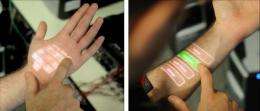
An armband projects a user interface onto the skin, enabling users to control devices with a larger touchscreen than is offered by many mobile devices. Credit: Harrison, et al.
(PhysOrg.com) -- If you find yourself getting annoyed at the tiny touchscreens on today's mobile devices, you might be interested in a "new" yet overlooked input surface: yourself. A new skin-based interface called Skinput allows users to use their own hands and arms as touchscreens by detecting the various ultralow-frequency sounds produced when tapping different parts of the skin.
Skinput is a collaboration between Chris Harrison at Carnegie Mellon University and Dan Morris and Desney Tan at Microsoft's research lab in Redmond, Washington. The researchers have shown that Skinput can allow users to simply tap their skin in order to control audio devices, play games, make phone calls, and navigate hierarchical browsing systems.
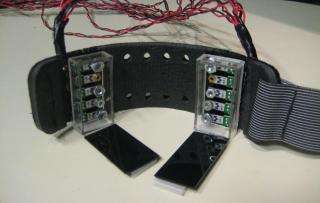
In Skinput, a keyboard, menu, or other graphics are beamed onto a user's palm and forearm from a pico projector embedded in an armband. An acoustic detector in the armband then determines which part of the display is activated by the user's touch. As the researchers explain, variations in bone density, size, and mass, as well as filtering effects from soft tissues and joints, mean different skin locations are acoustically distinct. Their software matches sound frequencies to specific skin locations, allowing the system to determine which “skin button” the user pressed.
This video is not supported by your browser at this time.
Currently, the acoustic detector can detect five skin locations with an accuracy of 95.5%, which corresponds to a sufficient versatility for many mobile applications. The prototype system then uses wireless technology like Bluetooth to transmit the commands to the device being controlled, such as a phone, iPod, or computer. Twenty volunteers who have tested the system have provided positive feedback on the ease of navigation. The researchers say the system also works well when the user is walking or running.As the researchers explain, the motivation for Skinput comes from the increasingly small interactive spaces on today's pocket-sized mobile devices. They note that the human body is an appealing input device “not only because we have roughly two square meters of external surface area, but also because much of it is easily accessible by our hands (e.g., arms, upper legs, torso).”
This video is not supported by your browser at this time.
Playing Tetris.
“Furthermore, proprioception - our sense of how our body is configured in three-dimensional space - allows us to accurately interact with our bodies in an eyes-free manner,” the researchers write in a recent paper. “For example, we can readily flick each of our fingers, touch the tip of our nose, and clap our hands together without visual assistance. Few external input devices can claim this accurate, eyes-free input characteristic and provide such a large interaction area.”In April, the researchers plan to present their work at the Computer-Human Interaction meeting in Atlanta, Georgia.
Enlarge
Skinput interface input armband sensors.
More information:
-- Chris Harrison, Desney Tan, Dan Morris. "Skinput: Appropriating the Body as an Input Surface." CHI 2010, April 10-15, 2010, Atlanta, Georgia, USA
-- Skinput project: http://www.chrisha … cts/skinput/
© 2010 PhysOrg.com
-
Good vibrations: Devices aid the deaf by translating sound waves to vibrations
Feb 26, 2009 |
not rated yet |
0
-
Breakthrough Keyboard Technology for Smaller Handsets
Sep 19, 2004 |
not rated yet |
0
-
Philips electronic skin technology enables new chameleon-like ambience designs
Dec 09, 2009 |
not rated yet |
0
-
Beyond -- way beyond -- WIMP interfaces
Jul 08, 2009 |
not rated yet |
0
-
Jaguar Leaps into Luxury of Bluetooth Wireless Technology
Mar 14, 2005 |
not rated yet |
0
-
Engineers build first sub-10-nm carbon nanotube transistor
Feb 01, 2012 |
5 / 5 (21) |
19
-
Something old, something new: Evolution and the structural divergence of duplicate genes
Jan 31, 2012 |
4.6 / 5 (7) |
1
-
The hidden nanoworld of ice crystals: Revealing the dynamic behavior of quasi-liquid layers
Jan 30, 2012 |
5 / 5 (2) |
1
-
Stock market network reveals investor clustering
Jan 27, 2012 |
4.1 / 5 (21) |
8
-
Of microchemistry and molecules: Electronic microfluidic device synthesizes biocompatible probes
Jan 26, 2012 |
not rated yet |
0
-
Tennis Court Speed Measurement
12 hours ago
-
Fastest way to cool water
20 hours ago
-
Counter-weights
Feb 02, 2012
-
Composite electric glass heating elements
Feb 02, 2012
-
pipe stress analysis
Feb 02, 2012
-
Interested in average household energy consumption in 2011...
Feb 01, 2012
- More from Physics Forums - General Engineering
More news stories
Hackers intercept FBI, Scotland Yard call (Update)
(AP) -- Trading jokes and swapping leads, investigators from the FBI and Scotland Yard spent the conference call strategizing about how to bring down the hacking collective known as Anonymous, responsible ...
13 hours ago |
5 / 5 (7) |
22
Japanese entrepreneurs aim for Silicon Valley
For an emerging generation of Japanese innovators, the dream isn't a job for life at a big company. They have new ambitions, and they're determined to go places. Especially Silicon Valley.
10 hours ago |
5 / 5 (1) |
1
A 'natural' solution for transportation
As the United States transitions away from a primarily petroleum-based transportation industry, a number of different alternative fuel sourcesethanol, biodiesel, electricity and hydrogenhave each ...
Technology / Energy & Green Tech
14 hours ago |
3 / 5 (2) |
13
Hackers deface website of lawyers for US Marine
Members of the hacker group Anonymous defaced the website on Friday of the law firm that defended a US Marine who faced charges in connection with the 2005 killing of 24 Iraqi civilians.
7 hours ago |
5 / 5 (2) |
2
TV executives crave viewers who watch 2 screens
Forget the small screen and the big screen. The hottest new thing in television is the "second screen" - the one on the tablet computer or cell phone that an increasing number of viewers keep an eye on while they're watching ...
7 hours ago |
1 / 5 (2) |
0
Amazon fungi found that eat polyurethane, even without oxygen
(PhysOrg.com) -- Until now polyurethane has been considered non-biodegradable, but a group of students from Yale University in the US has found fungi that will not only eat and digest it, they will do so even in the absence ...
Scientists chart high-precision map of Milky Way's magnetic fields
(PhysOrg.com) -- Scientists at the Naval Research Laboratory (NRL) are part of an international team that has pooled their radio observations into a database, producing the highest precision map to date of ...
Whole exome sequencing identifies cause of metabolic disease
Sequencing a patient's entire genome to discover the source of his or her disease is not routine yet. But geneticists are getting close.
Hearing metaphors activates brain regions involved in sensory experience
When a friend tells you she had a rough day, do you feel sandpaper under your fingers? The brain may be replaying sensory experiences to help understand common metaphors, new research suggests.
Renowned physicist invents microscope that can peer at living brain cells
(PhysOrg.com) -- Ever since scientists began studying the brain, theyve wanted to get a better look at what was going on. Researchers have poked and prodded and looked at dead cells under electron microscopes, ...
New kind of high-temperature photonic crystal could someday power everything from smartphones to spacecraft
A team of MIT researchers has developed a way of making a high-temperature version of a kind of materials called photonic crystals, using metals such as tungsten or tantalum. The new materials which ...
Mar 02, 2010
Rank: 5 / 5 (1)
Mar 02, 2010
Rank: 5 / 5 (2)
Most likely not the first to pop the idea, but why not embed it in a watch?
Apr 05, 2010
Rank: not rated yet
http://datastruct...hm.co.cc