New device for ultrafast optical communications
March 1, 2010
New device for ultrafast optical communications

Enlarge

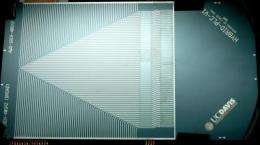
The faint tree-like structures visible on the right side are optical waveguides that bring the light into and out of the optical circuit. The pattern of gratings filters the light signal. The gold traces on the left side supply electrical current to power the device. Credit: Ryan Scott, UC Davis

A new device invented by engineers at UC Davis could make it much faster to convert pulses of light into electronic signals and back again. The technology could be applied to ultrafast, high-capacity communications, imaging of the Earth's surface and for encrypting secure messages.

"We have found a way to measure a very high capacity waveform with a combination of standard electronics and optics," said S.J. Ben Yoo, professor of electrical and computer engineering at UC Davis. A paper describing the technology was published Feb. 28 in the journal .

The device is up to 10,000 times faster than existing technologies for measuring light pulses, Yoo said. It overcomes the limitations of existing approaches, by measuring both the amplitude (intensity) and the phase of a pulse at the same time, and can measure information capacity into the 100 range in real time. Current electronics are limited to information capacity in tens of gigahertz bandwidth.

Higher-frequency pulses can pack more information into a given length of time. By making it possible to take a complex waveform and quickly decode it into a digital electronic signal, the device would make it possible to pack more data into optical signals.

Operated in reverse, the same kind of device could be used to generate from electronics.

The device -- developed by Yoo's UC Davis research group, including graduate student Nicolas Fontaine; postdoctoral researchers Ryan Scott, Linjie Zhou and Francisco Soares; and Professor Jonathan Heritage -- divides the incoming signal into slices of , processes the slices in parallel and then integrates them.

The technology could be used in ultra-high-speed communications and also in LiDAR (light detection and ranging) systems. LiDAR uses pulses of laser light to rapidly scan the landscape and produce highly detailed, three-dimensional images of the Earth's surface.

The next step is to work on putting the whole device into a small silicon chip, Yoo said.

Provided by University of California - Davis


Rank 5 /5 (14 votes)
Related Stories
Relevant PhysicsForums posts
  • Pure energy
    created5 hours ago
  • How to remove the magnetic property for screw driver?
    created8 hours ago
  • How to magnetize a concrete wall?
    created12 hours ago
  • Upward speed of an object in water
    created14 hours ago
  • flipping quarks
    created14 hours ago
  • partial derivation question
    created14 hours ago
  • More from Physics Forums - General Physics

More news stories

Physics research suggests new pathways for cancer progression

Observing that certain cancer cells may exhibit greater flexibility than normal cells, some scientists believe that this capability promotes rapid tumor growth. Now computer simulations developed by Boston University Biomedical ...

Physics / General Physics

created 56 minutes ago | popularity not rated yet | comments 0

Borexino Collaboration succeeds in spotting pep neutrinos emitted from the sun

(PhysOrg.com) -- To learn more about how the sun works, scientists study particles that are emitted from it into space due to thermonuclear reactions that occur inside; by applying known physics principles, ...

Physics / General Physics

created 3 hours ago | popularity 5 / 5 (4) | comments 0 | with audio podcast report

Transparent iron? For the first time, an experiment shows that atomic nuclei can become transparent

At the high-brilliance synchrotron light source PETRA III, a team of DESY scientists headed by Dr. Ralf Röhlsberger has succeeded in making atomic nuclei transparent with the help of X-ray light. At the ...

Physics / General Physics

created 22 hours ago | popularity 5 / 5 (8) | comments 3 | with audio podcast

Physicists build highly efficient 'no-waste' laser

A team of University of California, San Diego researchers has built the smallest room-temperature nanolaser to date, as well as an even more startling device: a highly efficient, "thresholdless" laser that ...

Physics / General Physics

created 22 hours ago | popularity 5 / 5 (17) | comments 4 | with audio podcast

Explained: Sigma

It's a question that arises with virtually every major new finding in science or medicine: What makes a result reliable enough to be taken seriously? The answer has to do with statistical significance -- but ...

Physics / General Physics

created 3 hours ago | popularity 5 / 5 (3) | comments 2


Tidal forces could squeeze out planetary water

Alien planets might experience tidal forces powerful enough to remove all their water, leaving behind hot, dry worlds like Venus, researchers said.

Can indigenous insects be used against the light brown apple moth?

The light brown apple moth (LBAM), Epiphyas postvittana (Walker), an invasive insect from Australia, was found in California in 2006. The LBAM feeds on apples, pears, stonefruits, citrus, grapes, berries and many other plants ...

NASA sees Tropical Cyclone Jasmine over Vanuatu and New Caledonia

NASA's Aqua satellite passed over Tropical Cyclone Jasmine on Feb. 8, 2012 as it was passing between Vanuatu and New Caledonia. NASA imagery showed Jasmine had a 20 nautical mile-wide eye.

Physically abused children report higher levels of psychosomatic symptoms

Children who display multiple psychosomatic symptoms, such as regular aches and pains and sleep and appetite problems, are more than twice as likely to be experiencing physical abuse at home than children who do not display ...

Facebook sees slowing growth

Few experts were surprised when Facebook disclosed in its recent IPO filing that its user growth had slowed in the U.S. and Canada. But a deeper look at Facebook's user numbers shows its growth is also slowing ...

New technology platform for molecule-based electronics

Researchers at the Nano-Science Center at the University of Copenhagen have developed a new nano-technology platform for the development of molecule-based electronic components using the wonder material graphene. At the same ...