'Anaconda' meets 'Jurassic Park': Study shows ancient snakes ate dinosaur babies (w/ Video)
March 2, 2010
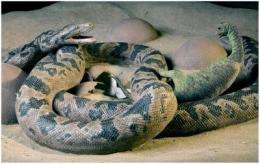
This is a life-sized reconstruction of the moment just before preservation. The scales and patterning of Sanajeh’s skin is based on modern relatives of the fossil snake. The hatchling dinosaur is reconstructed from known skeletal materials, but its color is conjectural. The eggs are based directly on the fossils. Credit: Sculpture by Tyler Keillor and original photography by Ximena Erickson; image modified by Bonnie Miljour
(PhysOrg.com) -- The remains of an extraordinary fossil unearthed in 67-million-year-old sediments from Gujarat, western India provide a rare glimpse at an unusual feeding behavior in ancient snakes.
An international paleontological team led by the University of Michigan's Jeff Wilson and the Geological Survey of India's Dhananjay Mohabey will publish their discovery online March 2 in the open-access journal PLoS Biology.
The remains of a nearly complete snake were found preserved in the nest of a sauropod dinosaur, adults of which are the largest animals known to have walked the earth. The snake was coiled around a recently hatched egg adjacent to a hatchling sauropod. Remains of other snake individuals associated with egg clutches at the same site indicate that the newly described snake made its living feeding on young dinosaurs.
This video is not supported by your browser at this time.
The remains of an extraordinary fossil unearthed in 67-million-year-old sediments from Gujarat, western India reveal that snakes preyed on hatchling dinosaurs.
"It was such a thrill to discover such a portentous moment frozen in time," said Mohabey, who made the initial discovery in the early 1980s.Working with the sediment-covered and inscrutable specimen in 1987, Mohabey recognized dinosaur eggshell and limb bones but was unable to fully interpret the specimen. In 2001, Wilson visited Mohabey at his office at the Geological Survey of India and was astonished when he examined the specimen.
"I saw the characteristic vertebral locking mechanism of snakes alongside dinosaur eggshell and larger bones, and I knew it was an extraordinary specimen---but I also knew we needed to develop it further," Wilson said.
From that point began a decade-long odyssey that led to a formal agreement with the Government of India Ministry of Mines in 2004 that allowed preparation and study of the fossil at the U-M Museum of Paleontology, weeks of museum study in India, and field reconnaissance at the original locality in Gujarat by a team that included Wilson, Mohabey, snake expert Jason Head of the University of Toronto-Mississaugua, and geologist Shanan Peters of the University of Wisconsin. The field research was funded by the National Geographic Society.
Preparation of the fossil at the U-M revealed the snake was coiled around a crushed dinosaur egg next to a freshly hatched sauropod dinosaur.
"We think that the hatchling had just exited its egg, and that activity attracted the snake," said Mohabey. "The eggs were lain in the loose sands near a small drainage and covered by a thin layer of sediment."
The arrangement of the bones and delicate structures, such as eggshells and the snake's skull, point to quick entombment.
"Sedimentation was unusually rapid and deep for this formation---a pulse of sand, probably mobilized during a storm, resulted in the preservation of this spectacular association," said Peters, who interpreted the paleoenvironment of the site.
The new snake, which was named Sanajeh indicus or "ancient-gaped one from the Indian subcontinent," because of its lizard-like gape, adds critical information that helps resolve the early diversification of snakes. Modern large-mouthed snakes are able to eat large prey because they have mobile skulls and wide gapes. Sanajeh bears only some of the traits of modern large-mouthed snakes and provides insight into how they evolved.
"Sanajeh was capable of ingesting the half meter-long sauropod hatchling because it was quite large itself, almost 3.5 meters long," Head said. "This points to an interesting evolutionary strategy for primitive snakes to eat large prey by increasing their body size."
Although the sauropod dinosaurs that Sanajeh preyed upon include the largest animals capable of walking on land, they began their life as small hatchlings that were about one-seventh the length of Sanajeh. Sauropods appear to have achieved their enormous size by virtue of a fast-growth phase, which would have kept them out of danger from Sanajeh-sized predators by the end of their first year of life.
This discovery of Sanajeh adds to a growing body of evidence suggesting that the Indian subcontinent retained ties to southern landmasses for longer than once hypothesized. Sanajeh's closest relatives are from Australia and speak to its strong ties to southern continents, collectively known as Gondwana.
A life-sized flesh reconstruction of the scene immediately before burial was designed and executed by University of Chicago paleoartist Tyler Keillor. The team will donate the first cast to the Geological Survey of India at a formal function to be held in Mumbai, India, on March 12, 2010.
More information: Wilson JA, Mohabey DM, Peters SE, Head JJ (2010) Predation upon Hatchling Dinosaurs by a New Snake from the Late Cretaceous of India. PLoS Biol 8(3): e1000322. doi:10.1371/journal.pbio.1000322
-
Skull study sheds light on dinosaur diversity
Sep 15, 2005 |
not rated yet |
0
-
Snake with hips most primitive ever found
Apr 20, 2006 |
not rated yet |
0
-
Hundreds of dinosaur nests found in India
Oct 02, 2009 |
not rated yet |
0
-
Outback snake fossil indicates lizard link
Feb 16, 2006 |
not rated yet |
0
-
Aussie museum displays huge dinosaur bones
Jul 20, 2005 |
not rated yet |
0
-
Engineers build first sub-10-nm carbon nanotube transistor
Feb 01, 2012 |
4.9 / 5 (30) |
30
-
Something old, something new: Evolution and the structural divergence of duplicate genes
Jan 31, 2012 |
4.6 / 5 (7) |
1
-
The hidden nanoworld of ice crystals: Revealing the dynamic behavior of quasi-liquid layers
Jan 30, 2012 |
5 / 5 (3) |
1
-
Stock market network reveals investor clustering
Jan 27, 2012 |
3.9 / 5 (23) |
8
-
Of microchemistry and molecules: Electronic microfluidic device synthesizes biocompatible probes
Jan 26, 2012 |
5 / 5 (1) |
0
-
Cancer drugs and Alzheimer's, Oh my!
5 hours ago
-
Squishing cells
6 hours ago
-
Any books/articles for evolutionary stable strategy models in humans?
17 hours ago
-
Science behind the bore feeling?
Feb 09, 2012
-
Homo Sapien vs. Chimpanzee - Divergence Timeline
Feb 09, 2012
-
a single mRNA strand is attached to sevaral ribosomes?
Feb 08, 2012
- More from Physics Forums - Biology
More news stories
US workers are 'giving away the store,' costing firms billions
Nearly 70 percent of the nation's service employees give away free goods and services from hamburgers to cable TV costing companies billions of dollars a year, according to a groundbreaking study.
Other Sciences / Economics & Business
15 hours ago |
5 / 5 (1) |
8
Storm warning: Financial tsunami heading this way
In today's global village, national coffers are more interconnected than ever before. And as the current economic crisis has proven, a downturn in one country can travel in a wave across the globe, like a financial tsunami. ...
Other Sciences / Economics & Business
16 hours ago |
3 / 5 (2) |
7
Kids show cultural gender bias
(PhysOrg.com) -- Talk about gender confusion! A recent study by University of Alberta researchers Elena Nicoladis and Cassandra Foursha-Stevenson in the Journal of Cross-Cultural Psychology into whether speaki ...
Other Sciences / Social Sciences
21 hours ago |
1.5 / 5 (2) |
2
Prague gets hold of modern genetics founder Mendel's papers
Germany has handed to the Czech Republic a manuscript of Johann Gregor Mendel, founder of modern genetics, on his plant hybridization experiments, the Czech foreign minister said Thursday.
12 hours ago |
5 / 5 (1) |
1
'Flipped classroom' teaching model gains an online community
Researchers at Harvard University have launched the Peer Instruction (PI) Network, a new global social network for users of interactive teaching methods.
Other Sciences / Social Sciences
16 hours ago |
5 / 5 (2) |
0
Humans may have helped the decline of African rainforests 3000 years ago
(PhysOrg.com) -- Large areas of rainforests in Central Africa mysteriously disappeared over three thousand years ago, to be replaced by savannas. The prevailing theory has been that the cause was a change ...
Japan scientist makes 'Avatar' robot
A Japanese-developed robot that mimics the movements of its human controller is bringing the Hollywood blockbuster "Avatar" one step closer to reality.
Fighting crimes against biodiversity: How to catch a killer weed
Invasive species which have the potential to destroy biodiversity and influence global change could be tracked and controlled in the same way as wanted criminals, according to new research from Queen Mary, University of London.
Metastatic breast cancer hitches a free ride from the immune system
Inflammatory breast cancer (IBC) is the most lethal form of breast cancer . It spreads easily through the lymphatic and blood vessels, forming metastasis which can lead to multi-organ failure. New research published in BioMed ...
A novel method for simultaneously measuring blood pressure and arterial stiffness
Arterial stiffness due to is a major contributor to cardiovascular disease but is very difficult to measure. It also can influence blood pressure readings since these rely on the time taken for arteries to return to normal ...
India's global pharmacy role threatened by EU pact
(AP) -- Efforts by India and the European Union to strengthen trade are threatening India's ability to deliver lifesaving medicines to the world's poorest, analysts say as the two sides push through protracted ...