Were short warm periods typical for transitions between interglacial and glacial epochs?
At the end of the last interglacial epoch, around 115,000 years ago, there were significant climate fluctuations. In Central and Eastern Europe, the slow transition from the Eemian Interglacial to the Weichselian Glacial was marked by a growing instability in vegetation trends with possibly at least two warming events.
This is the finding of German and Russian climate researchers who have evaluated geochemical and pollen analyses of lake sediments in Saxony-Anhalt, Brandenburg and Russia. Writing in Quaternary International, scientists from the Helmholtz Centre for Environmental Research (UFZ), the Saxon Academy of Sciences (SAW) in Leipzig and the Russian Academy of Sciences say that a short warming event at the very end of the last interglacial period marked the final transition to the ice age.
The Eemian Interglacial was the last interglacial epoch before the current one, the Holocene. It began around 126,000 years ago, ended around 115,000 years ago and is named after the river Eem in the Netherlands. The followed Weichselian Glacial ended around 15,000 years ago is the most recent glacial epoch named after the Polish river Weichsel. At its peak around 21,000 years ago, the glaciers stretched as far as the south of Berlin (Brandenburg Stadium).
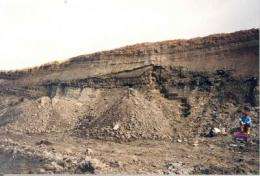
The researchers studied lake sediments to reconstruct the climate history of the Eemian Interglacial, since deposits on river and lake beds can build up a climate archive over the years. The sediment samples came from lakes that existed at the time, but which have since silted up and been uncovered in the former open cast mines at Gröbern near Bitterfeld, Neumark-Nord in the Geiseltal valley near Merseburg, and Klinge near Cottbus and at Ples on the upper reaches of the Volga, around 400 kilometres north-east of Moscow. Gröbern in Saxony-Anhalt is now seen by experts as one of the most studied places for Eemian Interglacial climate history in Germany. As well as pollen concentrations, the researchers analysed the level and ratios of stable carbon (13C/12C) and oxygen isotopes (18O/16O) in carbonates and organic matter from sediment layers, since these provide information about the vegetation development and an indication of the climate.
The results show a relatively stable climate over most of the time, but with instabilities at the beginning and end of the Eemian Interglacial. "The observed instability with the proven occurrence of short warming events during the transition from the last interglacial to the last glacial epoch could be, when viewed carefully, a general, naturally occurring characteristic of such transition phases," concludes Dr Tatjana Boettger of the UFZ, who analysed the sediment profiles at the UFZ's isotope laboratory in Halle. "Detailed studies of these phenomena are important for understanding the current controversial discussed climate trend so that we can assess the human contribution to climate change with more certainty," explains Dr Frank W. Junge of the SAW.
From reconstructions of climate history, we know that in the Earth's recent history, interglacial epochs occurred only once every 100,000 years or so and lasted for an average of around 10,000 years. The current interglacial epoch - the Holocene - has already lasted more than 10,000 years and reached its highest point so far around 6000 years ago. From a climate history perspective, we are currently at the end of the Holocene and could therefore expect to see a cooling-down in a few thousand years if there had been no human influence on the atmosphere and the resulting global warming.
More information: Tatjana Boettger, Elena Yu. Novenko, Andrej A. Velichko, Olga K. Borisova, Konstantin V. Kremenetski, Stefan Knetsch, Frank W. Junge (2009): Instability of climate and vegetation dynamics in Central and Eastern Europe during the final stage of the Last Interglacial (Eemian, Mikulino) and Early Glaciation, Quarternary International 207, 137-144. dx.doi.org/10.1016/j.quaint.2009.05.006
Provided by Helmholtz Association of German Research Centres


