Sorting device for analyzing biological reactions puts the power of a lab in a researcher’s pocket (w/ Video)
March 2, 2010
Sorting device for analyzing biological reactions puts the power of a lab in a researcher’s pocket

Enlarge

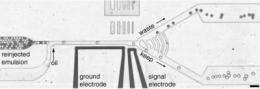
The microfluidic sorting device removes inactive and unwanted compounds, dumping the drops into a "bad egg" bin, and guides the others into a "keep" container. Specifically, as the drops flow through the channels they eventually encounter a junction (a two-channel fork). The device identifies the desired drops by using a laser focused on the channel before the fork to read a drop's fluorescence level. The drops with greater intensity of fluorescence (those exhibiting the highest levels of activity) are pulled towards the keep channel by the application of an electrical force, a process known as dielectrophoresis. Credit: Courtesy of Jeremy Agresti, Harvard School of Engineering and Applied Sciences.

Fictional candy maker Willy Wonka called his whimsical device to sort good chocolate eggs from bad, an eggucator. Likewise, by determining what enzymes and compounds to keep and which to discard, scientists are aiming to find their own golden eggs: more potent drugs and cleaner sources of energy.

Toward that end, Harvard researchers and a team of international collaborators demonstrated a new microfluidic sorting device that rapidly analyzes millions of biological reactions. Smaller than an iPod Nano, the device analyzes reactions a 1,000-times faster and uses 10 million-fold less volumes of reagent than conventional state-of-the-art robotic methods.

The scientists anticipate that the invention could reduce screening costs by 1 million-fold and make directed evolution, a means of engineering tailored biological compounds, more commonplace in the lab.

"Our finding is not so much a , but the first demonstration of a new technology," says project leader Jeremy Agresti, a former research associate in the lab of co-author David Weitz, Mallinckrodt Professor of Physics and of Applied Physics in the Harvard School of Engineering and Applied Sciences (SEAS) and Department of Physics. "What limits new areas of research in biology and biotechnology is the ability to assay or to do experiments on many different variables in parallel at once."

This video is not supported by your browser at this time.

The sorted drops move up the field gradient created by the electrodes by dielectrophoresis and are pulled into the keep channel. The movie is recorded at 4,000 frames s-1 and shows the result of sorting a demonstration emulsion containing fluorescein (light drops) or bromophenol blue 1 percent by weight in water. Credit: Jeremy Agresti, Harvard School of Engineering and Applied Sciences

The team's technology, first reported in the February 8th online Early Edition of the , bypasses conventional limitations through the use of drop-based microfluidics, squeezing tiny capsules of liquid through a series of intricate tubes, each narrower than a single human hair.

"Each microscopic drop can trap an individual cell and thus it becomes like a miniature test tube," explains Amy Rowat, a postdoctoral fellow at SEAS. "The drops are coated with a surfactant, or stabilization molecule, that prevents the drops from coalescing with each other and also prevents the contents from sticking to the wall of the drops."

To sort, the system removes inactive and unwanted compounds, dumping the drops into a "bad egg" bin, and guides the others into a "keep" container. Specifically, as the drops flow through the channels they eventually encounter a junction (a two-channel fork). Left alone, the drops will naturally flow towards the path of least fluidic resistance, or the waste channel.

The device identifies the desired drops by using a laser focused on the channel before the fork to read a drop's fluorescence level. The drops with greater intensity of fluorescence (those exhibiting the highest levels of activity) are pulled towards the keep channel by the application of an electrical force, a process known as dielectrophoresis.

"Our concept was to build a miniature laboratory for performing biological experiments quickly and efficiently," explains collaborator Adam Abate, a postdoctoral fellow in applied physics at SEAS. "To do this we needed to construct microfluidic versions of common bench-top tasks, such as isolating cells in a compartment, adding reagents, and sorting the good from the bad. The challenge was to do this with microscopic drops flowing past at thousands per second."

"The sorting process is remarkably efficient and fast. By shrinking down the reaction size to 10 picoliters of volumes, we increased the sorting speed by the same amount," adds Agresti. "In our demonstration with horseradish peroxidase, we evolved and improved an already efficient enzyme by sorting through 100 million variants and choosing the best among them."

In particular, the researchers were struck by the ability to increase the efficiency of an already efficient enzyme to near its theoretical maximum, the diffusion limit, where the enzyme can produce products as quickly as a new substrate can bump into it.

Using conventional means, the sorting process would have taken several years. Such a dramatic reduction of time could be a boon for the burgeoning field of synthetic biology. For example, a biofuels developer could use the device to screen populations of millions of organisms or metabolic pathways to find the most efficient producer of a chemical or fuel. Likewise, scientists could speed up the pace of drug development, determining the best chemical candidate compounds and then evolving them based upon desired properties.

"The high speed of our technique allows us to go through multiple cycles of mutation and screening in a very short time," says Agresti. "This is the way evolution works best. The more generations you can get through, the faster you can make progress."

Provided by Harvard University (news : web)

4.5 /5 (2 votes)  

Rank 4.5 /5 (2 votes)
Related Stories
Relevant PhysicsForums posts
  • Safe nitrogen compound to decompose a 500 deg C in a furnace?
    created6 hours ago
  • [ask]electron inside drinking water
    createdFeb 08, 2012
  • How to avoid formation of Lithium Chromate ???
    createdFeb 08, 2012
  • how to choose a reduced or oxidated form in a redox
    createdFeb 08, 2012
  • Mesomeric effect in acids.
    createdFeb 08, 2012
  • Looking for a safe endothermic chemical reaction
    createdFeb 07, 2012
  • More from Physics Forums - Chemistry

More news stories

Hydrogen from acidic water: Researchers develop potential low cost alternative to platinum for splitting water

A technique for creating a new molecule that structurally and chemically replicates the active part of the widely used industrial catalyst molybdenite has been developed by researchers with the Lawrence Berkeley ...

Chemistry / Materials Science

created 9 hours ago | popularity 5 / 5 (10) | comments 10 | with audio podcast

New method makes culture of complex tissue possible in any lab

Scientists at the University of California, San Diego have developed a new method for making scaffolds for culturing tissue in three-dimensional arrangements that mimic those in the body. This advance, published online in ...

Chemistry / Biochemistry

created 6 hours ago | popularity 5 / 5 (3) | comments 0 | with audio podcast

Flexible paper robots

(PhysOrg.com) -- These inexpensive robots can stretch, bend and twist under control, and lift objects up to 120 times their own weight. Being soft, they can apply gentle and even pressure, and adapt to varied ...

Chemistry / Materials Science

created 7 hours ago | popularity 5 / 5 (5) | comments 2 | with audio podcast

Engineers find inspiration for new materials in Piranha-proof armor

(PhysOrg.com) -- It’s a matchup worthy of a late-night cable movie: put a school of starving piranha and a 300-pound fish together, and who comes out the winner?

Chemistry / Materials Science

created 16 hours ago | popularity 4.3 / 5 (3) | comments 2 | with audio podcast

Materials that shrink when heated

One common reason that people with fillings experience toothache is that their fillings expand at a different rate to the original tooth when, for example, drinking a hot drink. Contrary to intuition, however, ...

Chemistry / Materials Science

created 8 hours ago | popularity 5 / 5 (1) | comments 1


'Dark plasmons' transmit energy

Microscopic channels of gold nanoparticles have the ability to transmit electromagnetic energy that starts as light and propagates via "dark plasmons," according to researchers at Rice University.

FDA-approved drug rapidly clears amyloid from the brain, reverses Alzheimer's symptoms in mice

Neuroscientists at Case Western Reserve University School of Medicine have made a dramatic breakthrough in their efforts to find a cure for Alzheimer's disease. The researchers' findings, published in the journal Science, show t ...

Ultraviolet protection molecule in plants yields its secrets

Lying around in the sun all day is hazardous not just for humans but also for plants, which have no means of escape. Ultraviolet (UV) radiation from the sun can damage proteins and DNA inside cells, leading ...

Anyone can learn to be more inventive, cognitive researcher says

There will always be a wild and unpredictable quality to creativity and invention, says Anthony McCaffrey, a cognitive psychology researcher at the University of Massachusetts Amherst, because an "Aha moment" is rare and ...

Cell biologists describes mechanism by which some people may be more susceptible to colon cancer

An international research team led by cell biologists at the University of California, Riverside has uncovered a new insight into colon cancer, the third leading cause of cancer-related deaths in the United ...

Researchers weigh in on ethics of H5N1 research

(Medical Xpress) -- In a commentary on the biosecurity controversy surrounding publication of bird flu research details, a bioethicist and a vaccine expert at Johns Hopkins reaffirm that "all scientists have an affirmativ ...