Baby monkeys receive signals through their mother's breast milk
March 2, 2010
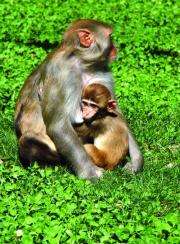
A rhesus macaque mother nurses her infant. Credit: Katie Hinde
Among rhesus macaque monkeys, mothers who weigh more and have had previous pregnancies produce more and better breast milk for their babies than mothers who weigh less and are less experienced. Scientists from the Smithsonian Institution and the University of California, Davis are using this natural variation in breast milk quality and quantity to show that a mother's milk sends a reliable signal to infants about their environment. This signal may program the infant's behavior and temperament according to expectations of available resources and discourages temperaments that prove risky when food is scarce. The study was published in the American Journal of Primatology Feb. 16.
Researchers used large groups of rhesus macaques living in an outdoor enclosure at the California National Primate Research Center at UC Davis. Researchers collected milk two different times from 59 mothers: once when their infants were 1 month old and again when the infants were 3 1/2 months old. They recorded the quantity of milk produced by each mother, and the energy value of each one's milk was analyzed for its content of sugars, proteins and fat. These figures were combined to calculate the available milk energy generated by each mother.
Although all of the monkeys in the study were fed the same diet, the researchers found natural variation in the quantity and richness of the milk generated by the 59 mothers. Milk from mothers who weighed more and had had previous pregnancies contained higher available energy when their infants were 1 month old than the milk of lighter, less experienced mothers.
"This is the first study for any mammal that presents evidence that natural variation in available milk energy from the mother is associated with later variation in infant behavior and temperament," said Katie Hinde, the study's lead author and anthropologist at the California National Primate Research Center and the nutrition laboratory at the Smithsonian's National Zoo. "Our results suggest that the milk energy available soon after birth may be a nutritional cue that calibrates the infant's behavior to environmental or maternal conditions."
At 3 to 4 months old, each infant was temporarily separated from its mother and assessed according to its behavior and temperament. The study found that infants whose mothers had higher levels of milk energy soon after their birth coped more effectively (moved around more, explored more, ate and drank) and showed greater confidence (were more playful, curious and active). Infants whose mothers had lower milk energy had lower activity levels and were less confident when separated from their mother. Mothers and infants were reunited immediately after the experiment.
Rhesus macaques are found throughout mainland Asia: from Afghanistan to India and from Thailand to southern China. A free-ranging colony of rhesus macaques was established in 1938 on Cayo Santiago—a small island off of the east coast of Puerto Rico. The only primates with a broader geographic distribution than rhesus macaques are humans.
-
First evidence that a common pollutant may reduce iodine levels in breast milk
Oct 13, 2008 |
not rated yet |
0
-
Foods high in conjugated linoleic acids can enrich breast milk
Jul 28, 2008 |
not rated yet |
0
-
Rhesus macaque moms 'go gaga' for baby, too
Oct 08, 2009 |
not rated yet |
0
-
Babies, Bacteria and Breast Milk: Genome Sequence Reveals Evolutionary Alliance
Jan 14, 2009 |
not rated yet |
0
-
Experts debate best alternative to mother's milk
Jul 17, 2006 |
not rated yet |
0
-
Engineers build first sub-10-nm carbon nanotube transistor
Feb 01, 2012 |
4.9 / 5 (31) |
30
-
Something old, something new: Evolution and the structural divergence of duplicate genes
Jan 31, 2012 |
4.6 / 5 (7) |
1
-
The hidden nanoworld of ice crystals: Revealing the dynamic behavior of quasi-liquid layers
Jan 30, 2012 |
5 / 5 (3) |
1
-
Stock market network reveals investor clustering
Jan 27, 2012 |
3.9 / 5 (23) |
8
-
Of microchemistry and molecules: Electronic microfluidic device synthesizes biocompatible probes
Jan 26, 2012 |
5 / 5 (1) |
0
-
Stem cell question.
1 hour ago
-
Protease cleavage
7 hours ago
-
Pertubance in a model
14 hours ago
-
Cancer drugs and Alzheimer's, Oh my!
22 hours ago
-
Squishing cells
23 hours ago
-
Any books/articles for evolutionary stable strategy models in humans?
Feb 09, 2012
- More from Physics Forums - Biology
More news stories
The power of estrogen -- male snakes attract other males
A new study has shown that boosting the estrogen levels of male garter snakes causes them to secrete the same pheromones that females use to attract suitors, and turned the males into just about the sexiest ...
12 hours ago |
4.8 / 5 (5) |
0
|
Grass to gas: Researchers' genome map speeds biofuel development
Researchers at the University of Georgia have taken a major step in the ongoing effort to find sources of cleaner, renewable energy by mapping the genomes of two originator cells of Miscanthus x giganteus, a large perenn ...
9 hours ago |
3.8 / 5 (5) |
0
|
Experts reveal how plants don't get sunburn
(PhysOrg.com) -- Experts at the University of Glasgow have discovered how plants survive the harmful rays of the sun.
12 hours ago |
4.7 / 5 (3) |
0
|
Miami battling invasion of giant African snails
No one knows how they got there. But an invasion of African giant snails has southern Florida in a panic over potential crop damage, disease and general yuckiness surrounding the slimy gastropods.
16 hours ago |
4 / 5 (1) |
4
Protein libraries in a snap
(PhysOrg.com) -- A Rice University undergraduate will depart with not only a degree but also a possible patent for his invention of an efficient way to create protein libraries, an important component of biomolecular ...
15 hours ago |
4.8 / 5 (4) |
0
|
Google users warned of threat to smartphone wallets
Users of Google smartphone wallets were being warned on Friday that there is a way to crack pass codes intended to thwart thieves from going on illicit shopping sprees.
Anonymous knocks CIA website offline (Update)
The website of the Central Intelligence Agency was inaccessible on Friday after the hacker group Anonymous claimed to have knocked it offline.
Complex wiring of the nervous system may rely on a just a handful of genes and proteins
Researchers at the Salk Institute have discovered a startling feature of early brain development that helps to explain how complex neuron wiring patterns are programmed using just a handful of critical genes. ...
New error-correcting codes guarantee the fastest possible rate of data transmission
Error-correcting codes are one of the triumphs of the digital age. Theyre a way of encoding information so that it can be transmitted across a communication channel such as an optical fiber o ...
Humans may have helped the decline of African rainforests 3000 years ago
(PhysOrg.com) -- Large areas of rainforests in Central Africa mysteriously disappeared over three thousand years ago, to be replaced by savannas. The prevailing theory has been that the cause was a change ...
Putting the squeeze on planets outside our solar system
(PhysOrg.com) -- Using high-powered lasers, scientists at Lawrence Livermore National Laboratory and collaborators discovered that molten magnesium silicate undergoes a phase change in the liquid state, abruptly ...