Learning keeps brain healthy: study
March 2, 2010
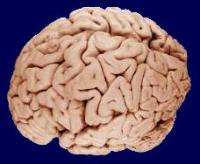
Image source: University of Wisconsin and Michigan State Comparative Mammalian Brain Collections and the National Museum of Health and Medicine.
UC Irvine neurobiologists are providing the first visual evidence that learning promotes brain health - and, therefore, that mental stimulation could limit the debilitating effects of aging on memory and the mind.
Using a novel visualization technique they devised to study memory, a research team led by Lulu Chen and Christine Gall found that everyday forms of learning animate neuron receptors that help keep brain cells functioning at optimum levels.
These receptors are activated by a protein called brain-derived neurotrophic factor, which facilitates the growth and differentiation of the connections, or synapses, responsible for communication among neurons. BDNF is key in the formation of memories.
"The findings confirm a critical relationship between learning and brain growth and point to ways we can amplify that relationship through possible future treatments," says Chen, a graduate researcher in anatomy & neurobiology.
Study results appear in the early online edition of the Proceedings of the National Academy of Sciences for the week of March 1.
In addition to discovering that brain activity sets off BDNF signaling at the sites where neurons develop synapses, researchers determined that this process is linked to learning-related brain rhythms, called theta rhythms, vital to the encoding of new memories.
Theta rhythms occurring in the hippocampus involve numerous neurons firing synchronously at a rate of three to eight times per second. These rhythms have been associated with long-term potentiation, a cellular mechanism underlying learning and memory.
In rodent studies, the team found that both unsupervised learning and artificial application of theta rhythms triggered BDNF signaling at synapse creation sites.
"This relationship has implications for maintaining good brain health," says Gall, a professor of anatomy & neurobiology. "There is evidence that theta rhythms weaken as we age, and our discoveries suggest that this can result in memory impairment. On the other hand, they suggest that staying mentally active as we age can keep neuronal BDNF signaling at a constant rate, which may limit memory and cognitive decline."
Researchers are now exploring whether learning-induced growth signals decrease with age and, if so, whether this can be reversed with a new family of experimental drugs.
Provided by University of California - Irvine
-
Drug triggers body's mechanism to reverse aging effect on memory process
Jul 28, 2006 |
not rated yet |
0
-
Proteins necessary for brain development found to be critical for long-term memory
Sep 05, 2006 |
not rated yet |
0
-
Researchers restore memory process in most common form of mental disability
Oct 05, 2007 |
not rated yet |
0
-
Memory molecule, deja vu
Jan 19, 2010 |
not rated yet |
0
-
Mechanism of nicotine's learning effects explored
Apr 04, 2007 |
not rated yet |
0
-
Engineers build first sub-10-nm carbon nanotube transistor
Feb 01, 2012 |
4.9 / 5 (30) |
30
-
Something old, something new: Evolution and the structural divergence of duplicate genes
Jan 31, 2012 |
4.6 / 5 (7) |
1
-
The hidden nanoworld of ice crystals: Revealing the dynamic behavior of quasi-liquid layers
Jan 30, 2012 |
5 / 5 (3) |
1
-
Stock market network reveals investor clustering
Jan 27, 2012 |
3.9 / 5 (23) |
8
-
Of microchemistry and molecules: Electronic microfluidic device synthesizes biocompatible probes
Jan 26, 2012 |
5 / 5 (1) |
0
-
Is Everyday Technology Killing Us?
Feb 08, 2012
-
Exercise and weight loss
Feb 08, 2012
-
Why do we have head aches? Our brains can't feel anything.
Feb 07, 2012
-
"The end of diseases" by David Agus, interview from Daily Show with Jon Stewart
Feb 04, 2012
-
Oncolytic adenovirus
Feb 04, 2012
-
Nutrition label stuffs and diets
Feb 02, 2012
- More from Physics Forums - Medical Sciences
More news stories
Team isolates nerve cells involved in storing long term memory and gene proteins associated with them
(Medical Xpress) -- A research team in Taiwan has succeeded in isolating two nerve cells in fruit fly brains that are believed to be the major players in allowing for the formation of long term memories. Furthermore, ...
News of plaque-clearing drug tops week of major advances against Alzheimer's disease
In the last eight days, scientists have delivered a powerful one-two punch in the fight to defeat Alzheimer's disease. At the same time, the White House and members of Congress are proposing increases in Alzheimer's research ...
51 minutes ago |
not rated yet |
1
To avoid early labor and delivery, weight and diet changes not the answer
One of the strongest known risk factors for spontaneous or unexpected preterm birth any birth that occurs before the 37th week of pregnancy, most often without a known cause is already having had one. For women ...
4 minutes ago |
not rated yet |
0
|
Joint patent for using the BRCA1 gene as a therapy for cardiovascular disease
St. Michael's Hospital and King Saud University have received their first joint U.S. patent to use the BRCA1 gene as a therapy for cardiovascular disease.
20 minutes ago |
not rated yet |
0
S.Africa in $208 mln AIDS drug venture with Swiss Lonza
South Africa on Friday unveiled plans for a 1.6 billion rand ($208 million, 157 million euro) pharmaceutical plant, in a joint venture with Swiss biochemicals group Lonza to produce anti-AIDS drugs.
Medicine & Health / HIV & AIDS
1 hour ago |
not rated yet |
0
The power of estrogen -- male snakes attract other males
A new study has shown that boosting the estrogen levels of male garter snakes causes them to secrete the same pheromones that females use to attract suitors, and turned the males into just about the sexiest ...
Could Venus be shifting gear?
(PhysOrg.com) -- ESAs Venus Express spacecraft has discovered that our cloud-covered neighbour spins a little slower than previously measured. Peering through the dense atmosphere in the infrared, the ...
Experts reveal how plants don't get sunburn
(PhysOrg.com) -- Experts at the University of Glasgow have discovered how plants survive the harmful rays of the sun.
Fool's gold may prove an unlikely alternative to overexploited catalytic materials
Catalytic materials, which lower the energy barriers for chemical reactions, are used in everything from the commercial production of chemicals to catalytic converters in car engines. However, with current catalytic materials ...
SLAC, Stanford team focuses on high-energy electrons to treat cancer
Accelerator physicists at SLAC and cancer specialists from Stanford are working on a new technology that could dramatically reduce the time needed for cancer radiation treatments. The team ran an initial experiment ...
Unpicking HIV’s invisibility cloak
Drug researchers hunting for alternative ways to treat human immunodeficiency virus (HIV) infections may soon have a novel targetits camouflage coat. HIV hides inside a cloak unusually rich in a sugar ...
Mar 03, 2010
Rank: not rated yet
Waste of good science funding.
Mar 03, 2010
Rank: not rated yet
Proof is only a phenomena of mathematics.